Lease Renewal Time: What 2026's Rate Increases Mean for Residents Already Living There
Published on September 7, 2026

The envelope usually arrives about sixty days before the anniversary of move-in. Inside is a short, friendly letter thanking your mother for being part of the community, followed by one sentence that changes the family budget: effective next month, her monthly rate will be $6,780. It was $6,340. Nobody warned you, nobody negotiated with you, and the letter reads as though the number is already settled.
It usually is not. Renewal pricing is the least examined moment in senior living, partly because families arrive at it exhausted from the move itself, and partly because almost every article written about senior living cost is aimed at people who have not moved in yet. This one is for the other group: the family whose parent is already there, whose renewal letter is sitting on the counter, and who has roughly three weeks to decide whether the number is fair.
The Word You Need Is “In-Place”
The senior living industry tracks two different rents, and the difference is the whole story for existing residents.
The asking rate is what a community advertises to prospects. The in-place rate is what people who already live there actually pay. Operators set them separately, and they do not move together.
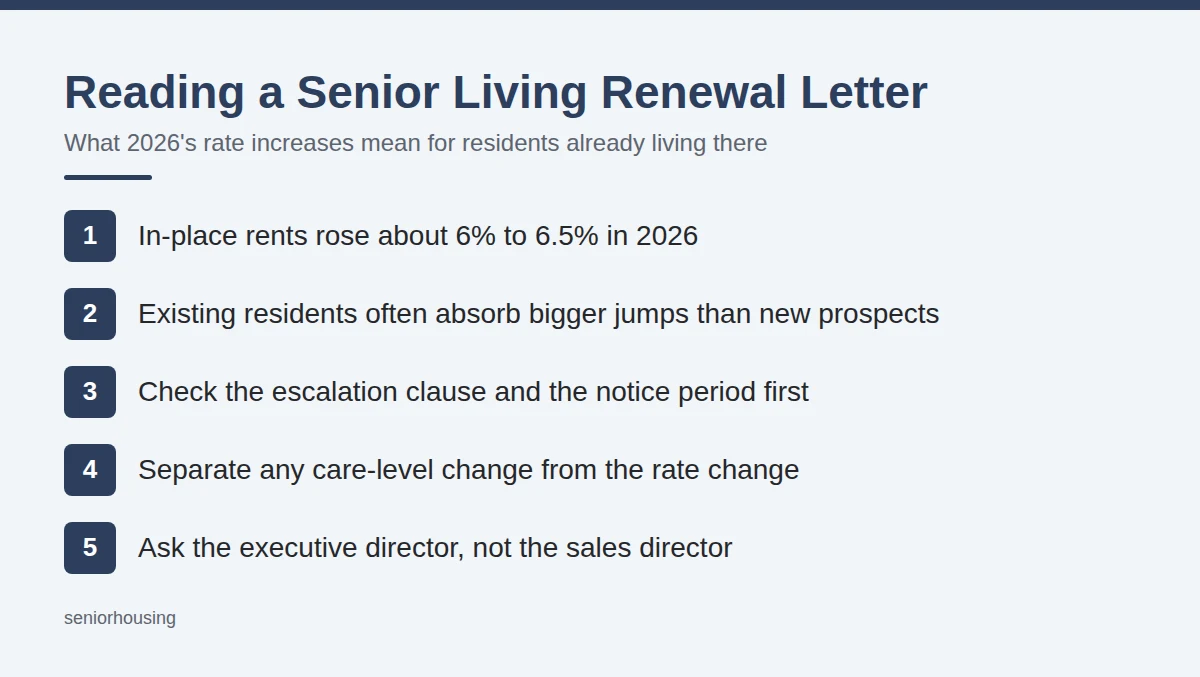
Through the first quarter of 2026, data from the National Investment Center for Seniors Housing and Care put year-over-year in-place rate growth at 6.1% for independent living and 6.5% for assisted living. Asking rates ran higher, 7.4% and 7.2%. Senior Housing News reported in April that operators were taking a deliberately more moderate approach to rental rates in 2026 than they had the year before, and the numbers bear that out. Independent living initial rates grew 14.9% year over year in 2025 and only 2.3% in the first quarter of 2026.
So “moderating” is true. What it is not is small. A 6% increase on a $6,340 apartment is $380 a month, or $4,560 over the year, and it compounds against every future increase.
There is a sharper wrinkle. In 2025, independent living in-place rents grew 8.1% while asking rents grew 6.7%. Read that again: the people already living there absorbed larger increases than the people being recruited. Existing residents are the most reliable revenue an operator has, and they are also the least likely to leave over a rate change. Pricing follows that logic.
Meanwhile, new prospects were being offered concessions. NIC measured assisted living discounts in March 2026 at roughly $515 a month, about 0.9 months of rent annualized, with independent living discounts near $543, about 1.3 months. Your parent’s new neighbor down the hall may genuinely be paying less than she is. That is not a scandal, it is standard lease-up economics, but it is worth knowing before you decide the renewal number is non-negotiable.
Find the Clause Before You Call Anyone
Pull the residency agreement out of the file before you respond to anything. Four provisions govern what the community can actually do.
The escalation clause. Some agreements name a formula (a fixed percentage, or a cap tied to CPI). Most say something closer to “rates may be adjusted annually at the discretion of the community.” Discretionary language is common and legal, and it also means the number in the letter is a decision rather than a calculation, which is exactly why it can be revisited.
The notice period. Typically 30 or 60 days for a rate change, and it is usually a hard requirement. If the letter gives you less notice than the contract promises, the effective date is wrong, and saying so politely is a reasonable opening.
Whether care fees escalate on the same schedule. In many agreements they do, which means a 6% headline increase is quietly 6% on base rent and 6% on the care package. Our breakdown of how base rent, care levels, and fees stack up walks through why the total moves faster than the advertised rate.
Your termination rights if you decline. Nearly every agreement lets a resident give notice and leave rather than accept the new rate. Knowing the notice period on that clause is what turns a conversation into a negotiation.
One more thing to check, and it is the most common source of renewal shock: whether the increase in the letter is only a rate increase. If a reassessment moved your mother from care level two to care level three in the same month, the letter may fold both changes into one new monthly figure. Those are two separate decisions with two separate justifications, and you are entitled to see them broken out. Ask for the prior month’s itemized statement next to the new one, line by line.

Normal, High, or Aggressive
There is no legal standard here, so use the market data as your yardstick. Against 2026’s in-place growth of roughly 6% to 6.5%:
- 4% to 6% is at or slightly below the current national trend. This is a reasonable increase in 2026, and in most cases the right move is to accept it.
- 6% to 8% is on trend, though at the upper end you should ask what drove it. Labor and insurance costs are the honest answers operators give, and both have been real.
- 9% and above is above trend. Ask for the reason in writing. A community that cannot articulate one beyond “annual adjustment” is testing what the market will bear.
- Any increase bundled with a care-level change should be unbundled before you evaluate either half.
Two caveats matter. First, regional variation is significant, and a tight market behaves differently from a soft one. Second, memory care has been running on its own track, with asking rates up about 5.1% and initial rates up only 2.2% in the most recent full-year NIC comparison, reflecting shorter median stays of roughly 18 months against 25 in assisted living.
Why the Letter Is More Negotiable Than It Looks
Occupancy is the reason families assume there is no leverage, and it is also the reason there is some.
National senior living occupancy reached about 89.9% in the second quarter of 2026. Six in ten properties across NIC’s 31 primary markets now run above 90%, and 77% are above 85%. A full building does not need to fight for your parent’s unit, which is the case against negotiating.
Here is the case for it. At 90% occupancy in a market with almost no new construction, the scarce resource is not demand, it is staff time and operational margin. An unplanned move-out costs the community a vacancy, an apartment turnover, a marketing spend, and a new move-in discount averaging several hundred dollars a month. Against that, holding your mother’s increase to 4% instead of 7% costs them about $190 a month. Executive directors know this arithmetic better than families do.
What you can realistically ask for, roughly in order of how often it works:
- A smaller increase, framed against a specific number you can afford.
- A phased increase, half now and half in six months.
- A delayed effective date, thirty or sixty days out.
- A frozen care level for twelve months, with reassessment only after a documented health change.
- Services instead of dollars, which is often the easiest yes: additional housekeeping, a parking space, guest meals, transportation, or a waived pet fee.
The last one matters more than it sounds. A community that will not move on rate can often move on value, because concessions in kind do not reset the rent roll that ownership reports on.

The Conversation, and Who to Have It With
Go to the executive director, not the sales or marketing director. Sales owns move-ins; the executive director owns the building’s budget and is the person who can actually approve an exception. Request a meeting rather than raising it at the front desk, and bring the current statement, the new letter, and the residency agreement.
A version of what to say:
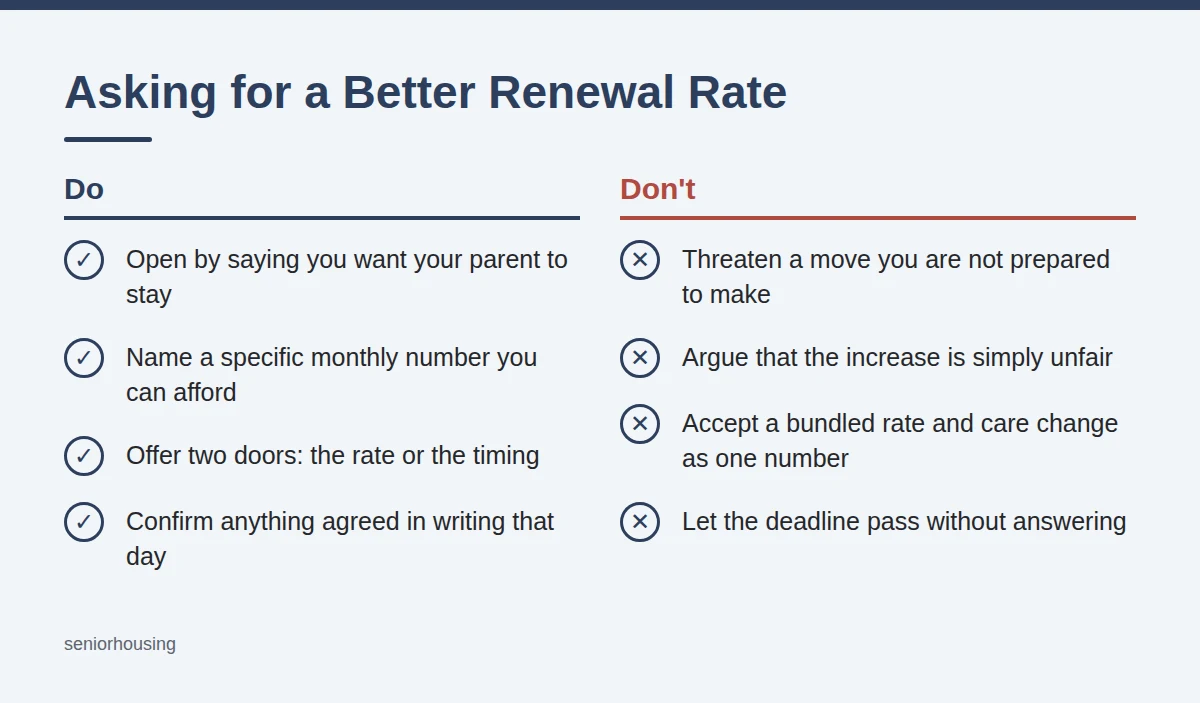
“We got the renewal letter and we want Mom to stay here. She is happy, and moving her would be hard on her. The increase takes us to $6,780, which is past what her income and savings can carry at that pace. We can manage $6,550. Is there anything you can do on the rate, or on the timing, to get us there?”
Four things are doing work in that script. It opens with the intent to stay, which removes the threat and keeps the conversation collaborative. It names a specific number rather than asking vaguely for a break. It grounds the request in affordability rather than fairness, which is the argument an operator can act on. And it offers two doors, rate or timing, so the answer does not have to be a flat no.
Then put it in writing. Send a short follow-up email the same day summarizing what was discussed and what was agreed. Verbal concessions in senior living have a way of not surviving a change in management.
If the answer is a genuine no, ask one final question: what would have to be true next year for the increase to be smaller? The answer tells you whether this is a building under cost pressure or an owner running a pricing strategy, and that shapes what you plan for.

When to Escalate, and When to Just Move
Escalation paths exist, though they are narrower than families hope. Rate increases themselves are rarely illegal. What is enforceable is process: the notice period, the disclosure of what a fee covers, and the accuracy of a care-level assessment. If the community shortened notice, changed terms mid-term, or raised a care level without a documented reassessment, your state’s long-term care ombudsman takes those complaints, and the call is free and confidential. Our guide to resident rights, contracts, and recourse covers how those complaints actually move.
Moving is the other option, and it deserves honest math rather than a threat. A new community means a fresh community fee often equal to a month’s rent, a fresh care assessment that may land at a higher tier than the current one, and a transition that is genuinely hard on a resident with any cognitive decline. Against 6%, moving rarely pencils out. Against a second consecutive 10% year, it sometimes does.
The more useful response to a steep increase is to re-run the long-term numbers rather than react to one letter. Our walkthrough of how many years the money actually lasts shows how a rate assumption of 6% instead of 3% can cut a runway nearly in half. If that math now ends before your parent’s likely lifespan does, the planning conversation to start this year, not in the year the money runs out, is Medicaid eligibility and spend-down.
What to Do This Week
Read the escalation clause and the notice period. Ask for the current and proposed statements side by side, itemized. Separate any care-level change from the rate change. Compare the percentage against the 6% to 6.5% national trend. Decide on a number you can actually afford. Then request the meeting, make the ask, and confirm it by email.
The one thing not to do is nothing. The renewal letter is written to sound final because most families treat it as final. The supply picture behind it, which our look at the senior housing supply crunch explains in more detail, means these letters will keep arriving with real numbers on them for years. The families who get the best outcomes are simply the ones who answer.
Rate practices, notice requirements, and tenant protections vary considerably by state and by contract type, and independent living leases are governed differently from assisted living service agreements. Before challenging a contract term or making a decision to move, have the agreement reviewed by an elder law attorney or a certified senior care advisor licensed in your state.
Further reading (sources)
- Senior Housing News on the more moderate approach operators took to 2026 rates
- Senior Housing News for how in-place rent growth split between independent and assisted living
- McKnight’s Senior Living with why assisted living rate growth kept climbing as demand cooled elsewhere
- NIC MAP with why the 3% annual increase assumption fell apart