The First Year After a Dementia Diagnosis: A Month-by-Month Roadmap for Families
Published on September 15, 2026

The appointment that changes everything usually lasts about twenty minutes. A neurologist says a word, hands over a prescription and a follow-up date six months out, and a family walks back to the parking lot holding a diagnosis and no instructions. The questions arrive in the car. Should he still be driving? Do we tell his sister? Is this the moment we start looking at places?
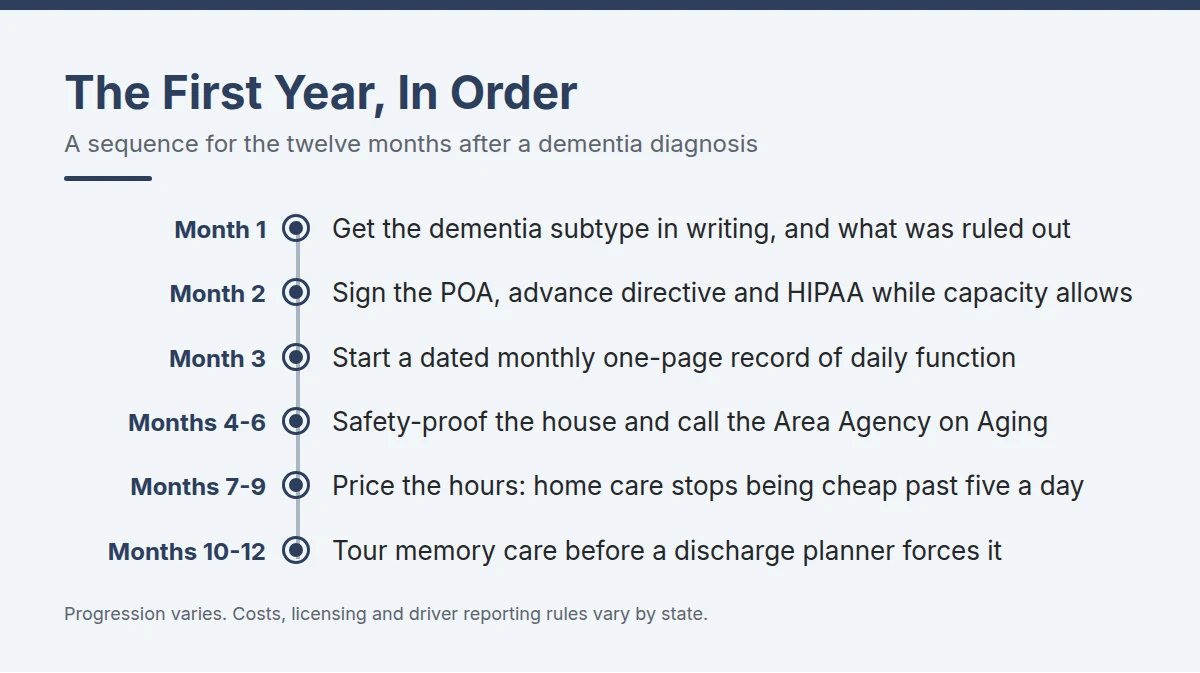
Almost every guide in this niche answers the last question, because that is where the industry’s attention is. Very little answers the first twelve months, which is where the decisions that make the rest of it manageable actually get made. What follows is a sequence. It will not fit your family exactly, and dementia does not progress on a schedule, but the order holds: learn what you are dealing with, secure the legal authority while it is still available, document the baseline, make the house safe, turn on the benefits, and only then start thinking about where your parent will live.
Month One: Find Out Which Dementia This Is
“Dementia” is a category, not a diagnosis. It is the umbrella term for a loss of cognitive function severe enough to interfere with daily life, and it covers several distinct diseases: Alzheimer’s disease, vascular dementia, dementia with Lewy bodies, frontotemporal dementia, and mixed presentations that combine two or more.
The subtype matters more than most families are told. It changes the expected trajectory, which symptoms arrive first, which medications help, and in at least one case which medications do real harm. People with Lewy body dementia can have severe sensitivity to antipsychotic drugs, a reaction well enough established that it belongs in bold on the chart and in the mouth of whoever accompanies your parent to the emergency department. Vascular dementia tends to progress in steps tied to cerebrovascular events rather than smoothly, which changes what a sudden decline means. Frontotemporal dementia often shows up as personality and behavior change years before memory does, which is why families so often spend a long time angry at someone who is ill.
So ask directly: which type, based on what evidence, and what was ruled out? Some conditions mimic or worsen cognitive decline and are treatable, including B12 deficiency, thyroid disease, medication interactions, untreated sleep apnea, and depression. Get the answer in writing.
Then book the appointment most families never hear about. Medicare Part B covers a separate visit specifically for a cognitive assessment and care plan, distinct from the yearly wellness visit. In that visit the provider reviews medications and medical history, identifies the social supports already in place, builds an actual written care plan, helps update advance care planning, and connects the family to community resources like adult day programs and support groups. After the Part B deductible you pay 20% of the Medicare-approved amount. Bring a second person to take notes, which Medicare explicitly encourages.
Month Two: Sign the Paperwork While Your Parent Still Can
Capacity is not a switch, and it is higher this month than it will be next year. The legal documents that let you help are only valid if your parent had the capacity to sign them, so this window is the whole ballgame.

The core set is a durable financial power of attorney, a healthcare power of attorney or proxy, an advance directive, and a HIPAA authorization so providers can talk to you at all. Each does a different job and none substitutes for another. Our guide to the paperwork every family needs before a senior move walks through what each document permits and where an elder law attorney genuinely earns the fee.
This is also the month to audit the insurance. If a long-term care policy exists, read it now: severe cognitive impairment is a standard benefit trigger on modern policies, alongside the usual count of activities of daily living, which means a forgotten policy in a filing cabinet can be worth thousands of dollars a month later. The reverse is equally important and harder to hear. You cannot buy long-term care coverage after a diagnosis. Underwriting closes, and it closes permanently.
Do the financial hygiene while you are in there. Many families discover, looking back, that money mistakes preceded the diagnosis by a year or more: unpaid bills, duplicate payments, unusual withdrawals, a new “friend” on the phone. Add a trusted contact to the bank accounts, turn on transaction alerts, and consolidate what can be consolidated. If your parent is married, recognize that the well spouse just became a caregiver without being asked, which reshapes the housing question later in ways worth understanding early. Our guide on what happens when one spouse needs care and the other does not covers that ground.
Month Three: Build the Baseline Nobody Tells You to Build
This is the most useful document of the entire year and no clinician will ask you to create it.
Once a month, write one dated page describing how your parent is actually functioning. Not a diary of feelings, a record of tasks. Who fills the pill organizer and who notices when a dose is missed. Whether meals are being prepared, eaten, or quietly skipped. Whether the bills are getting paid. How far he is driving and where. Whether bathing and dressing still happen without prompting. What the nights look like. How often orientation slips, and what it looks like when it does. Any new behaviors: suspicion, agitation, apathy, repeated questions.
Do this because nearly every gate ahead of you runs on documented function. A community’s care level assessment prices the monthly bill from it. A long-term care insurer approves or denies a claim on it. A Medicaid application rests on it. A physician deciding whether your parent still qualifies for a treatment reads it. And because human memory compresses: a year from now, asked when the decline started, you will guess wrong, and the family will argue about it.
Months Four Through Six: The House and the Car
Start with the house, because the fixes are cheap and the risk is immediate. Working from the Alzheimer’s Association’s home safety guidance, the usual list is stove and appliance controls, water heater temperature, medications and cleaning products locked away, better lighting on the path to the bathroom, clutter and loose rugs gone, and locks that a confused person cannot open onto a road at 3 a.m.

Then plan for wandering before it happens, not after. Six in ten people living with dementia will wander at least once, many of them repeatedly, and it can happen at any stage of the disease. That means door alarms or chimes, a current photograph kept somewhere you can find it fast, identification on your parent’s person, and a quiet word with the neighbors so someone recognizes him three streets over.
The car is harder. Driving is not one conversation and it is not one day, and treating it as an ultimatum is how families lose a year of cooperation. Build it in stages: restrict to daylight, then to familiar routes, then to a passenger always present. Ask the clinician what your state requires, because physician reporting rules and license review procedures vary enormously and some states put the obligation on the doctor rather than the family. When you need a neutral verdict, ask for a driving evaluation by an occupational therapist trained in it. A third party delivering the news preserves a relationship that a son delivering it can destroy.
Months Four Through Six, In Parallel: Turn the Benefits On
Most of what exists to help families in the first year is not advertised, and nobody at the neurology office will volunteer it.

Start with the GUIDE Model. Guiding an Improved Dementia Experience is an eight-year nationwide Medicare model that began on July 1, 2024, and it is the most concrete support currently available to a family caring for someone with dementia at home. Participating practices provide a care navigator, a 24/7 support line for the hours when things go wrong, caregiver training, connections to community services, and respite care reimbursed up to $2,500 a year. Ask your parent’s provider whether they participate. If they do not, ask who nearby does.
Then call the Eldercare Locator and find the Area Agency on Aging for your parent’s county. The National Family Caregiver Support Program, funded through the Older Americans Act, pays for respite, counseling, training, and supplemental services through those agencies, and the intake is a phone call rather than an application process. Ask specifically about adult day programs, which remain the most underused option in the field: supervised hours, structured activity, a meal, and social contact, at a per-hour cost well below in-home care.
If your parent is eligible for both Medicare and Medicaid, look at PACE, the all-inclusive program built to keep people out of nursing homes. It bundles the doctors, the day program, therapy, and transportation, and it is available in a growing number of counties.
None of this is administrative busywork. In a cluster-randomized trial across German general practices, Thyrian and colleagues assigned 634 people with dementia living at home, average age 80 and half of them living alone, to nurse-led dementia care management or usual care. At twelve months the managed group had significantly fewer behavioral and psychological symptoms and their caregivers reported significantly lower burden. Coordination, done deliberately, changes outcomes for both people in the room.
Months Seven Through Nine: When Supervision Becomes the Job
The gap that opens first is usually not medical. It is hours.
What starts as a few hours of companion help twice a week becomes weekday coverage, then daily, then the question of what happens between the aide leaving at five and someone arriving in the morning. This is the stage where families quietly spend more than they realize, because hourly care scales linearly and the need does not stop scaling. Our complete guide to in-home care breaks down the rates, the agency and private-hire tradeoffs, and the household employer rules that catch people off guard.
Watch for the crossover. When paid hours push past roughly five a day, when nights become active, or when transfers start needing two people, the hourly model stops being the economical choice and starts being the expensive way to buy partial coverage. That is not a failure of home care. It is the point at which the need outgrew the delivery model.
Months Ten Through Twelve: When Memory Care Enters the Conversation
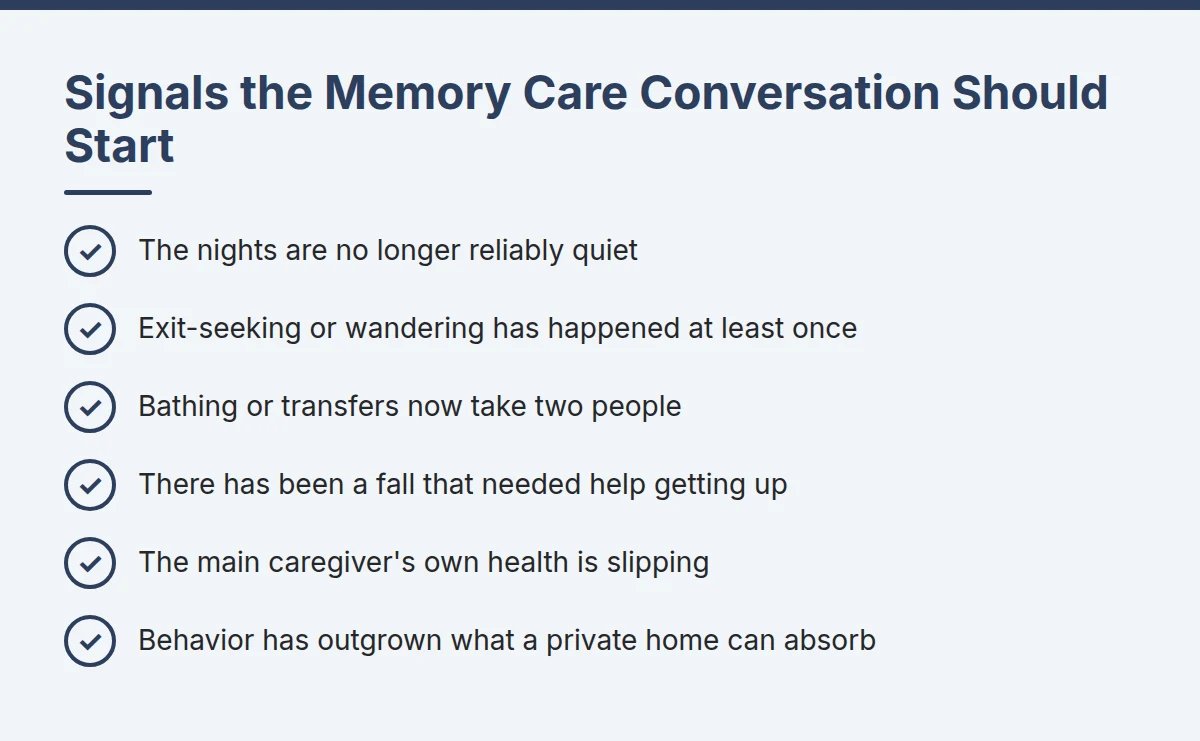
By the end of the first year, some families are nowhere near this and some are already past it. The honest signals that the conversation should start are these: nights are no longer reliably quiet, exit-seeking or wandering has happened at least once, transfers or bathing now take two people, there has been a fall that required help getting up, the person doing most of the caregiving is losing their own health, or the behavioral symptoms have outgrown what a private home can absorb.
The move families regret is the one made in a hospital discharge room in forty-eight hours. Good memory care communities have waitlists, admission assessments, and paperwork, and touring three of them while nothing is on fire is an entirely different experience from touring one because a social worker said you have until Friday. When you get there, our complete guide to memory care covers what separates a licensed memory care unit from a standard assisted living floor with a keypad on the door.
Visiting early costs nothing and commits you to nothing. It also means that if the day comes, you already know where you are going.
What the First Year Is Actually For
The first year is not for solving dementia. It is for converting a shock into a set of decisions your family makes calmly, on its own timetable, instead of at two in the morning in an emergency department with a social worker asking whether anyone holds power of attorney.
If you do only four things, do these: get the subtype in writing, sign the legal documents this quarter, start the monthly one-page baseline, and call the Area Agency on Aging before you think you need to. Everything else in this roadmap gets easier once those four are done.
Costs, licensing rules, driver reporting laws, and Medicaid eligibility all vary significantly by state, so treat everything here as a map rather than a set of directions. For the care picture, a geriatric care manager or certified senior care advisor is worth the hourly rate. For anything touching capacity, guardianship, asset protection, or Medicaid planning, involve an elder law attorney early rather than after a mistake. Nothing in this article is legal, medical, or financial advice.
Further reading (sources)
- National Institute on Aging on the first steps to take after a dementia diagnosis
- National Institute on Aging for how families should handle driving as dementia progresses
- Medicare.gov with what the separate cognitive assessment and care plan visit covers
- Centers for Medicare & Medicaid Services on the GUIDE Model’s care navigation and respite benefit
- Alzheimer’s Association for why six in ten people with dementia wander, and how to prepare
- Alzheimer’s Association on room-by-room home safety for a person living with dementia
- Administration for Community Living covering the respite and counseling funded by the National Family Caregiver Support Program
- Thyrian and colleagues in a randomized trial of nurse-led dementia care management in primary care