How Senior Living Pricing Actually Works: Base Rent, Care Levels, and Why the Bill Grows
Published on September 4, 2026

The Number on the Brochure Is Not the Bill
Every senior living website leads with one figure. “Starting at $5,300 a month.” Families anchor to it, build a budget around it, and then open the first invoice to find something several hundred dollars higher. A year later it is higher again. By year three, plenty of families are paying half again what they thought they signed up for, and nobody lied to them at any point along the way.
The reason is structural. A senior living bill is not one price. It is four separate layers stacked on top of each other, each governed by a different rule, and only the second layer is the one in the advertisement. Learn to read all four and you can model the real cost before you sign instead of discovering it a year in.
Layer Zero: What You Pay Before You Ever Sleep There
Most rental senior living communities charge a one-time community fee at move-in, sometimes called a move-in fee or administrative fee. It covers apartment turnover, the initial nursing assessment, and the paperwork of admission. In practice it runs from a few hundred dollars to several thousand, and a fee equal to roughly one month’s rent is common. It is almost always nonrefundable, including if your parent dies or moves out three weeks later.
That last part deserves a question on the tour. Ask whether any portion is refundable, over what window, and what happens if a hospital stay between signing and move-in delays the arrival. Get the answer in the residency agreement, not from the sales director.
Continuing care retirement communities work on an entirely different scale. Their entry fees commonly run from $50,000 to $450,000 or more, and refundability is the whole negotiation: a “90% refundable” contract typically refunds only after the unit is resold and only against a specific formula. If you are looking at a CCRC, the entry fee contract deserves an elder law attorney’s eyes before anything else.
Layer One: Base Rent, and What It Genuinely Includes
Base rent prices the apartment and the shared building services. Across the country the bundle is fairly consistent: the unit and utilities, three meals a day, weekly housekeeping and linens, scheduled transportation to medical appointments, maintenance, the activity calendar, and 24-hour staff presence with an emergency call system.
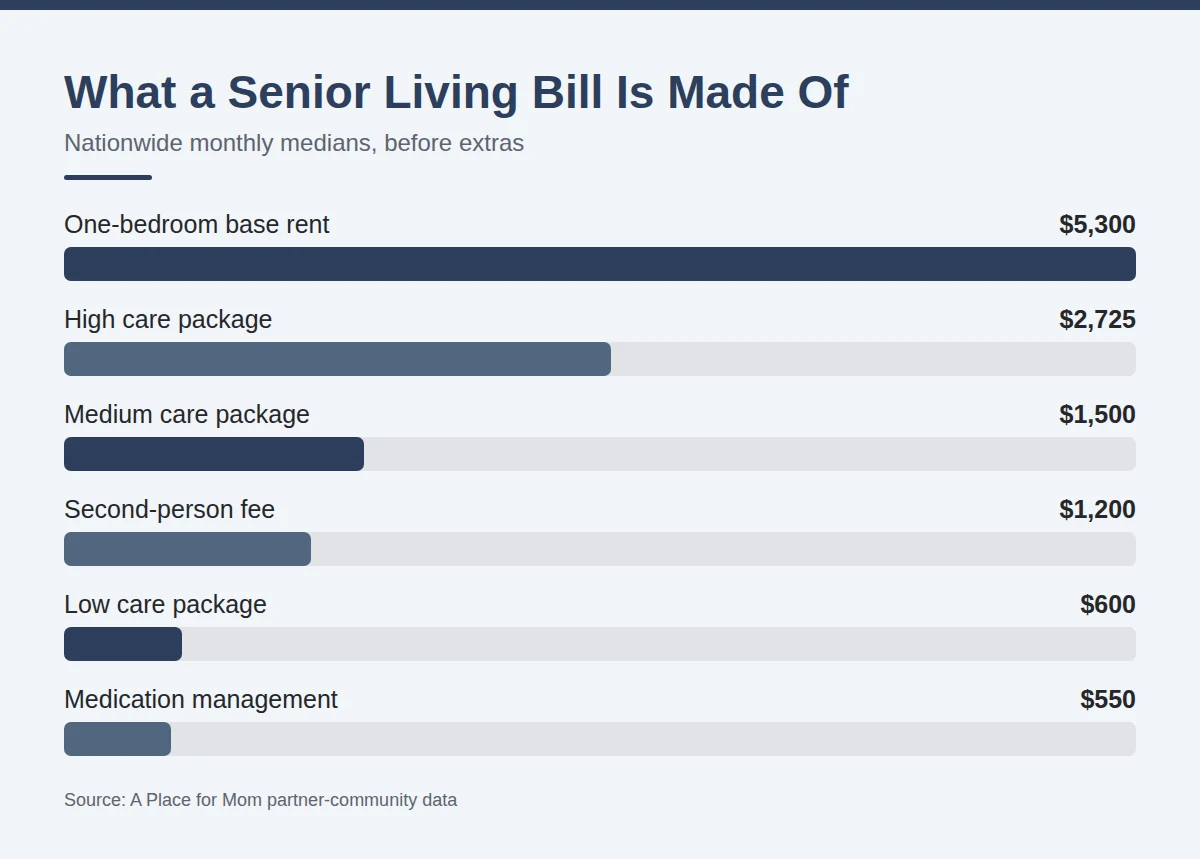
Base rent scales with the apartment, not with your parent. A studio, a one-bedroom, a two-bedroom, and a shared companion suite in the same building can span a two-to-one range. A Place for Mom’s nationwide data puts the median one-bedroom at about $5,300 a month, against a national assisted living median of roughly $5,419 including care. Our complete guide to assisted living breaks down the state-by-state spread, which is close to two and a half to one from Mississippi to Connecticut.

What base rent does not include is care. That distinction is the single most important thing to understand about senior living pricing, and it is the reason the advertised number and the invoice never match.
Layer Two: The Care-Level Assessment
Before move-in, a nurse assesses your parent. The tool is usually a recognized instrument such as the Katz Index, the Barthel ADL Index, or a Functional Independence Measure, scoring the activities of daily living (bathing, dressing, toileting, transferring, eating, continence) plus cognition and medication complexity. That score sets the care fee, which is added to base rent every month.
Communities package it four different ways, and the model matters more than the headline price:
- Tiered levels. Three to five named levels, each adding a fixed monthly amount. Simple to compare, but a resident who needs one extra service can jump a whole tier.
- Points. Every task carries a point weight based on staff time. Twice-daily medication setup might score 10 points, complex medication administration 20. Points are then either priced individually or bucketed into bands. This is the most granular model and the hardest to forecast.
- A la carte. Each service is separately priced. Transparent, but the total creeps upward one small line at a time.
- All-inclusive. One flat rate regardless of need. Higher on day one, flat later, and genuinely cheaper for a resident whose needs will escalate.
The dollars are substantial. Across the industry a low care package adds roughly $600 a month, a medium tier about $1,500, and a high tier $2,700 or more. Elsewhere in the industry, per-tier surcharges get quoted anywhere from $300 to $2,500 depending on the community and the state. So a $5,300 apartment can carry an $8,025 all-in price for a resident with high needs, before any extras.
Two questions turn this from a mystery into a spreadsheet. What does each level cost in dollars, listed on paper? And what specific care triggers a move from one level to the next? A community that will not put both in writing is telling you the assessment is discretionary, which means it is a revenue lever.

Layer Three: The Charges Quoted to Nobody
Beneath the care level sits a set of line items that rarely appear in a first quote.
Medication management is the big one, and it is frequently billed separately from the care tier even in communities that claim to bundle care. The nationwide median runs about $550 a month. Insulin injections, controlled substances, and eye drops sometimes carry their own surcharges on top. Because this is both expensive and clinically consequential, it deserves its own conversation, and our guide to what to ask about medication management before move-in covers the questions that matter.
Incontinence care is usually tiered separately: scheduled toileting reminders cost less than full incontinence management, and supplies may be billed at cost or marked up.
The second-person fee applies when both parents move into one apartment. The national median sits near $1,200 a month, with most communities charging somewhere between $500 and $1,800. Critically, that fee covers the second resident’s meals and occupancy, not their care. If both parents need help, expect two separate care assessments and two care fees.

Then the small recurring items nobody thinks to add up: the salon, personal laundry, cable and internet where they are not bundled into rent, a pet deposit plus a monthly pet charge, meals for visiting family, rides outside the scheduled transportation routes, and ticketed outings. Individually trivial. Together, often $200 to $400 a month.
Layer Four: The Annual Escalator
Every residency agreement contains a clause allowing the community to raise rates, typically once a year with 30 or 60 days’ written notice. Families read past it. It is the layer that does the most damage over a multi-year stay.
The industry’s own data says the familiar “about 3% a year” rule of thumb is close to useless. NIC MAP found senior housing increases ran 2.5% to 3.7% annually before the pandemic and reached 4.5% by early 2024, but the real story is a barbell: roughly half of properties raised rates under 2%, only about 8% landed in the expected 2% to 4% band, and around 30% went above 6%. About 40% of the properties posting large increases had posted large increases the year before as well. In other words, the average tells you almost nothing about the building your parent is actually moving into, but last year’s behavior tells you a lot.
For 2026, Senior Housing News reported assisted living operators implementing increases in the range of roughly 6.8% to 8.5%, moderating from the double-digit years that followed the pandemic but still well above general inflation.
The practical move: ask each community for its actual rate increases over the past three years, in writing, and use that number rather than a national average. Ask separately whether care-level fees escalate on the same schedule as base rent, because in many contracts they do, and that compounds two layers at once.
Putting It Together: Model Three Years, Not One
Here is what those four layers do to a realistic budget. National medians, not a quote, but the shape is right.
A parent moves into a one-bedroom at $5,300. The assessment puts her in the low care package at $600, and she needs medication management at $550. Month one is $6,450, already 22% above the brochure number, plus a $5,300 community fee on the way in.
Apply a 7% increase at each anniversary. Year two runs about $6,900 a month. Sometime in year three she has a fall, and the reassessment moves her from low care to medium. Month 36 lands near $8,400.
Three-year total: roughly $266,000, against the $190,800 a family would have projected from the advertised rate. The gap is about $75,000, and every dollar of it was disclosed somewhere in the paperwork.
That is the exercise worth doing before you sign, on all three of your finalist communities. If the three-year number changes which community you choose, you have just learned something the tour would never have told you. Once you have the projection, our walkthrough of how many years the money will actually last extends the same math across a full stay.
Before You Sign: Get These in Writing
- The full fee schedule, every level, in dollars.
- The written criteria that trigger a move between care levels.
- The re-assessment policy: how often, who performs it, whether the family is notified in advance, and whether you can request a re-assessment downward if your parent improves after rehab.
- Rate increase history for the past three years, and whether care fees escalate alongside base rent.
- Notice period for any increase, and your termination rights if you decline it.
- What is refundable, and when.
The re-assessment clause is the one most families never ask about, and it is the one that quietly rewrites the bill. Communities reassess on admission, after any health change or injury, and on a regular cycle that may be quarterly, semi-annual, or annual. A parent who comes home from a hip fracture will be reassessed, and the new level will hold until someone asks for it to be revisited. Your state may also give you disclosure and appeal rights here, which our guide to resident rights and admission contracts walks through.
None of this makes senior living a bad value. Compare the all-in number against what the equivalent hours would cost through an agency, laid out in our complete guide to in-home care, and communities often win on price well before they win on safety. The point is simply to know the real number, in year three as well as month one, before the decision is made rather than after.

Costs, fee structures, and disclosure rules vary substantially by state and by operator. Before signing a residency agreement or a CCRC entry-fee contract, have it reviewed by an elder law attorney or a certified senior care advisor who knows your state’s rules.
Further reading (sources)
- National Institute on Aging on what assisted living includes and why extra services cost more
- Administration for Community Living for what long-term care costs and who pays for it
- NIC MAP for why the 3% annual increase assumption falls apart
- Senior Housing News with what operators actually did to rental rates in 2026
- Senior Housing News on why how long a resident can pay matters more than whether they can