The Complete Guide to In-Home Care: Types, Costs, and How to Hire the Right Help in 2026
Published on September 3, 2026

The Option Every Family Tries First
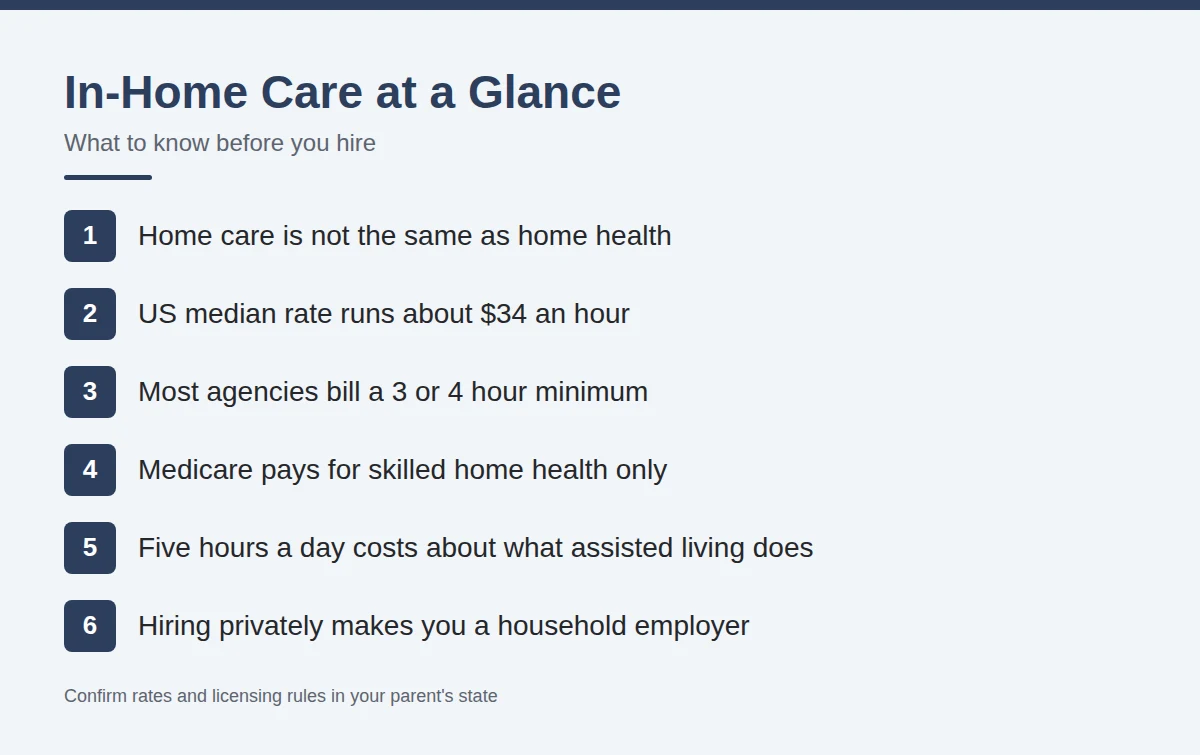
Before anyone tours a community, almost every family tries home care. It is the least disruptive answer to a problem that has started to feel urgent: Dad is unsteady on the stairs, Mom is not eating properly, and nobody wants to have the bigger conversation yet. So you look up “caregivers near me,” you call a number, and within a week a stranger is in your parent’s kitchen.
That is usually the right first move. What families rarely have going in is the vocabulary. Home care, home health, companion care, personal care, live-in, 24-hour: these are not interchangeable words, they are different services at wildly different prices, and only one of them is something Medicare will pay for. Buying the wrong one is how a family spends $4,000 a month and still ends up in the emergency room after a 2 a.m. fall.
This guide covers what each type actually is, what it costs in 2026, how agencies price and vet the people they send, what changes when you hire someone privately, and the point at which home care quietly stops being the cheaper or safer choice.
The Three Things People Mean by “Home Care”
Non-medical home care is the large majority of what gets bought, and it splits into three tiers that agencies price differently. Companion care is presence and socialization: conversation, board games, a ride to the pharmacy, a walk around the block, someone in the house so your father is not alone all afternoon. Homemaker services add the household work, so laundry, light cleaning, grocery shopping, and cooking. Personal care is hands-on help with the activities of daily living, meaning bathing, dressing, grooming, toileting, continence care, and transfers in and out of a bed or chair. Personal care is the most commonly purchased in-home service and the one that most often determines whether a parent can stay home at all.
Home health care is a different product entirely. It is medical, it is ordered by a physician, and it is delivered by or under the supervision of licensed nurses and therapists. Think wound care, injections, IV therapy, catheter management, post-surgical monitoring, and physical, occupational, or speech therapy after a hospitalization. Home health is prescribed, intermittent, and goal-directed. When the goal is met or progress stalls, it ends. It is not a way to have someone in the house every day.
Live-in and 24-hour care are also two different things, and agencies do not always volunteer the distinction. 24-hour care means two or three caregivers working shifts so that someone is awake and on duty at all times, billed by the hour. Live-in care means one caregiver residing in the home, billed at a flat daily rate, with a legally required uninterrupted sleep period and meal breaks. Live-in costs substantially less, and it is the wrong choice if your parent gets up three times a night. The question to ask yourself is not “do we need 24-hour care” but “does anyone need to be awake at 3 a.m.?”

What It Costs in 2026
Federal wage data puts the median pay for home health and personal care aides at $17.21 an hour as of May 2025. Agencies bill families roughly double the caregiver’s wage once supervision, insurance, payroll tax, and scheduling are priced in, which puts typical private-pay home care in the low to mid $30s an hour. Metro variation is real but narrower than families expect: the most expensive coastal metros sit a few dollars above that national figure and lower-cost Southern metros a few dollars below. Skilled home health, when it is paid privately rather than billed to insurance, runs higher.
The hourly number is not the number that matters. Multiply it out.
- Four hours a day, five days a week (a common starting package): roughly $2,900 a month.
- Forty hours a week: roughly $5,900 a month.
- Eight hours a day, seven days a week: roughly $8,200 a month.
- True around-the-clock shift care: north of $24,000 a month, which is why almost nobody buys it for long.
Two pricing details catch families off guard. Most agencies impose a minimum shift, commonly three or four hours, so a thirty-minute hand with the morning shower still bills as four hours. And rates typically rise on holidays, for overnight shifts, and for clients whose needs are heavy enough to require two caregivers on a transfer.
Now set that against a national assisted living median of roughly $5,419 a month, which bundles housing, meals, utilities, activities, and 24-hour staffing. At $34 an hour, about 160 hours of home care a month, a little over five hours a day, costs the same as assisted living and buys nineteen hours a day of nobody being there. That crossover is the single most useful number in this article.

Hiring Through an Agency vs. Hiring Privately
An agency charges more per hour and does more with it. A good one employs its caregivers rather than treating them as contractors, carries liability insurance and workers’ compensation, runs criminal background checks against state and national databases plus the abuse registry, handles payroll taxes, writes a care plan, sends a nurse or supervisor to review it periodically, and, critically, sends someone else when your regular caregiver has the flu. Roughly a third of the hourly rate never reaches the caregiver, and that spread is what buys the backup and the insurance.
A registry sits in the middle and is often mistaken for an agency. It matches you with an independent contractor, takes a fee, and leaves the employment relationship with you. Screening quality varies enormously. Ask directly which model you are buying, because the marketing looks identical.
Hiring privately is genuinely cheaper per hour, and the caregiver usually earns more, which is why the arrangement can produce excellent continuity. What families underestimate is that they have become household employers. That means Social Security and Medicare withholding, federal and state unemployment tax, overtime obligations under federal wage rules that cover most home care workers, workers’ compensation in many states, and a real liability exposure if someone is injured in the home. The IRS covers the mechanics in Publication 926. There is also no bench: when your caregiver quits, moves, or gets sick, you are the coverage. And be careful here if a long-term care policy is funding the care, because many policies reimburse only for services delivered by a licensed agency.
Neither model is wrong. Agencies fit families who need reliability more than they need the last few dollars an hour. Private hire fits families with the time to manage payroll, screening, and gaps in coverage themselves.
What Medicare and Medicaid Will and Will Not Pay
Medicare covers home health, not home care. To qualify, a physician must certify a plan of care, the patient must need intermittent skilled nursing or therapy, they must be certified homebound, and the provider must be Medicare-certified. Coverage is part-time and episodic. Medicare does not pay for around-the-clock care at home, homemaker services, meal delivery, or personal care when help with bathing and dressing is the only thing needed. That last exclusion is the one that surprises people, and it covers most of what aging parents actually need. Our guide to what Medicare actually pays for in senior housing walks the full boundary.
Medicaid is where long-term in-home help does get funded, through Home and Community-Based Services waivers that exist in every state under different names. Waivers commonly cover personal care, respite, adult day services, and home modifications. The catches are strict income and asset limits, and waiting lists that in many states run for years. A number of states also operate self-directed programs that let a family member be hired and paid as the caregiver, which is worth asking your Area Agency on Aging about specifically. For dual-eligible seniors who already need nursing-home-level care, a PACE program can bundle nearly all of this under one roof.
Otherwise, home care is private pay: savings, pensions, long-term care insurance benefits, a health savings account, or VA Aid and Attendance for wartime veterans and surviving spouses. Eligibility rules, waiver names, and licensing all vary considerably by state, so confirm the specifics where your parent actually lives.
Vetting the Agency, Then the Caregiver
State oversight of non-medical home care is uneven. Illinois licenses these companies as home services agencies, some states license nothing at all, and a “certified” badge on a website may only mean membership in a trade group. Do your own diligence:
- Are caregivers employees or independent contractors, and who carries workers’ compensation?
- What exactly does the background check include, and how recently was it run?
- Who writes the care plan, and how often does a supervisor visit to update it?
- What is the minimum shift, the cancellation window, and the holiday rate?
- What happens at 6 a.m. when the caregiver does not show up?
- Will the same two or three people be assigned, and what is the agency’s annual turnover?
- What dementia-specific training do caregivers receive, if any?
One answer deserves special attention. Non-medical aides in most states may remind a client to take medication but may not administer it, which is a meaningfully different thing from what a licensed community provides. If your parent takes a blood thinner, insulin, or a seizure medication, read our piece on how medication is actually handled in assisted living and ask the agency to be precise about what its staff are permitted to do.
Then interview the caregiver, not just the agency. Insist on meeting the person before the first shift, and treat the first two weeks as a trial.

When Home Care Stops Being the Better Answer
Watch for these, because they tend to arrive together:
- Paid hours have crept past five a day, so you are paying assisted living prices for partial coverage.
- Nights have become active: wandering, bathroom falls, sundowning.
- Transfers now take two people, which doubles the hourly rate.
- Your parent is safe but still alone and isolated for most of the week.
- The family caregiver filling the gaps is exhausted.
None of these means home care failed. It means the need outgrew the delivery model. Our aging in place versus senior living decision guide walks the comparison honestly, and if the answer turns out to be a move, the complete guide to assisted living covers what the monthly rate does and does not include.
Where to Start This Week
Write down the actual tasks and hours needed, not a vague sense of “some help.” Call three agencies and ask each for a written rate sheet covering minimums, overnight and holiday premiums, and cancellation terms. Check your state’s licensing lookup. If a long-term care policy exists, read the elimination period and the provider requirements before you hire anyone. Then start with fewer hours than you think you need and scale up, because it is far easier to add a shift than to walk one back.
Home care is not a smaller version of senior living. It is a different product with a different cost curve, and knowing where those curves cross is what keeps the decision yours rather than a crisis. For anything involving Medicaid eligibility, asset protection, or a contract you are unsure of, bring in a certified senior care advisor or an elder law attorney before you sign.

Further reading (sources)
- National Institute on Aging on what long-term care covers at home and who provides it
- Bureau of Labor Statistics for national and metro wage data on home health and personal care aides
- Medicare.gov on the homebound and skilled-need rules for home health coverage
- Medicaid.gov for how Home and Community-Based Services waivers work
- Internal Revenue Service with the household employer tax rules that apply to a private hire
- U.S. Department of Veterans Affairs on Aid and Attendance eligibility for veterans and surviving spouses