When a Parent Refuses to Move: Resistance, Persuasion, and Knowing When to Override
Published on August 20, 2026

The Search Rarely Stalls on Money
Families come to a senior living search expecting the hard part to be cost, or availability, or choosing between two communities that both looked fine on the tour. Then they hit the actual wall: a parent who folds their arms and says no. No, I am not moving. No, I do not need help. No, we are not discussing this again.
At that point the spreadsheet stops mattering. Surveys have found that only about 18 percent of older adults say they want to move into assisted living, so a refusal is not unusual behavior from an unusually stubborn parent. It is the normal response, and it is why most families decide under pressure rather than by agreement. Understanding what the no is made of is the difference between a conversation that moves and one that repeats itself for three years.
What the Refusal Is Usually About
The stated reason is rarely the whole reason. When a parent says “I am fine here,” they are usually protecting one of four things.
Control. Your parent has run their own life for sixty or seventy years. The move is not the threat; the threat is that someone else is now deciding. Social workers who do this work full time note that while adult children focus on safety, the parent’s priority is autonomy. Those are different problems, and a safety argument does not answer an autonomy fear.
Fear of decline. Agreeing to assisted living means agreeing out loud that they are declining, and that the next stop is smaller still. Refusal can be a way of refusing the diagnosis rather than the apartment.
Grief for the house. The kitchen where the family ate, the garden they planted, the room a spouse died in. A move means dispersing fifty years of objects, and no brochure addresses that loss. Families badly underestimate how much of the resistance is simple mourning.

Distrust of the messenger. If the child pushing hardest is the one who moved away, or the one who fought with them for a decade, the proposal carries all of that history. The same idea from a doctor or an old friend lands very differently.
There is a fifth possibility that deserves its own category: your parent may not be refusing at all, but be unable to recognize the problem. More on that below, because it changes everything.
Start Earlier and Smaller Than Feels Natural
The best conversation about senior housing happens years before anyone needs it, while it is still hypothetical and nobody’s independence is on the table. Senior living professionals give the same advice consistently: talk to your parent while they are thriving and in control, because you can discuss scenarios without triggering a defense of the present. It is also when a parent can name a power of attorney while they clearly have the capacity to do so, which prevents most of the ugly legal situations described at the end of this article.
If you are past that window, the principle still holds: go smaller than the goal. Do not open with a community. Open with a question. What could be better about daily life right now? What matters most to you as you get older? Who or what would improve your quality of life? Those questions invite a plan instead of defending against one.
Rules for the Conversation Itself
Pick a good day and go in without heat. Raising this mid-crisis, or when either of you is already upset, guarantees a no. Advisors put it plainly: communicate without emotion, and catch them on a good day.
Expect several conversations, not one. Asking someone to change where they live is enormous, and they need time to process it between visits. Calm persistence works; a single decisive sit-down almost never does.
Do not infantilize them. A stubborn parent is not a stubborn child, and orders, nagging, and the voice you use with a toddler will end the discussion faster than any objection they could raise. Treat them as the adult who is entitled to make this call, because legally they usually are.
Lead with the biggest issue only. Arrive with nine concerns and you sound like a prosecutor, and they will dismiss all nine. Safety comes first; the unopened mail can wait. And acknowledge what they can still do: if your mother needs help with housekeeping but still cooks well, propose help with the cleaning and leave the kitchen alone.
Recruit the people they trust. A parent who dismisses a daughter will often listen to their own physician, a pastor, or a friend who already made the move. That is not manipulation. It is routing the message through someone whose motives are not tangled up in family history.
Bridges That Are Not a Permanent Move
The most useful reframe available to you is that the choice is not between the house and a nursing home. Several options sit in between, letting a parent try something without conceding anything.
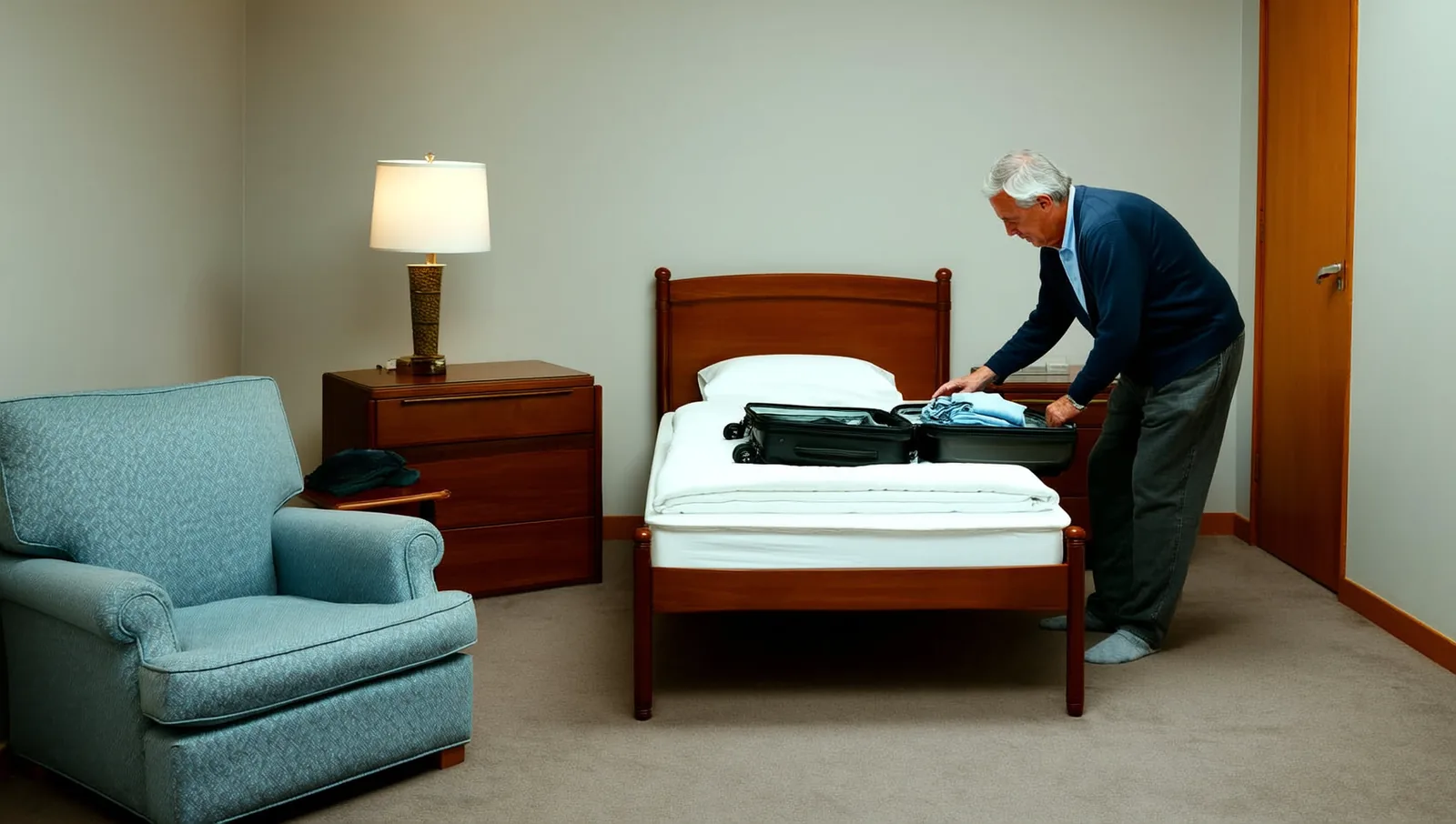
A trial or respite stay. Many assisted living communities offer short stays of a week to a month, often billed daily. A parent who has agreed to nothing can agree to two weeks while the family travels or while they recover from a procedure. The abstract fear of an institution gets replaced by an actual place with actual people, and many permanent move-ins start this way.
In-home care first. A few hours a week is a smaller ask than a move, and it generates evidence. If the hours keep climbing, the cost comparison shifts on its own, which is the honest math laid out in our master guide to aging in place versus senior living.
Adult day programs and PACE. For a parent who qualifies for nursing-home-level care but refuses to leave home, the PACE program bundles medical care, day services, therapy, and transportation under Medicare and Medicaid so many people can stay put safely. It honors the refusal rather than overriding it.
A smaller, less institutional setting. Some of the resistance is to the idea of a two-hundred-unit building with a lobby. Residential assisted living in a converted house with six to sixteen residents reads as a home to parents who reject everything else.
One caution: do not promise what you cannot fund. Families routinely assume Medicare will pay for whatever comes next, and it does not cover assisted living or long-term custodial care. Know exactly where Medicare’s coverage stops before you make reassurances you will have to withdraw.
The Triggers That Change the Calculus
Patience is the right default, but it is not unlimited. Certain events move the situation from your parent’s preference to an unsafe arrangement:
- A fall that causes injury, or repeated falls at all.
- Medication errors: doses missed, doubled, or bottles that do not add up.
- Driving that has become unsafe, especially getting lost on familiar routes.
- Wandering, leaving the stove on, or letting strangers into the house.
- Weight loss, spoiled food, unpaid bills, or utilities shut off.
- A hospital discharge where the planner says home is not an option without more support.
- The primary caregiver reaching the end of what they can physically do. Caregiver collapse is a safety event for two people, not a failure of loyalty.
Two or three of these together should prompt an urgent reassessment of care needs. At that point, move from open-ended persuasion toward a concrete plan with professional guidance and a timeline. If you are at that point, our guide to starting a senior living search sets out the first thirty days.
When the Refusal Is a Symptom, Not a Choice
This is the distinction families most often miss. Some parents refuse care because they weighed it and said no. Others cannot perceive that anything is wrong.
Anosognosia is the clinical inability to recognize one’s own impairment, and it is common in dementia. It is not denial, not stubbornness, and not something you can argue someone out of, because the part of the brain that would register the problem is the part that is damaged. A qualified clinician can evaluate it. If your parent has a dementia diagnosis and still insists nothing has changed, consider anosognosia and seek an assessment rather than assuming defiance.
The practical consequence is that the persuasion playbook stops working. You do not reason a person into an insight their brain cannot form. What works instead is redirection, offering choices within a decision already made, and changing the environment rather than the argument. If cognition is part of the picture, our guide to what to ask on a tour when dementia is involved covers what a community must be able to handle.
Scripts for the Hardest Sentences
When they say “I am not leaving this house.” Try: “I hear you, and I am not trying to take the house from you. Can we talk about what would have to be true for you to stay here safely?” This accepts the goal and moves to conditions, which is where the real negotiation lives.
When they say “I do not need help.” Try: “Maybe not. Would you be willing to let someone come two mornings a week so I can stop worrying? Do it for me, not for you.” Framing help as a gift to you rather than a deficit in them lets a proud parent accept it without losing face.
When you need to name what you are seeing. Try: “I have noticed the mail piling up, and you have had two falls since spring. I am not saying you have to move. I am saying I am frightened, and I would like us to look at options together.” Observation plus feeling, with no verdict attached.
When they refuse to discuss it at all. Try: “Okay. I will let it go today. Can we agree to talk about it again after your appointment next month?” A deferral you both agreed to beats a fight and keeps the door open.
Avoid ultimatums you will not enforce, “we have already decided,” anything beginning with “you can’t,” and arguments about whose turn it is to be right. Avoid the group ambush too. Siblings arriving en masse reads as a coup and hardens everyone.
The Narrow Path Where You Can Actually Override
Most of the time you cannot, and should not, override a parent’s decision. A competent adult is allowed to make choices their family considers unwise, including staying in a house that scares you. Elder law and geriatric practice call this the dignity of risk, and it is a real principle rather than a loophole.
Legal authority to decide for someone else comes in a few forms, and they are not interchangeable. A durable power of attorney and a healthcare proxy, signed voluntarily while your parent had capacity, may provide decision-making authority within the scope allowed by their terms and state law. A capacity assessment by an appropriately qualified clinician helps determine whether someone can understand a particular decision and its consequences. Capacity is decision-specific: a parent may lack the capacity to manage finances while retaining the capacity to choose where they live.
Guardianship or conservatorship, in which a court may remove some or many of a person’s decision-making rights, should be a last resort. It is expensive, adversarial, public, slow, and it can permanently damage a family relationship. It is warranted in a narrow set of cases, typically where there is no valid power of attorney, the parent clearly lacks capacity, and there is active harm: exploitation by a stranger or a family member, dangerous self-neglect, or a medical situation that cannot wait.
If you are anywhere near this territory, involve an elder law attorney before you act rather than after. Less restrictive interventions often exist, including supported decision-making arrangements, limited guardianship over finances only, or an adult protective services referral, and an attorney will know which your state recognizes. Nothing here is legal advice, and this is exactly where qualified counsel earns its fee. It is also worth understanding what rights your parent keeps once they are in a community, because those protections do not disappear when someone else signs the admission agreement.
When to Stop Pushing
Sometimes the right answer is to stop. If your parent is competent, aware of the risks, and choosing them, you are allowed to disagree and still respect the choice. What you can do is make the refusal safer: grab bars and a stair rail, a medical alert pendant, a daily check-in call, a lockbox for emergency access, no throw rugs, and a shortlist quietly built for the day things change.
Then say the thing worth saying out loud: “This is your call. I will keep helping you stay here as long as it is possible, and I will bring this up again if you fall or end up in the hospital.” That is not surrender. It is an agreement about the terms under which the conversation reopens, and it keeps you on the same side.

Most families do not persuade a parent in a single conversation. They lay groundwork over months, hold the relationship together, and move quickly when a trigger arrives. If you are in the long middle of that, you are not failing. Bring in a geriatric care manager or certified senior care advisor for the care picture and an elder law attorney for anything touching capacity or authority, and go gently. This is one of the hardest things families do.
Further reading (sources)
- National Institute on Aging on how to get help when a parent resists caregiving support
- National Institute on Aging for the first steps to take after a dementia diagnosis
- MarketWatch with the stay-at-home or move question facing aging retirees