The Complete Guide to Independent Living: Services, Costs, and How It Differs From Senior Apartments and 55+ Communities
Published on September 9, 2026

The Tier Families Look At First and Understand Least
Independent living is usually the first phrase an adult child types into a search bar. It is the friendliest sounding option, the cheapest one that still comes with staff and a dining room, and by a wide margin the one a parent is most likely to agree to tour. Nobody feels demoted by it.
It is also the tier where families most often buy something other than what they thought they were buying. At least three other kinds of housing use nearly identical brochure photography, and none of them are the same product. One of them provides fewer services for less money. One provides no services at all. And one looks identical on the tour but carries a six-figure check at the door. Knowing which building you are standing in changes the math by thousands of dollars a month and, more importantly, changes what happens when your parent’s health shifts.
What Independent Living Actually Is
Independent living is maintenance-free housing in a community setting, built for older adults who can manage their own daily lives. Most communities set a minimum age of 55 or 62. Residents live in private apartments, and in many communities in cottages or villas, typically with a full kitchen and in-unit laundry. The monthly fee bundles the housing with a package of services.
The defining word in the category is services, not care. Housekeeping, dining, transportation, maintenance, and an activity calendar are services. Helping someone bathe, dress, transfer out of bed, or take the right pill at the right hour is care, and independent living communities are generally neither licensed nor staffed to provide it. There is usually no nurse on duty overnight and no caregiver assigned to your parent at all. Most buildings have an emergency call system and staff on site, which is not the same thing as supervision.
That distinction is the whole ballgame. It determines the price, it determines who gets accepted, and it determines the day the community tells your family it can no longer meet your parent’s needs. If you are still deciding between care levels rather than shopping inside one, our comparison of independent living and assisted living sorts the entry point out first.
What the Monthly Fee Buys, and What It Never Buys
The bundle is fairly consistent across the country. Expect the fee to cover the apartment and most utilities, a dining plan (often one or two meals a day rather than three, sometimes a monthly dining credit), routine housekeeping and linen service, all building and grounds maintenance, scheduled transportation to appointments and shopping, the full activity and fitness calendar, and access to shared amenities such as a fitness room, library, pool, or workshop.
Housekeeping intervals vary more than families expect, so ask specifically: weekly, biweekly, and what it includes. Dining is the other place quotes diverge. A community advertising “chef-prepared dining” may be including ten meals a month, not ninety. Read the dining plan line by line before you compare two quotes that both say “meals included.”

What the fee never buys is personal care. No bathing assistance, no dressing, no transfers, no medication administration. Most communities will happily let a family bring in an outside home care agency at their own expense, and many keep a preferred-provider list. That arrangement works well for a while. It also stacks a second bill on top of the first, and once a parent needs several hours of help a day, the combined cost usually passes what assisted living would have charged in the first place.
Beyond the base fee, budget for the extras that bill separately in most buildings: a one-time community or administrative fee at move-in, a second-person fee if two people share the apartment, covered parking, personal laundry, beauty and barber services, guest meals, and premium outings.
What Independent Living Costs, and Why Nobody Can Quote You a National Price
There is no official national price for independent living, and it is worth understanding why. Nursing homes and assisted living are licensed care settings, so governments and researchers track what they cost. Independent living is market-rate housing with services attached, so nobody publishes an authoritative national median the way Medicare publishes nursing home data. The figures that circulate online mostly come from referral companies that are paid by the communities they list, which makes them marketing anchors rather than neutral measurements. Treat any single national number, including ours, with suspicion, and get written quotes from the specific buildings you are considering.
What holds true everywhere is the shape of the pricing rather than its level. Metro area matters as much as state, and a community thirty minutes outside a city core routinely prices well below one downtown. Apartment size moves the number more than families expect: a two-bedroom cottage is a different product from a studio, and marketing pages quote the studio.
The other thing that pushes the real number above the advertised one is the annual increase written into the residency agreement, which arrives every year whether or not anything about your parent’s life has changed. Our breakdown of what a renewal rate increase looks like and how to push back applies to independent living residents exactly as it does further up the continuum.
Almost all of this is private pay. Medicare covers none of it, and Medicaid does not pay independent living room and board. Families fund it from Social Security, pensions, retirement accounts, and very often proceeds from selling the house. Our guide to how families actually pay for senior living walks the full menu.
Rental or Entrance Fee: Two Ways to Pay for the Same Apartment
Independent living comes in two financial shapes, and the tour will not always make clear which one you are on.
The rental model is the common one. You pay a monthly fee, sign a lease that typically runs a year, and you can leave with notice. There is no large sum at risk, and no equity either. For most families this is the right structure, particularly when the parent is over 80 or when the health picture could change within a few years.
The entrance fee model belongs mostly to continuing care retirement communities. You pay a substantial sum up front, commonly in the six figures, and then a monthly fee on top. In exchange you secure access to higher levels of care on the same campus later. Refund provisions on that entrance fee range from nothing to around 90%, and the refund is only as sound as the operator holding it. Entrance fee communities also screen applicants medically and financially at the door, which means it is a plan you make while a parent is well, not a solution to a crisis.
The Three Lookalikes
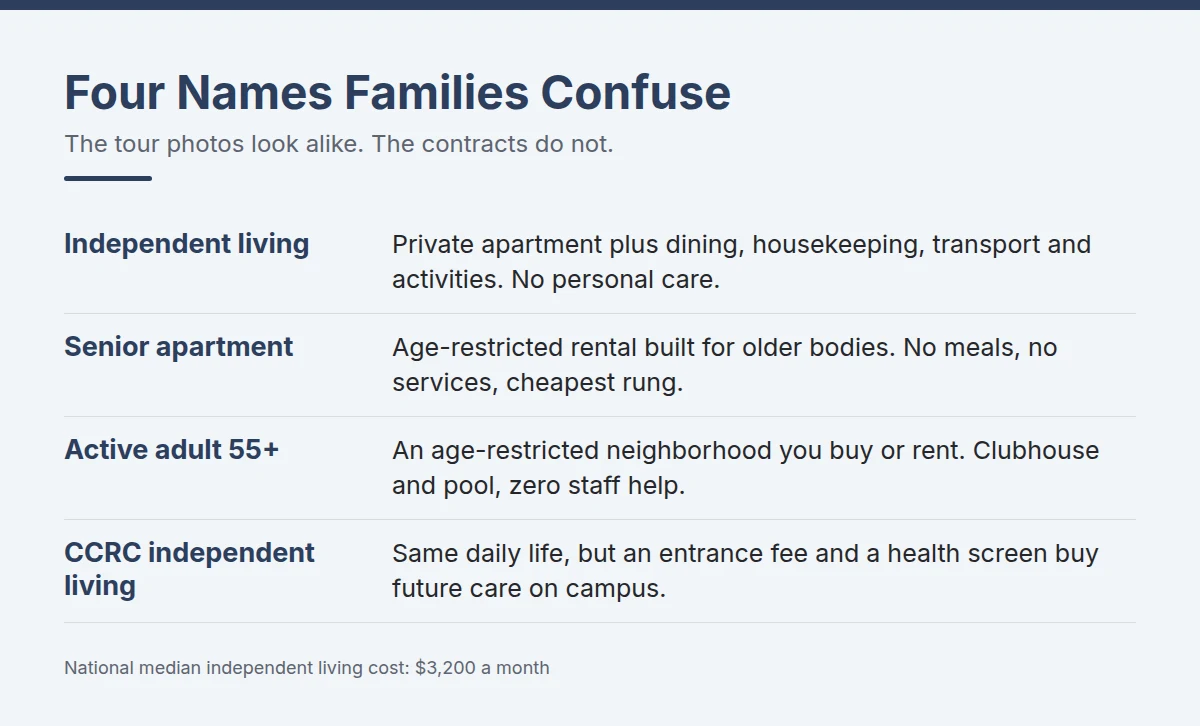
This is where most of the confusion lives. Our map of every senior housing type covers the full continuum, but these three sit close enough to independent living to be mistaken for it on a tour.

Age-restricted senior apartments are rental apartments built for older bodies: no stairs to the unit, grab bars, step-in showers, an elevator. Many run a community room and an activity calendar. What they do not include is dining, housekeeping, transportation, or care of any kind, which is exactly why they are the most affordable rung in senior housing. They come in market-rate and subsidized versions, and the subsidized ones (HUD Section 202 and similar programs) typically cap rent near 30% of adjusted income with waiting lists measured in years. If the need is housing rather than services, this is the cheaper correct answer, and the lists should be joined early.
Active adult and 55+ communities are neighborhoods, not care settings. You buy or rent a home the way you would anywhere else, with a clubhouse, pool, trails, and social clubs attached, and residency restricted by age under a federal exemption to fair housing rules. There is no dining plan, no housekeeping, and no staff who will ever help your mother with anything. Costs track the local housing market plus association dues. This is a lifestyle purchase made by healthy people in their sixties, and it is worth saying plainly that it is not a care plan.
The independent living tier inside a CCRC is the sneaky one, because it genuinely is independent living. The apartment, the dining room, and the activity calendar look and function the same. The difference is the contract underneath: an entrance fee, a medical and financial screen at admission, and a guarantee of higher care on the same campus. Families tour it alongside rental communities, compare only the monthly numbers, and miss that they are comparing a lease to a life plan.
Who It Actually Fits
Independent living is right for an older adult who handles bathing, dressing, and toileting without help, manages their own medications reliably, moves safely without hands-on assistance, and is looking to shed the burden of a house rather than to gain supervision.

It fits best when the motivation is positive. The people who thrive in independent living tend to move because they are tired of the roof and the lawn and the empty dining table, not because a hospital discharge planner told them they could not go home. Moving early, while a parent can still form friendships and learn a new building, produces better outcomes than moving late.
When Independent Living Stops Being Enough
Every independent living residency has a ceiling, and it is usually crossed gradually rather than in one event.
The medication signals come first for most families: doses missed or doubled, or a weekly organizer that is no longer being filled correctly. Then the physical ones. A fall, or the beginning of an obvious fear of falling, changes the picture immediately, as does weight loss or skipped meals even with a dining room one floor down. Watch grooming and laundry too, because bathing that has quietly become difficult is usually avoided rather than reported.
The social and cognitive signals are easier to miss. A parent who has stopped going to the activities and the dining room they used to enjoy has often withdrawn for a reason. Confusion about the date, the route back to the apartment, or a conversation repeated within the hour belongs in the same category. And there is a financial signal worth tracking: once privately paid home care climbs past roughly four hours a day, or the combined bill passes an assisted living quote, the arrangement has stopped making sense on its own terms.
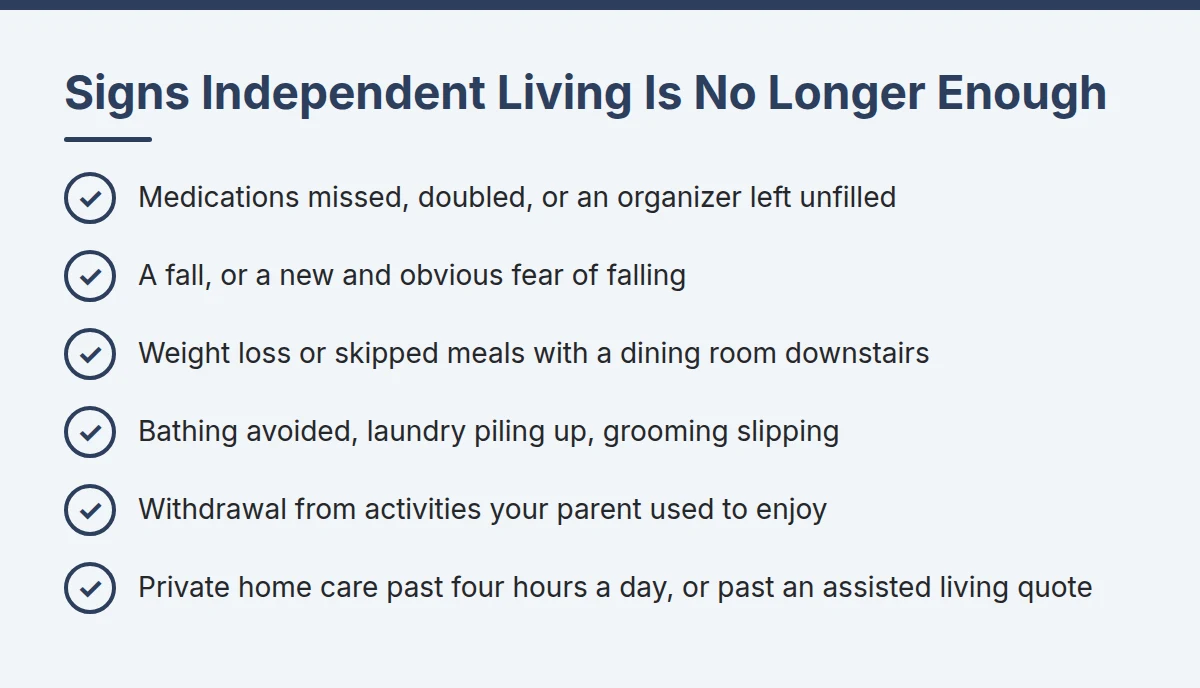
Any one of these deserves a conversation. Several together mean the setting no longer matches the need. The usual next step is assisted living, where personal care and 24-hour staffing are part of the license rather than something you contract for separately.
Move on the trend line rather than the crisis. Communities generally cannot keep a resident whose needs have passed what they are licensed to provide, and a discharge notice arriving during a hospital stay is the worst possible moment to start a search.
Costs, licensing rules, and what a community may legally do for a resident vary sharply by state, so verify every figure against local sources before deciding anything. Nothing here is legal or financial advice. A certified senior care advisor can assess what a specific community is actually staffed to deliver, and an elder law attorney should review any residency agreement or entrance fee contract before you sign it.
Further reading (sources)
- Medicare on what Medicare does and does not pay toward long-term care
- Administration for Community Living for who actually pays for long-term care in the United States
- Administration for Community Living, which services public programmes cover and which they never do
- HUD with the Section 202 programme for older adults who cannot afford market rents
- Joint Center for Housing Studies of Harvard University on housing cost burden among older adults