Medicaid and Long-Term Care: Eligibility, Spend-Down, and What It Actually Pays For
Published on September 5, 2026

The Program Almost Nobody Plans For
Most families arrive at Medicaid by subtraction. Savings go first, then the certificate of deposit, then the house, and somewhere in year three of a $6,500 monthly bill the math stops working. Medicaid is where they land, and it is the program that pays for the majority of nursing home residents in this country. Yet it is the one families understand least, because they spend their planning energy on what Medicare covers and only look at Medicaid when the runway is nearly gone.
That timing costs money. Medicaid rewards families who understood the rules five years early and penalizes the ones who tried to rearrange assets five months late. The good news is that the mechanics are learnable. They are strict, they vary by state, and they are not the mystery they get treated as.
One reframe before the numbers. Medicaid was built as a program for people with low incomes, but long-term care costs are high enough now that middle income households routinely end up eligible after paying privately for a few years. Needing Medicaid is not a sign that someone mismanaged their money. It is what a $100,000 annual nursing home bill does to an ordinary retirement.
Two Doors, and You Have to Walk Through Both
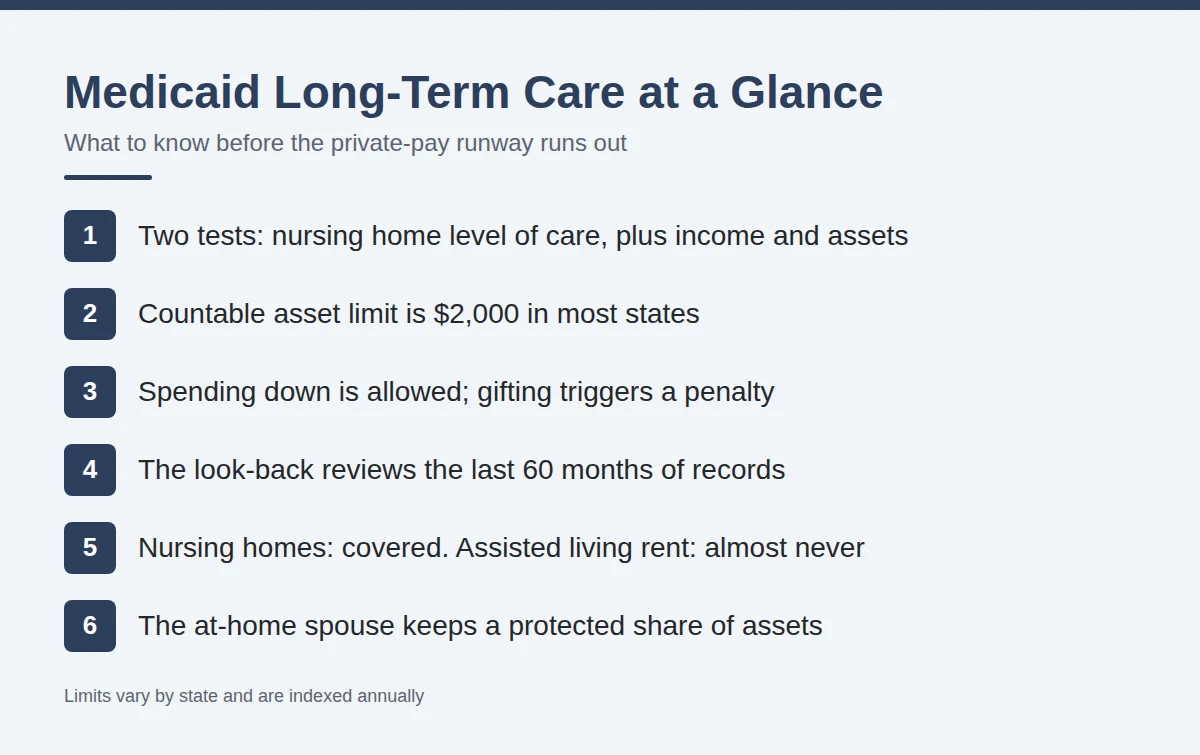
Every long-term care Medicaid application is judged on two separate tests, and failing either one is a denial.
Medical eligibility means your parent needs a nursing home level of care, as your state defines it. States assess how much help a person needs with activities of daily living: bathing, dressing, toileting, transferring, eating, and moving safely. Cognitive impairment counts too. This test applies even when the application is for care at home, which surprises people. To get Medicaid to fund help in the living room, your parent generally has to qualify for the nursing home they are trying to avoid.
Financial eligibility means income and countable assets both fall under your state’s limits. This is where nearly all the complexity lives.

The programs themselves come in three broad flavors. Nursing home Medicaid is an entitlement: qualify, and the state must pay, though you still have to find a facility that accepts Medicaid beds. Home and Community-Based Services waivers fund care at home or in community settings, and these are capped, which is why waitlists are ordinary. Aged, Blind, and Disabled Medicaid covers medical and some personal care services under state-set rules. Three doors, three different sets of numbers, one state agency.
The Numbers: Income and Asset Limits
For a single applicant, the countable asset limit is $2,000 in most states. Couples where both spouses are applying typically face $3,000 to $4,000. That figure has barely moved in decades, and it is the number that shocks families most.
Monthly income limits for long-term care Medicaid generally run somewhere between roughly $994 and $2,982 for an individual depending on the state and the program. Many states use an income cap pegged to 300 percent of the federal SSI benefit rate. In those states, income one dollar over the cap is a denial, but it is a solvable one: a Qualified Income Trust, often called a Miller trust, routes the excess income into a trust that pays the care bill and satisfies the cap. Other states let applicants spend excess income down on medical costs instead. Ask which kind of state you are in before you assume a high pension disqualifies anyone.
“Countable” is doing heavy lifting in that $2,000. These assets generally do not count:
- The primary residence, while the applicant lives there or intends to return, and while a spouse or dependent lives there
- One vehicle
- Personal belongings and household goods
- Term life insurance, and small cash value whole life policies under state limits
- An irrevocable prepaid funeral or burial contract
- Retirement accounts in some states, if they are in payout status
Federal law caps how much home equity stays protected. The 2025 floor was $730,000, with states permitted to elect a higher limit above $1 million, indexed annually. A high-value home is not automatically safe.
What “Spend-Down” Actually Means
Spend-down is the process of legitimately reducing countable assets to the limit. It is not a euphemism for hiding money, and the single most expensive mistake families make is treating it as one.

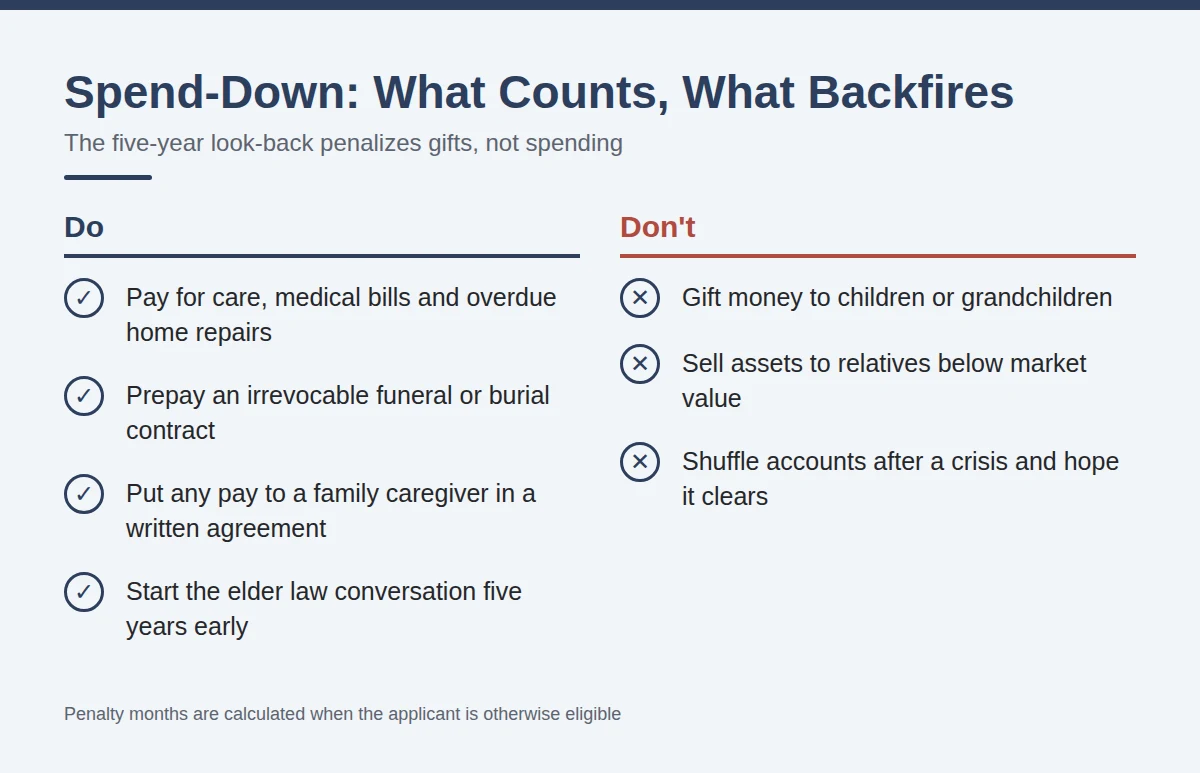
Spending is allowed. Gifting is penalized. Your parent can pay for care, pay off a mortgage or credit card, buy a more reliable car, replace a failing roof or furnace, buy hearing aids and dental work Medicare ignores, prepay a funeral, or make home modifications so a spouse can stay put. All of that converts countable assets into exempt assets or needed goods, and none of it triggers a penalty. Writing a $30,000 check to a grandchild for tuition does trigger one.
Because the private-pay years are usually the spend-down, it is worth understanding how a senior living bill actually escalates before you model how long the money lasts. Our breakdown of base rent, care levels, and the annual increase shows why the runway is almost always shorter than the first quote suggests, and our guide to every funding option in 2026 covers what sits between private pay and Medicaid.
The Five-Year Look-Back, and How the Penalty Is Calculated
When your parent applies, the state reviews the previous 60 months of financial records. Every asset given away or sold for less than fair market value during that window is a transfer subject to penalty. California is the notable exception, having eliminated its asset limit in 2024 and, with it, much of the practical bite of the look-back.
The penalty is not a fine and it is not a fixed number of months. The state divides the total value transferred by its published average monthly private-pay nursing home cost, and the result is the number of months your parent is ineligible. Transfer $90,000 in a state with a $9,000 monthly divisor and you get roughly ten months of ineligibility.
Here is the part that makes it dangerous: the penalty clock does not start when the gift was made. It starts when the applicant is otherwise eligible, in a facility, and applying. Meaning the penalty lands exactly when the money is gone and the care is needed, and somebody has to cover ten months of nursing home bills with assets that no longer exist. That is the scenario elder law attorneys are hired to prevent.
Not every transfer is penalized. Transfers to a spouse, to a blind or disabled child, or to a trust for a disabled person under 65 are generally exempt. Two housing-specific exceptions matter: the caregiver child exemption, where a home passes to an adult child who lived there and provided care that delayed institutionalization for at least two years, and the sibling exemption, for a sibling with an equity interest who lived in the home for a year. Paying a family caregiver is fine too, but only under a written personal care agreement at fair market rates, dated and signed before the care begins. An informal arrangement reads as a gift.
Protections for the Spouse Who Stays Home
Spousal impoverishment rules exist so that one spouse entering a nursing home does not leave the other destitute. They are the most generous provisions in the program and the least known.
The at-home spouse, called the community spouse, keeps a Community Spouse Resource Allowance, a protected share of the couple’s combined countable assets. In 2025 that allowance ran between a floor of about $31,584 and a ceiling of about $157,920, adjusted annually. The community spouse’s own income is not counted toward the applicant’s eligibility, and if their income falls below a Minimum Monthly Maintenance Needs Allowance, part of the institutionalized spouse’s income is diverted to them instead of going to the nursing home.
The house is generally exempt while the community spouse lives in it, and the home equity cap does not apply in that situation. If a house sale is on the table, the Medicaid consequences of selling, renting, or borrowing against it deserve a separate conversation, ideally before anything is listed.
What Medicaid Pays For, Setting by Setting
Nursing homes: comprehensively. Medicaid covers room, board, nursing care, personal care, and therapies in a Medicaid-certified facility. The resident contributes nearly all of their monthly income toward the cost, a share sometimes called patient liability, keeping only a small personal needs allowance that in many states is well under $100 a month. Not every facility accepts Medicaid, and some cap how many Medicaid beds they hold, so availability is a real constraint.

Assisted living: services only, and only sometimes. Roughly 44 states cover assisted living services in some form, and 29 use HCBS waivers to do it. What almost no state Medicaid program will pay is room and board, which is the largest line on an assisted living bill. Some states offset that through an SSI state supplement or a cap on what the community may charge a Medicaid resident, but the gap usually falls to the family. Add waiver enrollment caps and waitlists, and national advocacy groups have described Medicaid access to assisted living as real on paper and much less real in practice.
At home: often, through a waiver. HCBS waivers fund personal care, adult day programs, home-delivered meals, respite for family caregivers, transportation, and home modifications. Medicare covers none of that. For seniors eligible for both programs, a PACE program bundles Medicare and Medicaid into one coordinated benefit where it operates.
Estate Recovery: The Bill That Arrives Afterward
Federal law requires states to seek repayment of long-term care Medicaid spending from the estates of recipients who were 55 or older. In practice the house is the target, because it was exempt during life but sits in the estate at death.
Recovery is deferred while a surviving spouse is living, while a child under 21 or a blind or disabled child of any age survives, and states must offer an undue hardship waiver, commonly used where an heir has lived in and depends on the home. Some states pursue only probate assets while others reach further. This is genuinely one of the biggest state-to-state differences in the entire program, and it is the reason “keeping the house exempt” and “keeping the house in the family” are two different goals that require two different plans.
What to Do Now
If your parent has more than a couple of years of private-pay runway, the useful move is to sit with an elder law attorney while you still have options, not after the account statement gets thin. Ask three questions: what our state’s income and asset limits actually are, whether we are an income-cap state, and what our state does on estate recovery. Get your parent’s durable power of attorney reviewed at the same time, because someone will have to sign the application.
If the money is nearly gone, apply anyway and apply early. Applications take weeks to months, states will backdate coverage up to three months in many cases, and a denial can be appealed. Gather five years of bank statements, deeds, titles, insurance policies, and tax returns before you start, because the caseworker will ask for all of it.
Every figure in this guide is a national reference point, not your state’s rule, and most of them are indexed annually. Verify the current numbers for your state with your local Area Agency on Aging, your State Health Insurance Assistance Program, or a certified elder law attorney. This is the corner of senior housing where general advice is worth the least and specific advice is worth the most.
Further reading (sources)
- Medicaid.gov for how long-term services and supports are structured
- Medicaid.gov with the spousal impoverishment rules and allowances
- ASPE (HHS) covering state estate recovery obligations and their limits
- Medicare.gov on where Medicare stops and long-term care begins
- KFF for state-level data on Medicaid long-term services and supports
- Senior Housing News with the GAO finding on public spending in assisted living