Medication Management in Assisted Living: What Families Should Ask Before Move-In
Published on September 1, 2026

The One Task That Happens Every Single Day
Families tour assisted living and ask about the dining room, the activity calendar, the size of the apartment, and the monthly rate. Almost nobody asks the question that will matter most on a random Tuesday in February: who is going to hand my mother her pills, and how will anyone know if they got it wrong?
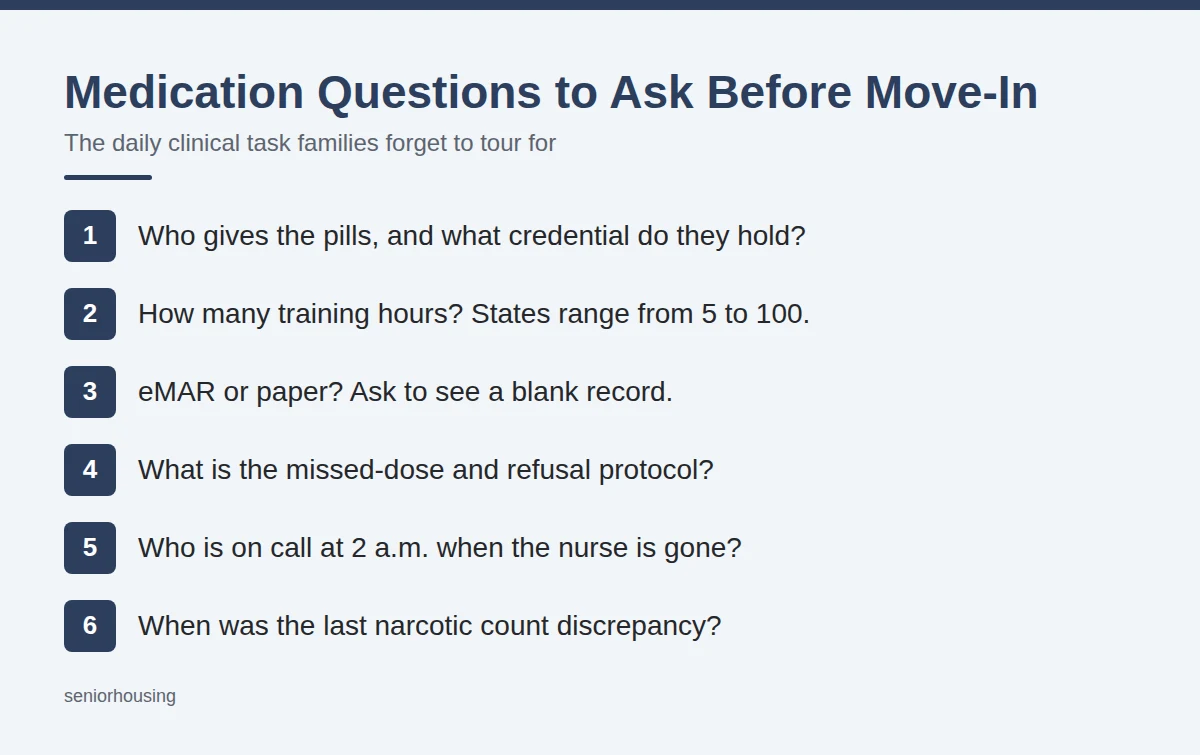
Medication administration is the most frequent clinical task in assisted living. A resident on eight prescriptions gets touched by the medication system somewhere between two and four times a day, roughly a thousand times a year. Nothing else the community does happens with that frequency or carries that much room for quiet, cumulative harm. If your parent takes a blood thinner, insulin, a heart rhythm drug, or a seizure medication, the medication system is not one feature among many. It is the feature.
The good news is that this is a knowable thing. Unlike vague promises about compassion or engagement, medication management leaves a paper trail, runs on documented protocols, and is governed by state rules you can look up. You just have to ask.
Who Actually Hands Your Parent the Pills
Start here, because the answer surprises most families. In the majority of states, the person administering medications in assisted living is not a nurse. They are an unlicensed staff member working under a delegating nurse, with a job title like medication aide, med tech, certified medication assistant, or QMAP depending on where you live.
This is legal, common, and not inherently unsafe. What varies enormously is the training standing behind that title, because assisted living has no federal license and every state writes its own rules. The spread is not small. North Carolina approves medication courses for adult care home staff that run 5, 10, or 15 hours. Nevada requires a 16-hour course. Nebraska and New Jersey both require roughly 40 hours, with New Jersey also requiring the candidate to be an active certified nurse aide and to complete supervised medication passes. Alabama requires 60 hours of theory and lab plus 40 hours of supervised clinical time. Texas sits at the top with about 100 hours of classroom instruction plus lab and clinical hours. A few states, Tennessee among them, do not permit non-nurses to administer medications in assisted living at all.
So the honest version of the tour question is not “do you have nurses?” It is three questions:
- What is the job title and credential of the person who will give my parent medications at 8 a.m. on a Sunday?
- How many hours of medication training did they complete, and who signed off that they were competent to pass meds alone?
- Which licensed nurse delegates and supervises them, how many hours a week is that nurse physically in the building, and who covers nights and weekends?
Our complete guide to assisted living covers how state licensing shapes the rest of the care model, and the same patchwork logic applies here. Two communities forty miles apart, across a state line, can be running genuinely different medication systems while using identical brochure language.
What the Error Research Actually Found
There is real observational research on this, and it is worth understanding before you either panic or relax.
The most cited study observed 4,866 medication administrations across 12 assisted living settings in Oregon, Washington, and New Jersey. Researchers recorded errors in 28.2 percent of them. That headline number sounds alarming until you read the breakdown: 70.8 percent of the errors were wrong time, meaning the dose was given outside the permitted window rather than given wrong. Strip out timing and the error rate falls to 8.2 percent, with wrong dose at 12.9 percent of errors and omitted doses at 11.1 percent. Only three errors in the entire study were judged to carry potential clinical significance. Residents in that sample averaged 13.1 medications each.

A second study observed 11 communities across South Carolina, which permits non-nurses to administer medications, and Tennessee, which does not. It found a 42 percent error rate, or 20 percent excluding timing errors. Its most useful finding for families is counterintuitive: medication aides did not commit more errors than licensed practical nurses. The higher error rates came from other unlicensed staff who were handling medications and assisting with self-administration without medication aide training. The authors concluded that everyone who touches medications should be trained to the medication aide level.
Both studies are more than a decade old, and electronic systems have spread considerably since. But the structural lesson holds. Timing slippage is the dominant error type, credential alone does not predict safety, and the real risk sits with undertrained staff quietly filling gaps. That is exactly what a family can probe on a tour.
More recent work reinforces why the routine matters. A 2025 observational study of 152 staff and resident care interactions across four Maryland assisted living communities found that interactions during supportive and ambulatory care tasks, the everyday category that medication passes fall into, were significantly more negative in tone than interactions during intimate personal care. The rushed part of the day is the part that gets impersonal, and impersonal med passes are where doses get pushed, refused, or skipped.
eMAR or Paper: Ask to See the System
Ask whether the community documents medication administration electronically or on a paper medication administration record, and then ask to look at a blank one.
An electronic MAR is not magic, but it changes the failure modes in ways that matter. It timestamps administration as it happens rather than relying on someone charting from memory at the end of a shift. It flags overdue doses in real time instead of at the next audit. It removes transcription, the step where a handwritten order gets copied onto a new sheet and a decimal point moves. Many systems add barcode scanning to confirm the right resident and the right drug.
Paper is not automatically disqualifying, particularly in small settings. Plenty of well-run residential care homes manage six residents on paper with fewer problems than a 90-unit building running mediocre software. But paper puts the entire burden on individual diligence, and diligence is exactly what erodes when a community is short-staffed. If the answer is paper, ask how often a nurse audits the MARs and what the last audit found.
Missed Doses, Refusals, and the 2 a.m. Question
Every system misses doses. What separates good communities from bad ones is what happens next, so ask for the protocol in specifics.
If a dose is missed, who is notified and how fast? Does the family hear about it, or only the physician? What is the community’s threshold for calling the prescriber versus documenting and moving on? If your parent refuses a medication, which residents with dementia frequently do, what does staff do? Persistent refusal handled by walking away is a documentation problem dressed up as respecting autonomy, and it is one of the specific reasons families touring for a parent with cognitive decline should read our guide on what to ask when assisted living is really memory care.
Then ask about after hours. Many communities have nursing coverage during business hours and a med tech alone overnight with a phone number to call. That is a defensible model if the escalation path is clear. It is a serious gap if nobody can articulate who picks up the phone at 2 a.m. Research on staffing and quality in care homes consistently points to the same predictors: managerial and staff stability, consistent assignment so staff genuinely know residents, training that goes beyond orientation, and enough autonomy for frontline staff to act. Turnover is a medication safety question, not just an HR statistic. Ask for it.
Controlled Substances Deserve Their Own Question
If your parent takes an opioid for arthritis pain, a benzodiazepine for anxiety, or a controlled sleep medication, ask about narcotic control directly. Accepted practice in assisted living includes shift-to-shift counts at the start and end of every shift, a bound narcotic logbook recording resident name, drug, dose, date, and time, double-lock storage accessible only to authorized staff, and a second staff signature witnessing administration where staffing permits.

The question that gets an honest answer is not “do you count narcotics?” Everyone says yes. Ask instead: when was your last count discrepancy, and what did you do about it? A community that says it has never had one is either very small, very new, or not looking. A director who describes a real discrepancy, the investigation, and the outcome is showing you a functioning system.
What the New Medication Technology Actually Does
Medication software is having a moment in senior living, and it is worth knowing what these tools do and do not solve. In December 2025, a California operator running 61 small-home assisted living and memory care communities launched a medication order management system through its in-house innovation unit. The system uses a large language model to read and interpret incoming medication orders from physicians, save them automatically, route them internally, and push notifications to a resident’s family contacts.
That is genuinely useful, because order transcription is a real failure point and families are usually the last to learn a prescription changed. But read the scope carefully. It is an order management system, not an electronic MAR. It does not administer anything and does not replace the med tech at the cart or the pharmacist reviewing the regimen. No error reduction figures have been published for it.
That distinction is the one to carry into every tour where technology comes up. Ask what the software actually does: intake orders, document administration, alert on missed doses, or all three. Ask what happens when it goes down. Technology moves the error from the handwriting to the interface, which is progress, but it does not remove the human at the point of care.
Bring the Real Medication List to the Assessment
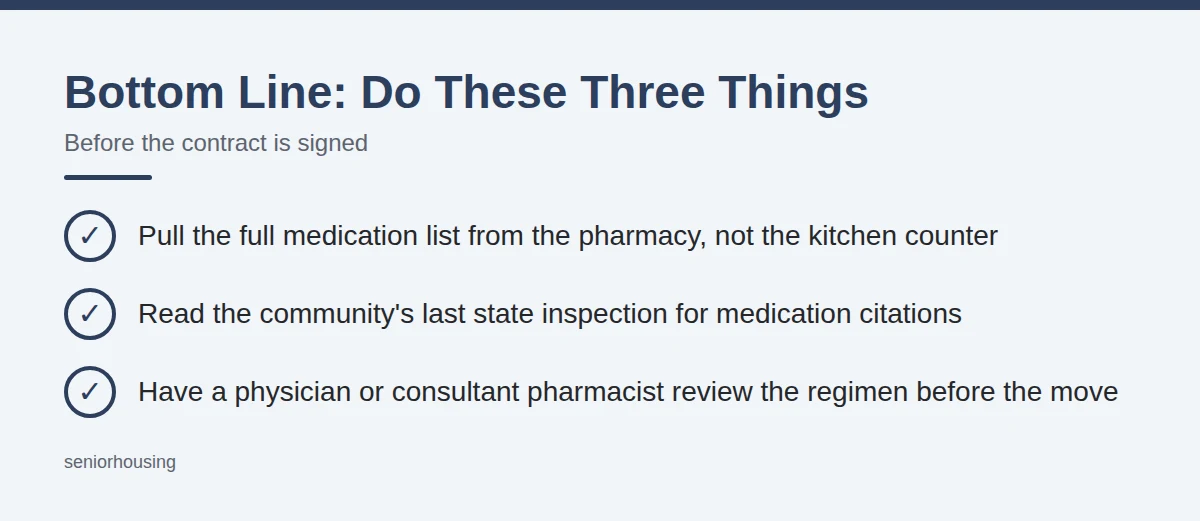
Before the pre-move-in assessment, get an accurate list from the pharmacy rather than the kitchen counter, including over the counter drugs, supplements, eye drops, and inhalers. Then ask the community three things about your parent’s specific regimen.
First, can they handle it at all? Injections, insulin sliding scales, blood thinners requiring monitoring, oxygen, and crushed medications through a tube each sit differently under different state rules, and some are outside what unlicensed staff may do in your state. Second, what does it cost? Medication management is frequently a separate line item or a care tier trigger, and a parent on twelve medications may land two pricing tiers above a parent on four. Third, is a consultant pharmacist reviewing the regimen? Polypharmacy is defined as five or more medications and is associated with falls, adverse reactions, and hospitalization in older adults. A move is one of the few natural moments to get the list reviewed against the American Geriatrics Society Beers Criteria and pruned.

Communities differ enormously in what they can clinically absorb, which is part of the broader question of which type of senior housing actually fits your parent’s needs.
Red Flags, and What to Do With the Answers
A few answers should slow you down. Vagueness about who administers medications and what credential they hold. An inability to name the delegating nurse. No clear missed-dose protocol. Reluctance to show you a blank MAR. Nobody who can describe a real controlled-substance discrepancy. Staff turnover the director will not quantify. And the softest but most telling one: a marketing director who answers every medication question by redirecting to how caring the team is.
Ask for the community’s most recent state inspection report and read the medication-related citations. Every state that licenses assisted living inspects it, and medication deficiencies are among the most commonly cited. A community with one corrected citation is normal. A pattern across multiple surveys is a system, not an accident. If problems emerge after move-in, your recourse runs through the process laid out in our guide to resident rights and complaint procedures.
None of this requires you to become a clinician. It requires you to treat the medication system as the daily, repeated, high-stakes operation it is, and to ask about it with the same seriousness you would bring to the monthly rate. Because costs and regulations vary sharply by state, and because a parent on high-risk medications raises genuine clinical and legal questions, families in this position should consider working with a certified senior care advisor, and should ask the prescribing physician or a consultant pharmacist to review the full regimen before the move rather than after.
Further reading (sources)
- Journal of the American Geriatrics Society on the types and prevalence of medication administration errors observed in assisted living
- Zimmerman et al. for why medication aides did not out-error licensed practical nurses
- Journal of Nursing Care Quality with how care interaction quality drops during routine supportive tasks
- NIHR StaRQ study on what staffing stability and skill mix do to care quality
- Senior Housing News for a California operator’s tech hub and medication platform launch
- NCAL for the state-by-state assisted living regulatory summaries
- Advanced Health Institute on narcotic count and storage practice in assisted living
- Cleveland Clinic with a plain explanation of the Beers Criteria for older adults