The Paperwork Before a Senior Move: Power of Attorney, Advance Directives, and When to Call a Lawyer
Published on September 11, 2026

The Phone Call Where Families Find Out
You call the community to ask how your mother did overnight after her fall, and the nurse cannot tell you. Not will not. Cannot. You are her daughter, you found the place, you toured it, you are helping pay the bill, and in the eyes of federal privacy law you are a stranger to her medical record.
That call is how most families discover the paperwork problem, and by then it is an emergency rather than an errand. The same gap shows up in slower, more expensive ways: a bank that refuses to let an adult child move money because the power of attorney is twelve years old, a Medicaid application that stalls for months because nobody can produce five years of statements for an account only the parent could access, a hospital asking what your father would have wanted while everyone in the waiting room guesses.
None of this requires a large legal budget. Most of it requires a stack of ordinary documents, signed while your parent clearly has the capacity to sign them, and a clear sense of which piece does which job. This guide covers the stack, what each document does and does not permit, and the shorter list of situations where you genuinely need an elder law attorney rather than a form.
Two Kinds of Authority, and Why One Does Not Cover the Other
The most common and costliest misconception in this area is that “power of attorney” is a single thing. It is two separate authorities, usually created by two separate documents, and holding one gives you nothing under the other.
A financial power of attorney lets an agent handle money and property: bank accounts, bills, taxes, insurance, real estate. A healthcare power of attorney, also called a healthcare proxy or medical power of attorney, lets an agent make medical decisions when a parent cannot. A daughter with a beautifully drafted financial POA still cannot consent to surgery. A son named as healthcare agent still cannot sign the residency agreement or write the check.
Both share one hard requirement: your parent has to have the mental capacity to sign them. Capacity is decision-specific and it is assessed at the moment of signing, which is why the honest advice is always the same. Do this early, while it is hypothetical and nobody’s independence is on the table. Once capacity is genuinely gone, the only remaining route is a court, and that route is slow, public, and expensive.
The Financial Power of Attorney
Ask for a durable financial power of attorney. Durable means the authority survives your parent’s incapacity, which is the entire point. A non-durable POA evaporates exactly when it becomes necessary.
Some families choose a springing POA, which takes effect only when a physician certifies incapacity. It sounds safer and it often creates delay, because someone has to obtain that certification before a bank will act. Many elder law attorneys prefer a durable POA that is effective immediately and held by a trusted agent, on the theory that the person you would not trust with immediate authority is the wrong agent regardless.
What a financial POA generally permits, depending on the powers written into it: banking, paying the community’s monthly invoice, filing taxes, dealing with insurers, applying for Medicaid or VA benefits, and, if the document says so explicitly, selling the house.
What it does not permit is just as important. It does not give medical decision authority. It does not let an agent rewrite a will. It does not override a parent who still has capacity and disagrees. And it ends at death, when authority passes to the executor named in the will.
Two practical traps. First, banks and brokerages routinely balk at POAs they consider stale or too generic, and some insist on their own institutional form. Walk the signed document into every institution your parent uses while your parent is still able to sort out an objection. Second, powers that matter later, such as the authority to make gifts or fund a trust, have to be granted expressly. A generic form usually omits them, and that omission can close doors during Medicaid planning years later.
The Healthcare Power of Attorney and the Advance Directive
The healthcare side usually comes as one packet with two parts. The healthcare power of attorney names the person who speaks for your parent. The living will states what your parent wants regarding life-sustaining treatment: ventilators, feeding tubes, CPR, dialysis, comfort care. Together they are commonly called an advance directive.
An advance directive is a planning document, not a medical order. It speaks in future conditional terms, it applies whenever the person cannot speak for themselves, and every adult should have one regardless of health. Name a successor agent, because first choices get sick, travel, and predecease. And have the conversation that goes with the form, because an agent who knows what your parent actually values will make better calls than one reading a checklist in a hallway at 2 a.m.

POLST Is the Other Document, and It Is Not the Same Thing
A POLST (Portable Medical Orders, known in some states as MOLST, POST, or MOST) is a medical order signed by a clinician. That distinction is the whole story. Paramedics arriving at a community at midnight are not going to read and interpret a living will, but they will follow a POLST, because it is an actionable order in the same way a prescription is.
The other differences follow from that. An advance directive is for every adult; a POLST is for people who are seriously ill or frail enough that a clinician would not be surprised if they died within the next year. An advance directive names an agent; a POLST does not. A POLST travels with the patient between home, hospital, and community, which is why it is usually printed on brightly colored paper and posted where responders will see it.
They are companions, not substitutes. Many communities ask for both at move-in, and a POLST should be revisited whenever the clinical picture changes. If your parent is approaching that stage, our guide to hospice in assisted living, nursing homes, and at home covers how these orders play out in practice.
The HIPAA Authorization Nobody Remembers
Back to the nurse who could not tell you anything. A healthcare POA generally gives your agent access to medical information, but in many arrangements that authority is tied to the moment your parent can no longer decide. Meanwhile your parent is perfectly competent, fully willing for you to be involved, and you still cannot get a callback from the cardiologist.
A HIPAA authorization solves this. It is a short, separate document in which your parent names the people who may receive their health information, starting now. It does not transfer any decision-making power, which is precisely why it is easy to sign: your parent gives up no control at all.
Sign one at every provider. The primary care physician, each specialist, the hospital system’s patient portal, the pharmacy, and the senior living community itself all keep separate records and separate release forms. This is the single highest-value hour of paperwork a family can do, and it is the piece most often skipped.

Wills and Trusts Are Estate Documents, Not Move-In Documents
Families sometimes arrive with a will and assume the legal work is done. A will does nothing while your parent is alive. It directs what happens after death and has no bearing on who signs an admission agreement or talks to a doctor.
A revocable living trust is more useful during life. Assets held in it can be managed by a successor trustee if your parent becomes incapacitated, and it keeps the estate out of probate. What it does not do is shield assets from Medicaid, because the person who can revoke a trust still owns what is in it. Only an irrevocable trust does that. It is genuinely attorney territory, and funding one starts the penalty clock described below. Check beneficiary designations at the same time, since retirement accounts and life insurance pass by designation and ignore the will entirely.
What the Admissions Office Actually Asks For
Beyond the legal stack, communities have their own list. It varies by state and by care level, but expect to produce most of the following:
- Government photo ID, Social Security card, and Medicare, Medicaid, or insurance cards
- A physician’s report or health assessment, often on a state-specific form, plus recent tuberculosis screening
- A current medication list from the prescribing physician or pharmacy
- Copies of both powers of attorney, the advance directive, and a POLST or DNR order if one exists
- Financial disclosure showing the ability to pay, and sometimes proof of long-term care insurance
- Emergency contacts and the community’s own release and consent forms

Read the residency agreement itself with equal care, especially who is signing and in what capacity. Signing “as agent under power of attorney” is different from signing as a personal guarantor of the bill, and families get that wrong. Our guide to contracts, protections, and recourse in senior living walks through the clauses worth arguing about. Even a move into independent living, where no personal care is provided, comes with a residency agreement and emergency contact forms that assume somebody holds authority.
What You Can Handle, and What Needs an Attorney
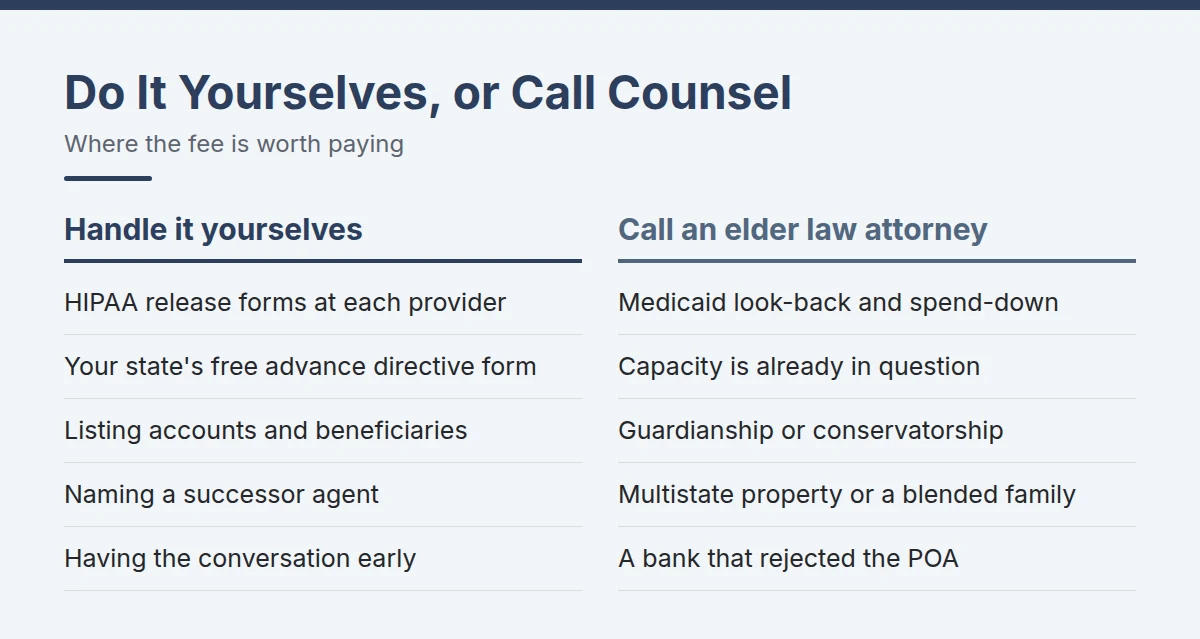
Plenty of this is a family project. HIPAA authorizations are usually one-page provider forms. Most states publish a free statutory advance directive, and many hospitals and Area Agencies on Aging will help complete one. Gathering documents, listing accounts, confirming beneficiaries, and having the conversation about what your parent wants are all things no lawyer needs to bill for.
Four situations change that calculus, and in each one the cost of doing it yourself dwarfs the fee.
Medicaid look-back planning. Medicaid reviews the previous 60 months of financial records in most states, and assets given away inside that window trigger a penalty period. The cruelty of the design is the timing: the penalty lands when the money is already gone and the care is already needed. If there is any chance Medicaid is in your parent’s future, read our guide to eligibility, spend-down, and the look-back, then sit with counsel while you still have options rather than after the account statement gets thin.
Capacity is already in question. If your parent cannot understand the document they are being asked to sign, a POA signed today may be challenged and voided later. An attorney knows how to document capacity contemporaneously, or to tell you honestly that the window has closed.
Guardianship or conservatorship. When there is no valid POA, capacity is clearly gone, and there is active harm such as financial exploitation or dangerous self-neglect, a court may be the only route. It is adversarial, public, slow, and hard on a family. Less restrictive alternatives often exist, and an attorney will know which your state recognizes. Our guide to what to do when a parent refuses to move covers where that line sits.
Complexity of any kind. Property in more than one state, a blended family, siblings who do not agree, a family business or farm, a special needs adult child, or a second marriage with children from the first. Also call counsel if a bank has already rejected the POA, because fixing that is faster with a lawyer’s letter than with a fourth visit to the branch.
Do It Before You Need It
The families who move a parent calmly are almost never the ones who were better at paperwork. They are the ones who did it a year or three early, when the conversation was about hypotheticals and everyone still had the luxury of disagreeing for a while.
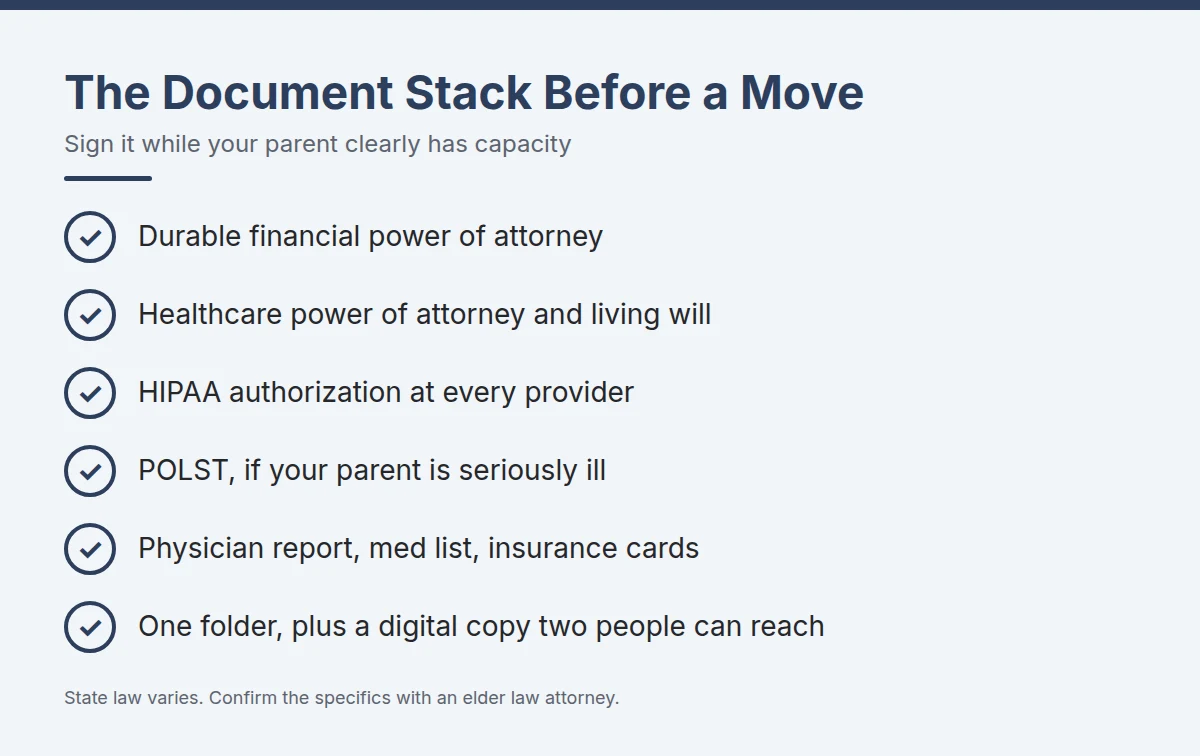
If you do nothing else this month, do these four things: confirm a durable financial POA exists and is recent, confirm a healthcare POA and advance directive exist and name a successor agent, sign HIPAA authorizations at every provider, and put the whole set in one folder with a digital copy that two people can reach.
Nothing here is legal advice, and it is not meant to substitute for it. State law varies considerably on every document described above, and this is the corner of senior housing where general guidance is worth the least and a qualified elder law attorney is worth the most. Use this as the map, then bring the specifics to someone licensed where your parent lives.
Further reading (sources)
- National Institute on Aging on the legal and financial steps that follow a dementia diagnosis
- National Institute on Aging with what advance care planning and advance directives actually cover
- National POLST on how portable medical orders differ from an advance directive
- U.S. Department of Health and Human Services for your parent’s privacy rights and who may receive their records
- Consumer Financial Protection Bureau with the duties that come with managing someone else’s money
- Alzheimer’s Association covering the financial and legal planning documents families need
- Eldercare Locator for finding an Area Agency on Aging that can help with forms