Senior Living for Couples: What Happens When One Spouse Needs Care and the Other Does Not
Published on September 13, 2026
The Couple Every Guide Forgets
Almost everything written about senior living assumes a single resident. One parent, one apartment, one care assessment, one monthly bill. Walk into a community and the brochure the sales director hands you is built around one person.
That is not how most couples arrive. A husband and wife in their eighties have usually aged at different speeds. One of them is still driving, still handling the checkbook, still walking the dog most mornings. The other has had two falls this year, or is eighteen months into a dementia diagnosis. They do not need the same thing, and they do not want to live apart.
This is one of the most common situations in the entire field and one of the least well covered. The reassuring part is that the industry has real structures for it. The complication is that those structures price, contract, and physically arrange a couple in very different ways, and the differences tend to surface only after something has been signed.
Three Ways a Community Handles a Mismatched Couple
One apartment, two care plans. Most assisted living communities will house a couple in a single one-bedroom or two-bedroom apartment and assess each spouse separately. The independent spouse pays a second-person fee covering occupancy and meals. The spouse who needs help gets a written care plan and a care fee on top of it. Under this arrangement the well spouse is a resident, not staff, and that distinction is the whole point: the community owns the care, so a wife is not the person getting her husband to the bathroom at three in the morning.
One campus, two addresses. Continuing care retirement communities, also called life plan communities, run independent living, assisted living, memory care, and skilled nursing on a single property. A couple can share an apartment in independent living until one spouse outgrows it, then that spouse moves to the assisted living or memory care building while the other stays put. They still eat together and share the same campus, and nobody has to get in a car to visit. Our map of every senior housing type lays out how those tiers differ.
Two separate communities. This is the outcome families most want to avoid and the one they most often back into, usually because a crisis forced a placement before anyone had researched anything. The healthy spouse stays in the house or in an independent living building across town while the other lands in whichever memory care community had an open bed. Sometimes it genuinely is the right answer, when the care need is specialized and nothing nearby offers it on one campus. It should be a decision, though, not an accident.
All three are policies rather than laws, and they vary building to building. Two communities on the same street under the same corporate brand can answer the couples question differently, so ask each one directly instead of assuming the category settles it.
What the Second Person Actually Costs
The pricing here is not intuitive, and the mistake families make is assuming a couple pays double.
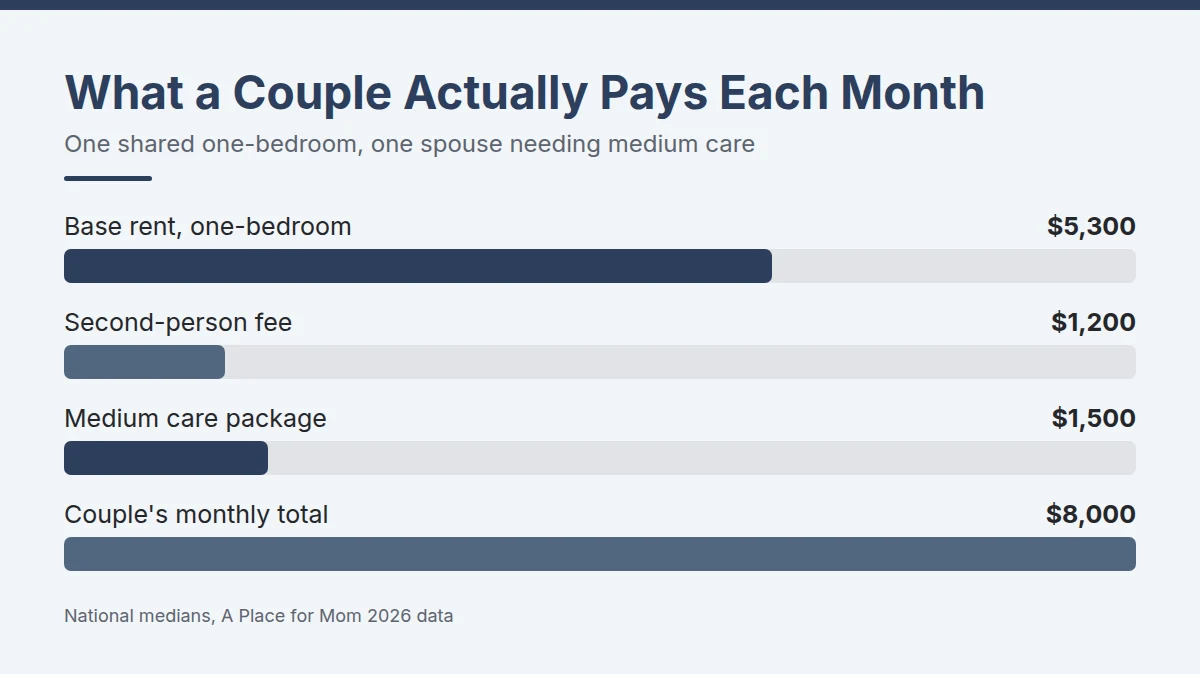
They do not. Base rent prices the apartment, so two people sharing a one-bedroom pay one rent. On top of that the community adds a second-person fee, which nationally lands near $1,200 a month and typically falls somewhere between $500 and $1,800. That fee buys the second resident’s meals, occupancy, and access to community services. It does not buy care.
Care is assessed and billed per person. If one spouse needs medication management and help dressing while the other needs nothing, the invoice reads: base rent, plus the second-person fee, plus one care fee. Working from typical nationwide figures, a one-bedroom near $5,300, a second-person fee of $1,200, and a medium care package at roughly $1,500 puts a couple around $8,000 a month. Swap in a high-needs care package and it is closer to $9,200. Our guide to how senior living pricing actually works unpacks each of those layers.
Two things are worth pinning down in writing before anyone signs. First, ask whether the second-person fee stays flat if that spouse later develops care needs of their own, because in most contracts a second care assessment simply gets stacked on top. Second, ask exactly what happens to the fee if the second person moves to another level of care or dies. That second question turns out to be the most expensive one in the document.
When One Spouse Moves Up a Level
The transition that breaks a couple’s budget is usually not assisted living. It is the day the spouse with dementia needs memory care.
Memory care is a separate building or a secured wing, carries its own license conditions in most states, runs higher staffing ratios, and prices accordingly. Nationally, memory care typically runs on the order of a fifth to a quarter more than assisted living, for what is often less square footage. When one spouse transfers in, the couple generally stops being one household on the invoice and becomes two. The well spouse keeps paying for the apartment. The other now carries a memory care rate. A couple paying about $8,000 together can find themselves paying $12,000 across two units in the same community in the same month.
Ask three questions well before that day rather than during it. Does the community guarantee a memory care bed to an existing resident, or does your spouse join the same waitlist as an outside applicant? Does the remaining spouse have the right to downsize to a smaller apartment at that point, on what notice, and at what rate? And does the second-person fee come off the bill once that spouse is billed separately, or does the couple effectively pay it twice? Communities answer all three differently and very few volunteer the answers. If dementia is already in the picture, our guide to choosing a memory care community covers what to look for in the building itself.
Medicaid and the Rule That Protects the Spouse at Home
Two people paying privately burn through savings roughly twice as fast, so the Medicaid conversation reaches couples sooner than it reaches single residents. The fear that arrives with it is specific and entirely reasonable: if one spouse needs Medicaid, does the other end up with nothing?
No. Federal spousal impoverishment rules exist for exactly this situation. When one spouse enters a nursing home or another Medicaid-funded care setting, the spouse staying in the community keeps a protected share of the couple’s countable assets, known as the Community Spouse Resource Allowance. For 2026 the federal ceiling is $162,660 and the floor sits near $32,532, with each state choosing its own figure inside that band. The community spouse’s own income is not counted toward the applicant’s eligibility at all. If that income falls below the Minimum Monthly Maintenance Needs Allowance, part of the institutionalized spouse’s income gets diverted to the spouse at home rather than to the facility, and the 2026 maximum for that allowance is $4,066.50 a month. The house is generally exempt while the community spouse lives in it.
Two cautions belong with those numbers. The protections are strongest for nursing home care; Medicaid coverage of assisted living runs through state waivers and almost never covers room and board, which is the largest line on the bill. And every figure above is a federal reference point that states adjust, so a couple comfortably protected in one state may face a different calculation in another. Our guides to Medicaid eligibility and spend-down and to what breaks when senior care crosses a state line cover both in depth. This is the corner of senior housing where an elder law attorney earns the fee several times over, and the moment to call one is before assets move, not after.
What Happens When One of Them Dies
A meaningful share of couples who move in together will face this within a few years, and the contract language is far easier to read while both spouses are well.
In a rental community the practical questions are narrow. How quickly does the second-person fee come off the bill? May the surviving spouse transfer to a smaller apartment, at what rent, and with how much notice? Is there a period during which the community will hold the larger unit? Some agreements drop the fee the following month. Others run it to the end of a 30 or 60 day notice period, which is a real cost at a terrible time.
CCRC entrance fee contracts are more tangled, because a large sum is already sitting in the building. Refund terms, whether the agreement continues for the survivor at the same monthly rate, and whether that survivor can move to a smaller unit without triggering a new entrance fee are all contract-specific. If an entrance fee is anywhere in the deal, that document needs an attorney’s eyes before signing rather than after a death.
What to Ask on the Tour
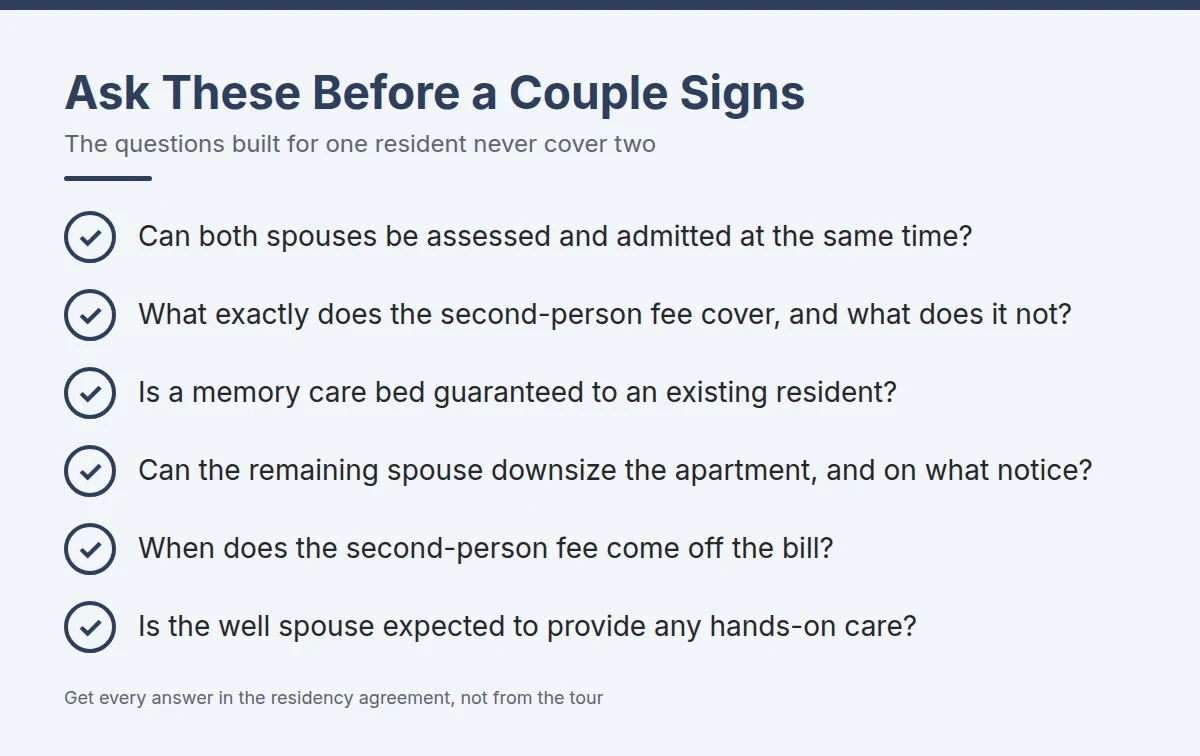
Bring the couples questions to the first tour, not the third. Can both spouses be assessed and admitted at the same time? Has this community ever housed a couple where one spouse was in memory care, and how did it actually work? What is the second-person fee and precisely what does it cover? Is the well spouse expected to provide any hands-on care (the answer should be no)? What triggers a transfer between levels, and who makes that call, the family or the community? Can an apartment be held or downsized during a transition?

Then ask about the thing nobody prices: the well spouse who has been the caregiver for years and has no idea how to stop. The better communities plan for that person on purpose, with programming of their own, their own friendships, and a spousal support group that meets whether or not anyone is in crisis. A couple who move in together and then lose each other to separate schedules on the same campus have not really been kept together.
None of this is legal or financial advice, and every dollar figure here varies by state and by community. Before committing, sit down with a certified senior care advisor about the housing and an elder law attorney about the money, particularly if Medicaid or a CCRC entrance fee is anywhere in the picture.
Further reading (sources)
- National Institute on Aging on what assisted living includes and how extra services are priced
- National Institute on Aging for what does and does not pay for long-term care
- Medicaid.gov covering the spousal impoverishment protections
- Centers for Medicare & Medicaid Services with the 2026 spousal impoverishment and resource standards
- Eldercare Locator for reaching the Area Agency on Aging that covers your county