Types of Senior Housing Explained: From 55+ Communities to Skilled Nursing
Published on August 30, 2026

Nobody Hands You the Glossary
Most families arrive at this subject in a hurry and without the vocabulary. A doctor says your father needs “more support.” A brochure promises “a vibrant lifestyle with a full continuum of care.” A cousin insists you should “just look at a home.” None of those phrases means anything specific, and by the time you have toured three places you may still not know whether you saw independent living, assisted living, or something in between.
The confusion is not your fault. Senior housing has no single national vocabulary. Some of these labels are legal licensing categories, some are marketing terms, and a few are both, depending on which state you are standing in. What one state calls assisted living, another calls a residential care facility or a personal care home. Two buildings with nearly identical signs out front can hold entirely different licenses and be permitted to deliver entirely different care.
This guide is the map. Below is every major type of senior housing in the United States, what each one actually provides, who it fits, roughly what it costs, and where to read further on our site. Start here, then go deep on the one or two that match your parent.
The Question Underneath Every Label
Strip away the branding and there are really only two variables that separate these options.
The first is how much hands-on help a resident needs, from none at all to round-the-clock nursing. The second is whether the setting is licensed to deliver care, which determines what staff are legally allowed to do for your parent. A luxury 55+ community with a golf course cannot legally help your mother into the shower. A plain brick care home with twelve residents can.
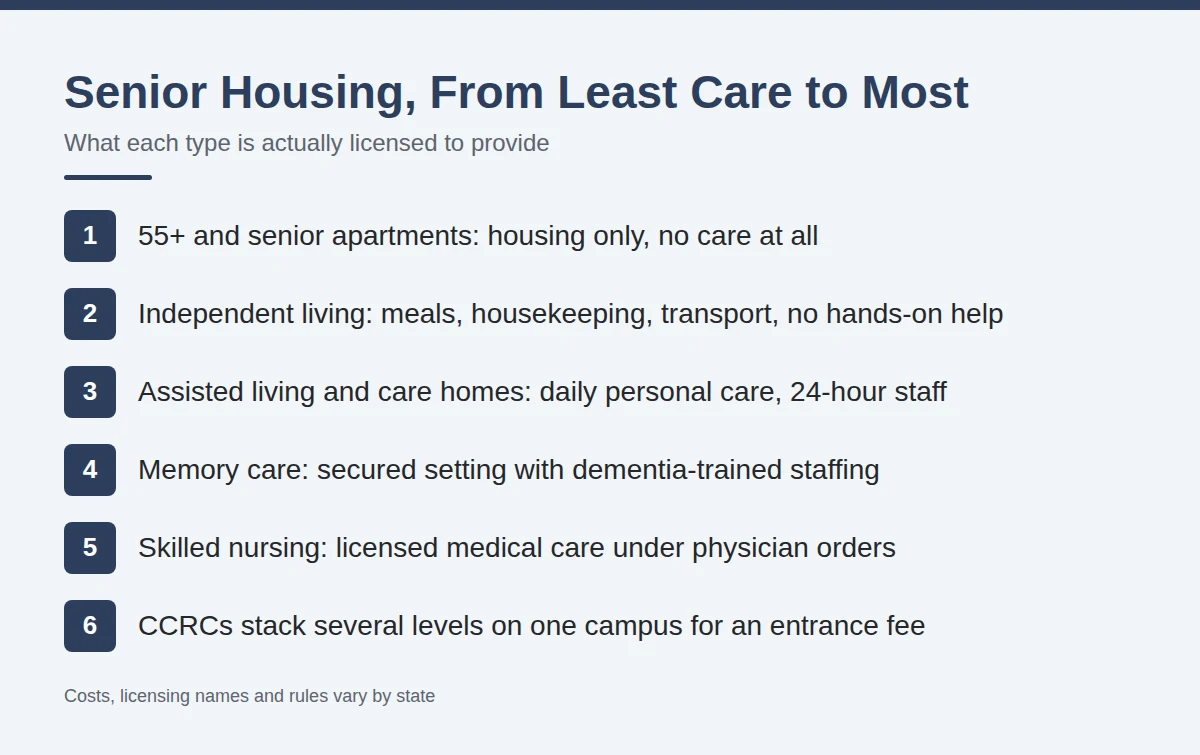
Everything that follows is arranged along that first axis, from the lowest level of care to the highest. Keep the second one in mind as you read, because it is the difference between a place that can keep your parent and a place that will eventually have to ask them to leave.
Housing Without Care: 55+ Communities and Senior Apartments
Active adult and 55+ communities are neighborhoods, not care settings. You buy or rent a house, condo, or townhome the way you would anywhere else, and the community restricts residency by age under a federal exemption to fair housing rules. What you get is a clubhouse, a pool, walking trails, organized social clubs, and neighbors in the same stage of life. What you do not get is a single service: no meals, no housekeeping, no help of any kind. Costs track the local housing market plus association dues. This is a lifestyle decision made by healthy people in their sixties, and it is worth being honest with yourself that it is not a care plan.
Senior apartments are age-restricted rental apartments built with older bodies in mind: no stairs to the unit, grab bars, step-in showers, wider doorways, an elevator. Many run an activity calendar and a community room. None provide personal care or meal plans, which is exactly why they are the most affordable option in senior living. They come in two versions. Market-rate senior apartments rent at ordinary local rates. Subsidized ones, funded through programs like HUD Section 202, typically cap rent at around 30% of a household’s adjusted income, and the waiting lists in most cities run for years rather than months. If your parent’s income is modest and the need is housing rather than care, get on those lists early.
Independent Living: Services, Not Care
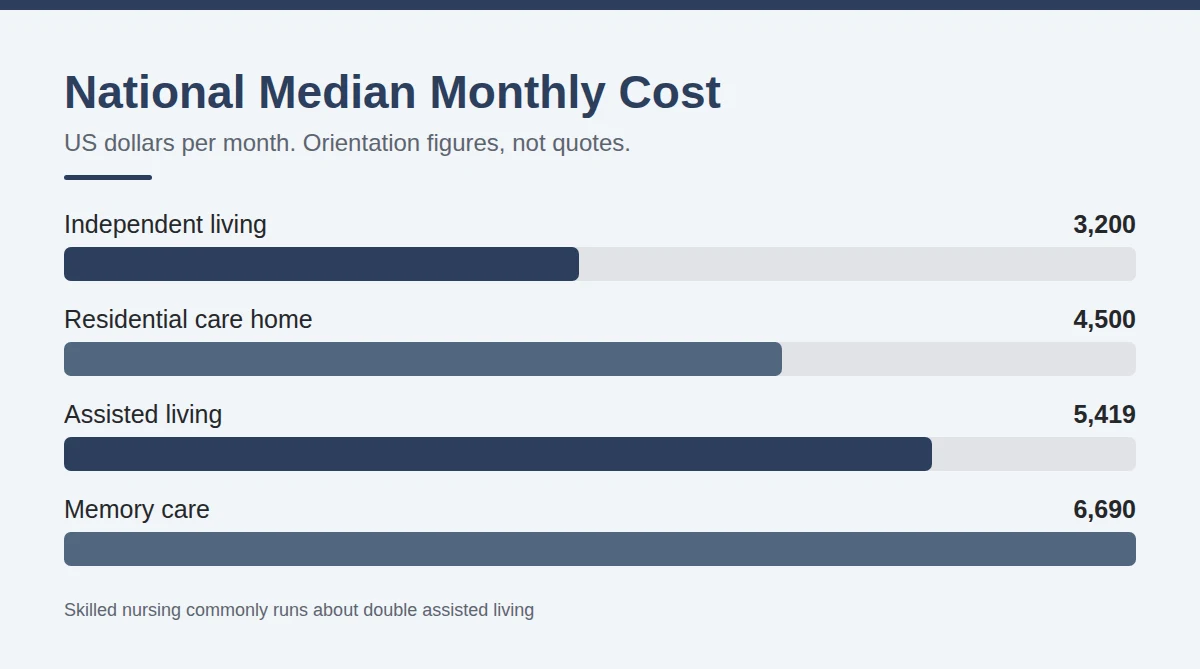
Independent living is maintenance-free housing in a community setting, generally with a minimum age of 55. The monthly fee bundles the apartment or cottage with housekeeping, scheduled transportation, building maintenance, a dining plan, a full activity calendar, and often concierge services. The national median runs about $3,200 a month.
Notice what is missing from that list. Independent living is a services product, not a care product. Staff do not help with bathing, dressing, toileting, or transfers, and most communities do not manage medications. If a resident’s needs grow, many will allow a family to bring in an outside home care agency at their own expense, which works well for a while and gets expensive quickly.

The fit is a parent who is safe on their own but isolated, tired of a house that has become a burden, or eating badly because cooking for one is miserable. Our comparison of independent living and assisted living is the piece to read if you are deciding between those two, and our look at the amenities that actually shape daily life is worth a skim before you let a lobby impress you.
Assisted Living: The Broad Middle
Assisted living adds personal care to that same apartment-style housing, plus staff on site 24 hours a day. Aides help with the activities of daily living (bathing, dressing, grooming, toileting, transferring, eating), medication management is nearly always included, and three meals a day come with the rent. The national median is roughly $5,419 a month, but almost nobody pays exactly that, because most communities price in two layers: a base rent for the apartment and shared services, plus a care fee that climbs with your parent’s assessed needs.
There is no federal definition of assisted living and no federal license. Every state writes its own rules on staffing, training, medication administration, and what conditions force a discharge, and the spread between the strictest and loosest states is wide. Our complete guide to assisted living covers what the base rent buys, how states license and inspect, and the point at which a resident outgrows the setting.
Residential Care Homes: Assisted Living in a House
Same care, radically different building. A residential care home is a private house, usually converted, with somewhere between six and sixteen residents and live-in or shift-based staff. Depending on the state you will see it licensed as a board and care home, an RCFE, an adult family home, or a group home, and in most states it sits under the same regulatory family as larger assisted living.
The trade is intimacy for infrastructure. Staff-to-resident ratios are typically better, the environment is quieter, and a resident who finds a 120-unit building overwhelming often settles well here. In exchange you get less programming, fewer amenities, and a thinner bench if a caregiver calls in sick. Nationally the median runs near $4,500 a month, with a private room closer to $5,500, so smaller does not reliably mean cheaper. Our family guide to small care homes covers how to evaluate an operator that has no national brand behind it.
Memory Care: Secured and Specifically Staffed
Memory care is assisted living rebuilt around dementia. The perimeter is secured so residents cannot wander out unsupervised, staff are trained specifically in dementia behaviors, staffing ratios are richer, the daily routine is structured, and the physical design uses cues, contrast, and looped walking paths to reduce agitation. The national median is about $6,690 a month, and that premium over assisted living reflects real staffing rather than nicer carpet.

The trap here is vocabulary again. A “memory wing” inside a standard assisted living community is not necessarily licensed memory care, and the difference matters enormously for a parent who exit-seeks. Start with our complete guide to memory care, and if your parent is in the gray zone of early cognitive decline, read what to ask on tour about dementia care before you sign anywhere.
Skilled Nursing: The Medical End of the Range
Nursing homes, also called skilled nursing facilities, provide 24-hour licensed nursing and personal care under physician orders. This is the highest level of care outside a hospital, and unlike assisted living it is federally regulated, certified for Medicare and Medicaid, inspected on a federal schedule, and publicly rated on the Medicare website.
Skilled nursing gets used two very different ways, and families routinely confuse them. The short-term use is rehabilitation after a hospital stay, where Medicare can cover up to 100 days if a qualifying inpatient stay and ongoing skilled need are both documented. The long-term use is custodial care for someone who needs nursing indefinitely, which Medicare does not cover at all. That gap is the single most expensive misunderstanding in this field, and our guide to what Medicare actually pays for walks the boundary line in detail. Expect the bill to run roughly double assisted living in your area.
CCRCs and Life Plan Communities: Several Levels, One Address
A continuing care retirement community, increasingly marketed as a life plan community, puts independent living, assisted living, memory care, and usually skilled nursing on a single campus, so a resident can move up the continuum without moving towns or leaving a spouse behind.
The financial structure is what makes a CCRC different from everything above. Most charge a substantial entrance fee, commonly in the six figures and occasionally above a million dollars, alongside a monthly fee. Contracts come in three broad shapes. Type A, or life care, carries the highest entrance fee and largely fixes your care costs for life. Type B, modified, includes a set allowance of discounted higher-level care before market rates begin. Type C, fee-for-service, has the lowest entry cost and charges full market rate whenever you need care. Refund provisions on the entrance fee vary from nothing to 90%.
Two things families miss. First, you generally must qualify both medically and financially at entry, which means a CCRC is a plan you make while your parent is still well, not a solution to a crisis. Second, an entrance fee refund is only as sound as the operator holding it, so the community’s financial disclosures deserve a genuine review by your own advisor. Our guide to how families pay for senior living and our walk-through of contracts and resident protections both apply here with extra force.
PACE: The Option That Is Not Housing at All

PACE, the Program of All-Inclusive Care for the Elderly, is worth knowing about before you tour anything. It is a Medicare and Medicaid benefit that bundles primary care, day programs, therapy, prescriptions, and transportation for someone who qualifies for nursing-home-level care but wants to stay in their own home. It is not a building you move into, and it is not available everywhere, but for dual-eligible seniors in a covered county it can replace a move entirely. Our guide to PACE programs explains who qualifies and what the trade-offs are.
What It All Costs, Side by Side
Median monthly costs are useful for orientation and useless as quotes. In assisted living alone the spread between the cheapest and most expensive states approaches two and a half to one, and every figure below moves with location, unit size, and care level.
Two practical notes. Care fees, not base rent, are what blow up a budget, so ask for the assessment tool and the tier pricing in writing before you compare any two communities. And the money almost always comes from several places at once. Our complete guide to funding options covers the full menu, and because the family home is usually the largest asset in play, our breakdown of whether to sell, rent, or borrow against it is the next thing to read.
Finding Your Parent on This Map
Three questions place almost anyone.
What can they do alone? Trouble with two or more activities of daily living generally rules out independent living and everything below it on this page. Is cognition involved? A dementia diagnosis with wandering or exit-seeking points to memory care regardless of how well your parent handles the rest. What is the money and the timeline? A healthy 68-year-old with assets and ten years of runway is the natural CCRC or 55+ candidate. A family with a discharge date next Tuesday is choosing among what has a bed.
If you are at the very beginning, our step-by-step guide to starting a senior living search sequences the first thirty days. And before you assume a move is the answer, our master guide to aging in place versus senior living runs the honest cost math on staying put.
One last thing worth saying plainly. Most families do not make this decision once. They make it two or three times across a decade, as a parent moves from a house to independent living to assisted living, or from home to memory care. Understanding the whole map now means the next decision is a step you planned rather than a crisis you absorbed.
Costs, licensing categories, and Medicaid coverage vary sharply by state, so verify every figure and rule against your own state’s regulator before deciding anything. Nothing here is legal or financial advice. A certified senior care advisor or geriatric care manager can assess what a specific community is genuinely licensed and staffed to do, and an elder law attorney should review any admission agreement or CCRC contract before you sign it.
Further reading (sources)
- National Institute on Aging on how residential facilities, assisted living and nursing homes differ
- National Institute on Aging for the full picture of long-term care and when each setting fits
- Medicare with what Medicare pays toward long-term care, and what it never pays
- Medicare, the official quality ratings for every certified nursing home
- HUD on Section 202, the subsidised senior apartment programme
- Eldercare Locator for finding the agencies that advise on care options in your own county