Affordable Assisted Living Built With Tax Credits and Medicaid: How It Works and How Families Get In
Published on September 16, 2026

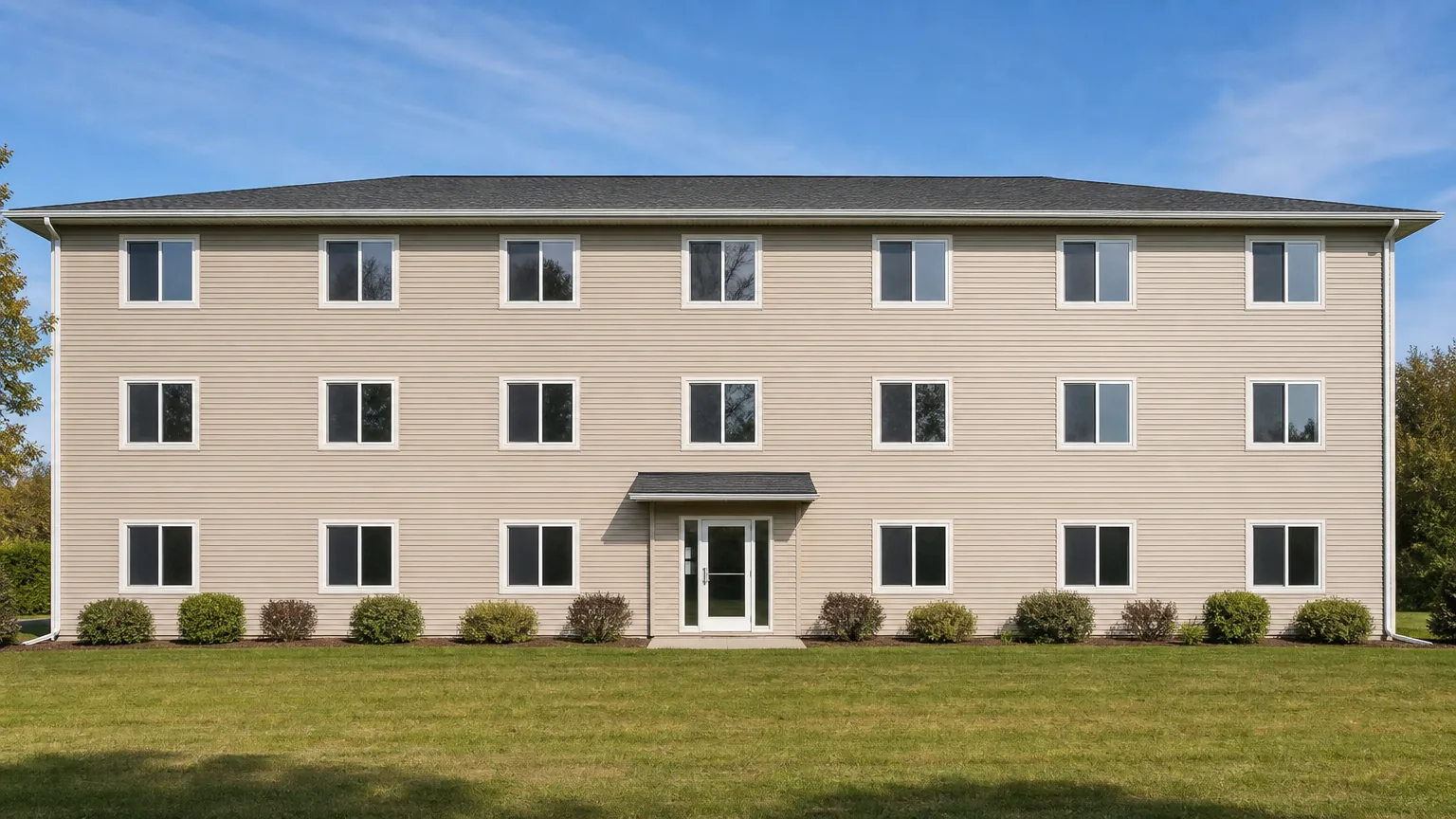
In late August 2026, a developer announced it had broken ground on three assisted living buildings near Columbus and Dayton, Ohio. Each will have 120 apartments, staff on site around the clock, and three meals a day, like any market-rate community. The difference is how they were paid for. The state’s housing finance agency awarded them federal low-income housing tax credits, and each building will be approved to bill Ohio’s Medicaid program for residents’ care. Along with two sister projects that started in 2025, they are among the first assisted living buildings in the state designed from the ground up to be affordable.
For most families, assisted living and Medicaid barely fit in the same sentence. Many state Medicaid programs will help pay for care in assisted living, but federal rules keep that money away from rent and meals, and the rent at a typical community is priced for private payers. Affordable assisted living is built around that gap. The building is financed so the rent can stay low, and Medicaid pays for the care, which can make the difference between a parent keeping a private apartment and moving into a shared nursing home room.
These buildings are also rare, and getting into one takes more planning than touring a typical community. Here is how the money works, the two eligibility tests your parent has to pass, what the care package includes, and how to get in line before a building opens.
What Makes Assisted Living “Affordable”
Affordable assisted living is licensed assisted living in every way a resident will notice: a private apartment, staff available day and night, help with bathing, dressing, and medications, and meals in a shared dining room. What sets it apart is the money behind it. The building was financed with the Low-Income Housing Tax Credit, the federal program behind more affordable rental housing than any other, and the community is approved to bill the state’s Medicaid program for residents’ care. If you want a refresher on what assisted living is licensed to do, and what it is not, start with our complete guide to assisted living.
It is not the same as a subsidized senior apartment, which offers an affordable lease but no personal care, and it is not a nursing home. It sits between the two, which is exactly where the options for low-income older adults have been thinnest.
How thin? A team led by researchers at Johns Hopkins matched HUD’s national database of tax credit properties against a national list of licensed assisted living communities. They found 197 assisted living buildings financed with tax credits out of 37,510, roughly half of one percent. Five states held nearly half of them: Massachusetts (31), Indiana (26), Iowa (13), Colorado (12), and Maine (12). Thirteen states had none. Compared with other assisted living, these buildings were more likely to sit in medically underserved areas and in lower-income neighborhoods, a sign they may be reaching a different population than most assisted living does.
One Building, Three Payers
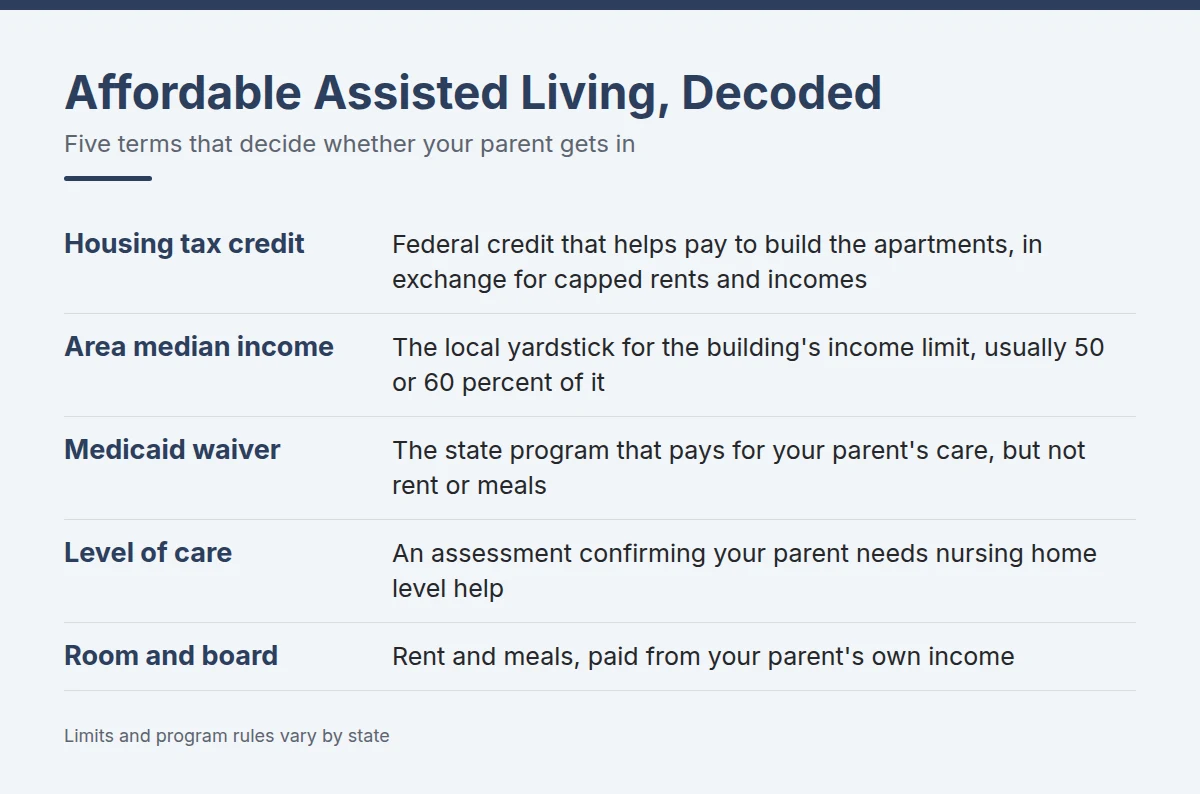
The simplest way to understand affordable assisted living is to split the monthly cost into three layers, because each one is paid by someone different.
The building: housing tax credits. A state housing finance agency awards the credits, which help pay to build the apartments. The three Ohio buildings received 4 percent credits, paired with tax-exempt bonds the agency issued. In return, the owner accepts two limits that last for decades. Residents’ household income has to fall under a ceiling, usually 50 or 60 percent of the area median income. And the rent is capped at 30 percent of that income ceiling, not 30 percent of what your parent actually receives each month. That second detail matters, because on a small Social Security check even a capped tax credit rent can be out of reach.
The care: a Medicaid waiver. Personal care, medication help, and supervision are billed to the state Medicaid program, often through a home and community-based services waiver. Federal Medicaid rules require providers to accept the program’s payment as payment in full for covered services, so the care the waiver pays for should not come back to your parent as a second charge. That is a real difference from private pay, where care levels and annual increases push the bill up year after year.
Room and board: your parent’s own income. This is the gap every family eventually meets. Federal rules bar waiver dollars from paying for room and board, and the regulation defines board as three meals a day. Rent and food therefore come out of your parent’s income, typically Social Security, which only works if the charge is set at a level a Medicaid resident can pay. States handle that differently. Ohio requires waiver participants to be able to pay a room and board amount equal to the federal SSI benefit minus $50. With the 2026 federal benefit at $994 a month, that comes to $944.
Put the layers together and the model comes into focus. The tax credits make a low rent possible for the owner, the state sets or shapes what a Medicaid resident pays for room and board, and the waiver covers the care. The Ohio projects are described as serving residents at roughly half the Medicaid cost of nursing home care.
Two Tests, Run by Two Different Offices
Families often assume that qualifying for Medicaid is the whole application. It is not. Your parent has to clear two separate eligibility tests, run by different people, and neither one checks the other for you.
Test one: the building’s income limit. Before move-in, the property will verify that your parent’s household income falls under the limit for the apartment. Expect to provide Social Security and pension award letters, recent bank statements, and anything else that shows income. A parent who already qualifies for long-term care Medicaid will usually be under the limit, but confirm it, because limits change by county and household size, and a spouse’s income counts too.

Test two: Medicaid waiver eligibility. The care side has its own gatekeepers. Your parent must be financially eligible for long-term care Medicaid, which brings its income and asset limits and the five-year look-back, and must be assessed as needing a nursing home level of care. In central Ohio, the Area Agency on Aging makes that level of care determination for the assisted living waiver. Our guide to Medicaid eligibility, spend-down, and the look-back walks through the financial rules.
The waiver slot. Then comes the part nobody controls. Waiver programs can cap enrollment, and when the slots fill, people wait. California’s assisted living waiver had a waiting list of more than 18,300 people at the end of 2025. A waiting list position also stays in the state where it was earned, which matters if you are considering moving a parent across state lines to reach one of these buildings.
What the Care Package Looks Like
Affordable does not mean bare. The Ohio buildings are a useful example of what the model offers: 120 apartments each, 67 studios and 53 one-bedrooms, every unit with a kitchenette (sink, refrigerator, microwave), a private bathroom with a shower and grab bars, its own heating and air conditioning, and an emergency alert system. Certified staff will be on site 24 hours a day to help with daily activities, a commercial kitchen will serve three meals a day plus snacks, and there is transportation to local shops and services, along with a fitness room, beauty salon, library, and activity rooms.

Residents whose care is funded by a waiver also get federal protections worth knowing by name. Medicaid’s rules for residential settings call for a lease or other legally enforceable agreement with the same eviction protections tenants have under state law, an apartment door the resident can lock, a choice of roommate if the unit is shared, freedom to decorate, control over their own schedule, access to food at any time, and visitors at any time. Restricting any of those requires a specific assessed need, documented in the resident’s person-centered service plan. A house rule does not qualify.
The tradeoffs are real too. Most apartments in the Ohio buildings are studios, so space is tight, and any assisted living has limits on how much care it can deliver. Ask directly whether the community can keep a resident who develops moderate dementia, needs two people for transfers, or starts to wander, and where residents go when it cannot. If your parent has a recent dementia diagnosis, plan for the stage after this building now; our roadmap for the first year after a dementia diagnosis lays out the signals that usually come first.
Finally, ask for the list of what the waiver covers and what it does not. Anything outside that list, from salon visits to extra transportation, can still carry a fee.
Getting in Line Before the Doors Open
New affordable assisted living takes time to build. The Ohio buildings broke ground in August 2026 and are expected to open in fall or winter 2027, which gives families who notice early more than a year. Use it, because the housing application and the Medicaid process run on separate clocks, and you want both finished before an apartment comes open.
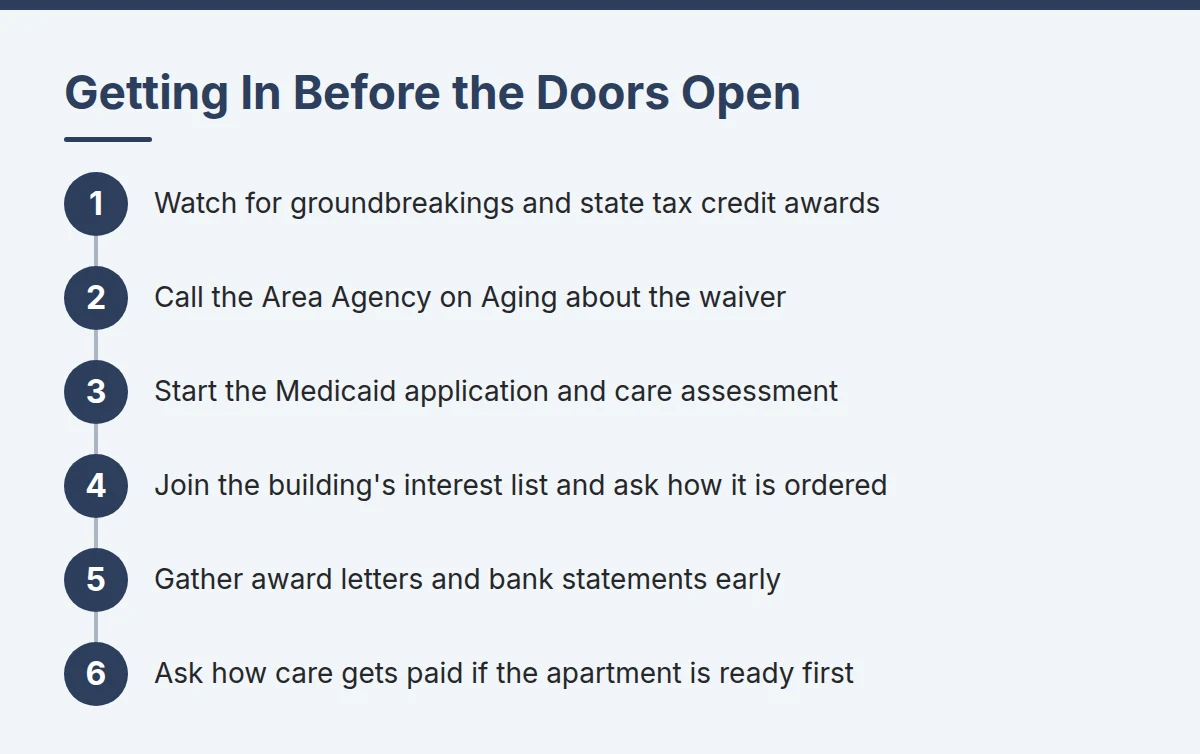
- Spot buildings early. Watch local news for groundbreakings, and watch for tax credit awards announced by your state’s housing finance agency.
- Call the Area Agency on Aging. In central Ohio, the agency takes assisted living waiver referrals and publishes a list of the communities that accept the waiver. Elsewhere, it can point you to the right office. The Eldercare Locator will find the agency that serves your parent’s area.
- Start the Medicaid side now. File the financial application, request the level of care assessment, and if there is a waiver waiting list, get on it and ask how it is ordered.
- Join the building’s interest list. Contact the operator named in the groundbreaking coverage or its leasing office. Ask when formal applications open, whether the list runs first come, first served or by lottery, and what happens if a letter goes unanswered.
- Gather the income paperwork. Award letters, pension statements, and recent bank statements. Much of it overlaps with what the Medicaid application asks for.
- Plan for a gap. If the apartment is ready before the waiver is, ask whether your parent can move in and pay for care privately for a short time, and what that would cost.
Why There Are So Few, and What Could Change
If the model works on paper, why are there only about 200 of these buildings? When the Johns Hopkins team interviewed 25 people working in roles tied to affordable assisted living development, three themes stood out. Tax credits can be paired with other funding to build affordable assisted living, but only in the right regulatory environment. The model depends on a Medicaid rate high enough to cover the care. And because a project usually needs both tax credits and Medicaid, the complexity of pairing the two often stalls development. State-level factors weigh heavily on whether these buildings get built at all, which is why the map is so uneven.
Some places are leaning in. Washington, D.C., pairs a Medicaid waiver that covers assisted living with a tax credit allocation plan that gives priority to assisted living and senior housing developments. In Congress, a House bill introduced in May 2026, the ACCESS Act, would make assisted living services a required Medicaid benefit and add a new selection criterion to state tax credit plans favoring projects that deliver long-term care services outside institutions. A companion bill was introduced in the Senate. As of September 2026 neither had moved beyond committee, so treat it as something to watch rather than something to plan around.
Where to Start This Week
If your parent already qualifies for Medicaid, or is getting close, affordable assisted living deserves a phone call even if nothing exists nearby today, because the next building may already be funded. Call the Area Agency on Aging, ask which local communities accept the assisted living waiver, and ask whether any new ones are under construction.
This search often happens under pressure, after a fall, a hospital stay, or a savings account that ran out faster than anyone planned, and the paperwork can feel like one more wall. It is worth climbing. Income limits, waiver rules, room and board amounts, and availability all vary significantly by state and change from year to year, so confirm the details with your state Medicaid agency or Area Agency on Aging. Bring in an elder law attorney for asset or spend-down questions, and a certified senior care advisor if you need help comparing communities. Nothing in this guide is legal or financial advice.
Further reading (sources)
- Yield PRO on three affordable assisted living buildings breaking ground in Ohio
- Kaplan and colleagues with a national count of assisted living financed by housing tax credits
- The same research team for interviews on why pairing tax credits with Medicaid stalls projects
- 26 U.S.C. § 42 covering the income tests and 30 percent rent cap behind the tax credit
- 42 CFR 441.310 on the federal bar on waiver funds paying for room and board
- 42 CFR 441.301 with lease, privacy, and visitor protections in waiver-funded settings
- 42 CFR 447.15 for providers accepting Medicaid payment as payment in full
- Ohio Administrative Code 5160-33-03 on Ohio’s assisted living waiver eligibility and room and board rule
- Social Security Administration with this year’s federal SSI payment amounts
- Central Ohio Area Agency on Aging covering how the assisted living waiver separates care from room and board
- Shelterforce for waiver waiting lists and pairing Medicaid care with affordable housing
- GovInfo on the House text of the ACCESS Act
- Eldercare Locator for finding the Area Agency on Aging that serves your parent