Appealing a Medicare Rehab Cutoff: What to Do When the Nursing Home Says Coverage Ends Friday
Published on September 17, 2026

The notice usually arrives midweek. Someone from social services or the business office brings your mother a one-page form titled Notice of Medicare Non-Coverage, asks for a signature, and explains that Medicare will stop paying for her skilled nursing care on Friday. Maybe the therapists say she has plateaued. Maybe she still needs a hand at her elbow to reach the bathroom. Within minutes the talk has moved on to what comes next: a long-term bed at the private rate, a discharge home, or a scramble to line up help.
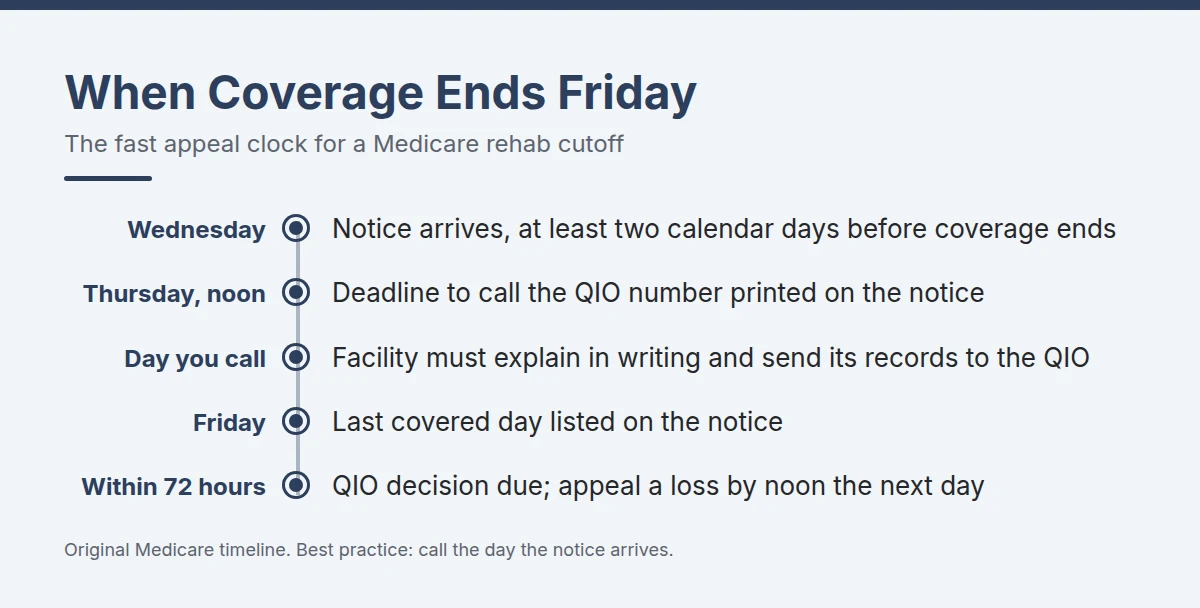
That page reads like a verdict, but it is really the first step of an appeal. The phone number printed on it reaches an independent reviewer authorized by Medicare. Call by noon on Thursday and that reviewer examines her records, the facility has to put its reasons in writing, and it cannot bill her for the disputed days while the review is underway.
Here is what the notice means, how to ask for the fast appeal, why “no longer improving” is not by itself a reason for Medicare to stop paying, and what happens to the bill whether you win or lose. The process applies under both Original Medicare and Medicare Advantage. For a refresher on the 100-day benefit itself, see our guide to what Medicare actually pays for.
The Notice Is Where the Appeal Starts
Skilled nursing facilities must give this standardized notice when Medicare-covered services are about to end, and home health agencies, hospices, and outpatient rehabilitation facilities use the same form. It has to arrive at least two calendar days before coverage ends. CMS’s own manual uses the scenario families actually face: if the last covered day is a Friday, the notice is due by Wednesday. The rule counts calendar days, not hours, so a notice handed over late Wednesday afternoon is still on time.
The form gives the date coverage ends, warns that your parent may have to pay for services after that date, explains the right to an immediate appeal, and lists the toll-free number of the Quality Improvement Organization, or QIO, that reviews these appeals in your state. Three details matter more than they look.
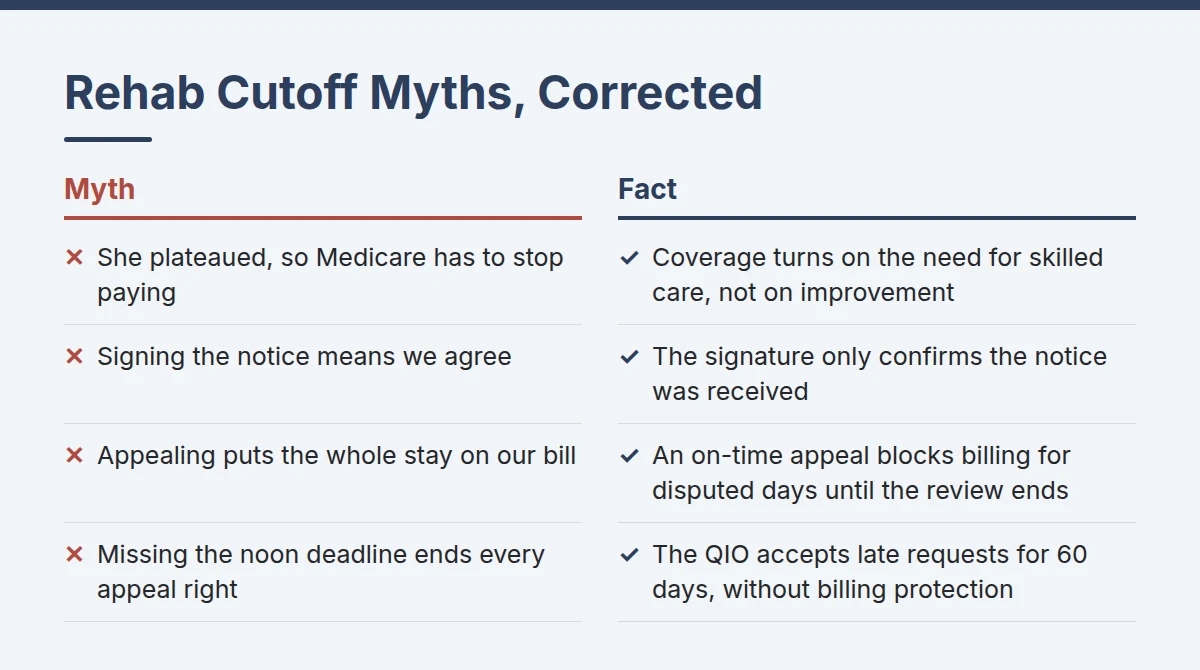
Signing is not agreeing. The signature only confirms that your parent received and understands the notice. A refusal to sign gets noted on the form, and the right to appeal survives either way.
Family can receive it. If your parent cannot handle the paperwork, the facility can deliver the notice to a representative, even by phone when that person lives elsewhere, and the date of that call counts as the date of receipt. A health care power of attorney makes this far smoother, and our guide to the paperwork before a senior move explains which documents do what.
A defective notice costs the facility. If the reviewer finds the notice was late or incomplete, the facility is responsible for the cost of continued services until two days after your parent receives a valid one.
Two situations fall outside this process. When your parent has used all 100 days in the benefit period, no notice is required, because there is no clinical decision left to appeal. And coverage ending is not the same as being told to leave. A nursing home that wants to discharge a resident must follow separate notice and appeal rules, covered in our guide to resident rights. This notice is only about whether Medicare keeps paying.
How to Ask for the Fast Appeal
The deadline printed on the notice is noon of the day before coverage ends, so a Friday cutoff means noon on Thursday. Do not aim for the deadline. Call the QIO the day the notice arrives, say your parent disagrees with the decision to end Medicare coverage, and ask for an immediate review. A phone call is enough, and nothing has to be put in writing. QIOs must take these requests 24 hours a day, seven days a week, so a notice that lands before a weekend is no reason to wait.
Once you call, the work shifts to the facility, and it moves fast:
- The QIO notifies the facility the same day.
- The facility explains itself in writing. By close of business that day, it must hand your parent a Detailed Explanation of Non-Coverage laying out the specific reasons coverage should end, the Medicare rule or policy behind them, and the facts about your parent that it says make that rule apply.
- The facility sends its records to the reviewer the same day. Ask for copies. It must provide them by close of business the day after you ask, and it may charge a reasonable copying fee.
- The reviewer hears both sides, asking for your parent’s views and giving the facility a chance to explain.
- A decision is due within 72 hours of the request. The notice tells families to expect it generally no later than two days after the coverage end date.
The rules also put the burden of proof on the facility. It has to show that ending coverage is correct, on grounds of medical necessity or another Medicare coverage policy. Your family’s job is to make sure the reviewer hears what the chart may not say.
So line up clinical support. Ask the attending physician and the therapists directly whether your parent still needs skilled care. If they say yes, ask them to tell the reviewer, or to write a short note naming the skilled services that remain necessary and why. When the reviewer calls you, be concrete: the fall last Tuesday, the wound that has not closed, the transfers that still take two staff members.

The doctor matters for another reason. Winning the appeal does not create physician orders. If the doctor already signed off on ending care, CMS expects that physician to be told about the ruling and given the chance to reinstate orders, but a facility cannot deliver care nobody has ordered, and you may need another doctor to write them.
”She’s Plateaued” Is Not a Coverage Rule
The explanation families hear most is some version of “she has stopped making progress.” It sounds like a rule. It is not one.
Medicare’s own regulation says a patient’s restoration potential “is not the deciding factor” in whether skilled services are needed, and that even when recovery is not possible, a patient may need skilled services “to prevent further deterioration or preserve current capabilities.” The settlement in Jimmo v. Sebelius, approved by the court on January 24, 2013, drove the point home. CMS restated that coverage of skilled nursing and therapy in skilled nursing facilities, home health, and outpatient therapy “does not turn on the presence or absence of a beneficiary’s potential for improvement, but rather on the beneficiary’s need for skilled care,” and it revised its manuals to restate a maintenance coverage standard. CMS itself says the settlement may mean a change in practice for “providers, adjudicators, and contractors” who may have wrongly believed Medicare covers this care only when a patient is expected to improve. Medicare’s consumer website lists, among the conditions for skilled nursing coverage, needing skilled care “to improve or maintain your current condition, or to prevent or delay it from getting worse.”

What the settlement did not do matters just as much. It did not guarantee all 100 days or change Medicare’s other requirements. The care still has to be reasonable and necessary. It still has to be skilled, meaning so inherently complex that it can be performed safely and effectively only by, or under the supervision of, professional or technical staff. And it has to be needed daily: skilled services seven days a week, or skilled rehabilitation at least five days a week when it is not offered all seven. A pause of a day or two, such as when the doctor suspends therapy because a patient is exhausted, does not end coverage by itself if discharge for those days would not be practical.
That gives you the real question for the reviewer. It is not whether your parent is still improving. It is whether the care still needs a nurse’s or therapist’s skill. An exercise routine that an aide or a family member could safely carry out does not qualify. A maintenance program that needs a therapist’s specialized judgment to be safe and effective, based on an individualized assessment of your parent, can. Read the detailed explanation line by line, and if the only reason it gives is a lack of progress, tell the reviewer so and name the Jimmo settlement.
What Happens to the Bill
Money is where most families hesitate, so here is the full picture.
While the review is underway, care continues. If you asked on time, the facility may not bill for the disputed services until the review is finished, including a second-level review that is also requested on time.
If the reviewer sides with your parent, Medicare keeps covering the stay as long as your parent’s needs still qualify, with the usual daily coinsurance, which is $217 for days 21 through 100 in 2026. When the facility later decides to end coverage again, it must issue a new notice, and your parent can appeal again.
If the reviewer sides with the facility, coverage runs through the date on the notice, and any days your parent stays after it are theirs to pay. Because the notice says a decision generally arrives within two days of that date, staying through a losing appeal usually costs only a short stretch at the private daily rate.
If your parent stays after coverage ends, a facility billing Original Medicare must give a second form before custodial care begins, the Skilled Nursing Facility Advance Beneficiary Notice of Non-coverage, which is how it shifts the cost to your parent. You can still ask the facility to submit a claim to Medicare, known as a demand bill. That produces an official Medicare decision you can appeal through the standard claims process, even after the fast appeal is over.
If long-term care is the likely next chapter, start planning now while there are still choices. Long-term nursing home care is where Medicaid usually enters the picture, and our guide to Medicaid eligibility and spend-down explains how it works and how much it varies by state. If assisted living fits better and money is tight, some communities are built with housing tax credits and Medicaid to keep the rent within reach.
If the Answer Is No, or Noon Has Passed
Ask for a second look, fast. In Original Medicare, a family that loses at the QIO can request an expedited reconsideration from a separate reviewer called a Qualified Independent Contractor. The deadline is noon of the day after the QIO first notifies you of its decision. That contractor has 72 hours after receiving the request and the records it needs, and your family can ask for up to 14 more days. As long as you asked on time, billing for the disputed days stays on hold until it rules. The next level after that is a hearing before an administrative law judge.
A missed deadline does not end your parent’s rights. The QIO still accepts late requests for up to 60 days after the coverage end date, and it decides within seven days if your parent is still receiving the services, or within 30 days if not. What a late request gives up is the billing protection, so the facility can charge for days after the end date while the review is pending.
Get help on either path. Your State Health Insurance Assistance Program, or SHIP, offers free, unbiased Medicare counseling and can guide your family through an end-of-care appeal. The long-term care ombudsman for your area advocates for nursing home residents and is worth a call when a notice or a discharge feels rushed. If the stakes are high or the case moves past the second level, bring in an elder law attorney.
Medicare Advantage: Same Notice, Different Fine Print
In a Medicare Advantage plan, the plan makes the coverage decision, but the nursing home delivers the same notice, the appeal goes to the same QIO, and the burden of proof sits with the plan. A few rules differ:
- Approvals in blocks. When a plan authorizes a stay a set number of days at a time, the end of each approved block counts as a termination, with its own notice and its own right to appeal.
- A decision by the end date. The QIO must decide by close of business the day after it receives the information it needs, and the notice tells plan members they will generally hear by the coverage end date.
- Late requests still count. A request made after the deadline still goes to the QIO, just without the billing protection.
- A different second step. If the QIO sides with the plan, you have 60 days to ask it to reconsider, and it must answer within 14 days.
There is good reason to push back on plan denials in this setting. When the HHS Office of Inspector General examined requests for skilled nursing facility admission from June 2024, the 19 Medicare Advantage insurers it reviewed had denied 12 percent of them. Enrollees and their providers appealed just 18 percent of those denials, and the insurers overturned 95 percent of the appealed denials in the enrollee’s favor. That study covered admission denials rather than stays cut short, but it shows how often a first “no” in skilled nursing does not hold up.
Make the Call
A rehab cutoff tends to land on a family already worn out from a hospital stay, and it arrives on a form that looks final. It is not. Sign the notice, because signing is not agreeing. Call the number on it the day it arrives. Get the doctor and the therapists on record. Then read the detailed explanation for any sign that “not improving” is the real reason.
Forms, deadlines, and plan procedures change, so confirm the specifics with the QIO, a SHIP counselor, or your parent’s plan, and involve an elder law attorney when legal or financial stakes are high. Nothing in this guide is legal advice. What the rules do promise is an independent second look, but only if someone asks for it.
Further reading (sources)
- CMS Medicare Claims Processing Manual on notice timing, the noon deadline, and billing during a fast appeal (Chapter 30)
- CMS with the Jimmo settlement and the maintenance coverage standard
- 42 CFR 405.1202 for the burden of proof, the detailed notice, and the 72-hour decision
- 42 CFR 409.32 on why restoration potential is not the deciding factor
- 42 CFR 409.34 covering what counts as needing skilled care daily
- 42 CFR 422.626 for fast-track appeals in Medicare Advantage
- Medicare.gov with how fast appeals work when services are ending
- Medicare.gov on skilled nursing facility coverage conditions and 2026 costs
- HHS Office of Inspector General on Medicare Advantage denials of skilled nursing admission
- State Health Insurance Assistance Programs for help appealing the end of Medicare-covered care