Before You Tour Memory Care: The Reversible Conditions That Can Look Like Dementia
Published on September 24, 2026

The suggestion usually comes from someone in scrubs. Your mother went into the hospital with pneumonia, a fall or a urinary infection, and by day three she is not sure what month it is, keeps pulling at her IV line, and has asked twice who the man in the corridor was. A case manager mentions, kindly, that she may not be safe at home anymore and that the family might start looking at memory care. By the weekend there is a spreadsheet, and three tours are booked.
Before the first tour, check the assumption underneath it: that the confusion you are seeing is dementia. Very often nobody has actually tested that. Several common conditions produce the same forgetfulness, disorientation and personality change, and a number of them clear up with treatment. Below are the look-alikes, what a proper workup includes, how long to wait before signing anything, and why a placement built on the wrong label is so hard to undo. This piece sits one step before our first-year roadmap after a dementia diagnosis and our complete guide to memory care, which both assume the diagnosis is settled.
Why the First Label Is Often the Wrong One
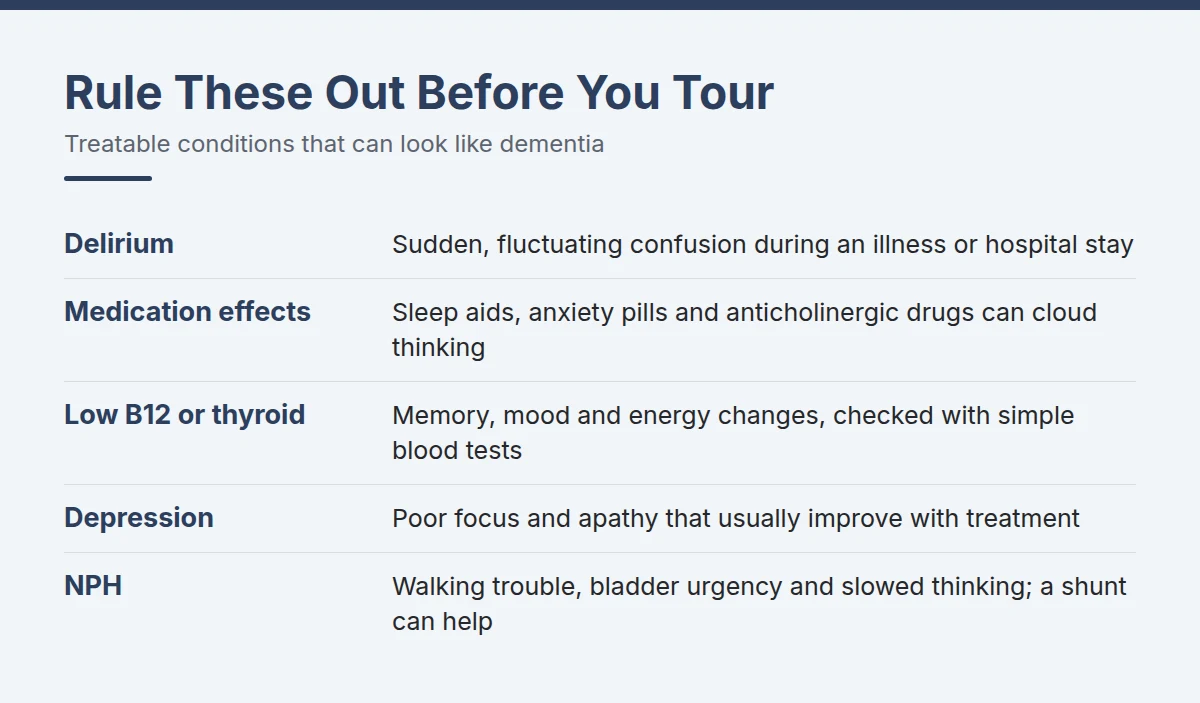
Dementia has a formal definition, and it rules two things out. Under the criteria restated in the Alzheimer’s Association’s current diagnostic guideline, the decline must be a change from the person’s earlier functioning, and it must not be explained by delirium or by a major psychiatric disorder such as depression.
A hospital is close to the worst place to apply that test. Your parent is sick, sleeping badly, possibly in pain, in a strange room, and probably on new medications. Any one of those can cause confusion on its own. A memory score taken that week measures the illness and the setting as much as the brain.
The honest counterweight: dementia that truly reverses is rare. Clarfield’s meta-analysis of 39 studies and more than 7,000 patients found potentially reversible causes in 9% of dementia cases, and only 0.6% actually reversed, partially or fully. The Alzheimer’s Association guideline warns that calling the standard blood tests “labs for reversible causes of dementia” can mislead for that reason: the conditions they look for rarely cause a slow decline on their own.
What they often do is make an existing decline much worse, which is the part that matters for housing. The real question is how much of what you are seeing is dementia and how much is something treatable layered on top. The guideline notes that when someone already slipping suddenly gets worse, the usual culprit is a new, common problem such as an infection, dehydration, an underactive thyroid or low B12. A parent with mild Alzheimer’s disease plus a sedating sleep aid can look like someone who needs a secured unit. Without the sleep aid, the same parent may manage in assisted living, or at home with help.
Delirium: The Hospital Look-Alike
Delirium is an acute disturbance of attention and thinking. It comes on over hours or a few days, usually during an illness, after surgery or in the hospital, and it tends to fluctuate, so a parent can be fairly clear at breakfast and lost by evening. Infections, dehydration, surgery, lack of sleep and medications are among the usual triggers.
It does not always look agitated. In the quiet form, a person becomes drowsy, slow and withdrawn, which is easy to read as exhaustion, sadness or simple old age.
Delirium is neither harmless nor always brief. A clinical review by Inouye and colleagues calls it common, serious and under-recognised, and a possible route to lasting cognitive damage; the Alzheimer’s Association guideline treats it as a medical emergency. MedlinePlus notes that recovery can take weeks or sometimes months. When Cole and colleagues pooled 18 studies of older hospital patients with delirium, roughly 45% were still delirious at discharge, a third at one month and one in five at six months, and those who stayed delirious did consistently worse, including on nursing home placement.
Two practical conclusions follow. First, a dementia label applied during a hospital stay deserves a second look once the delirium has cleared. Second, the most useful witness in a delirium assessment is probably you. The guideline says the diagnosis rests on an estimate of the person’s previous baseline, gathered from someone who knows them. Tell the team plainly what your mother was like two weeks ago. “She did the crossword in pen and paid her own bills” is clinical information, and it may be the only baseline anyone in the building has.
The Medicine Cabinet
Medication side effects sit on the National Institute on Aging’s list of things that cause memory problems, and older adults are more sensitive to many drugs and clear some of them more slowly. The American Geriatrics Society’s Beers Criteria, the standard list of medications older adults should usually avoid, flags several groups for their effect on the brain:
- Benzodiazepines, prescribed for anxiety and sleep, which raise the risk of cognitive impairment, delirium and falls.
- The “Z-drug” sleeping pills, which carry similar risks.
- Drugs with strong anticholinergic effects, a group that includes the older antihistamines in many over-the-counter nighttime pain relievers and sleep aids, some bladder medicines and some older antidepressants. The 2023 update specifically warns about the combined burden of taking several at once.
- Opioids, which that update added to the drugs that can bring on or worsen delirium.

The fix is a full review, not a guess. Put every bottle in one bag, prescriptions, over-the-counter products and supplements alike, and take it to the doctor or a pharmacist with one question: could this be affecting her thinking? Do not stop anything on your own; several of these drugs need to be tapered. If your parent has a Medicare drug plan and takes medications for more than one chronic condition, the plan may offer a free pharmacist review through its Medication Therapy Management program, and our guide to how Part D coverage changes around a senior living move covers the plan side.
Low B12 and a Slow Thyroid: Two Simple Blood Tests
Vitamin B12 deficiency is common in later life. According to the NIH Office of Dietary Supplements, many older adults do not make enough stomach acid to absorb the B12 in food, and metformin and acid-reducing drugs can lower levels further. Its list of deficiency symptoms includes confusion, poor memory, depression, dementia and problems with balance. Test before you treat: the point is to find a real deficiency, not to start a supplement on hope.
An underactive thyroid slows many of the body’s functions. It is more common after age 60, it develops gradually enough that symptoms can go unnoticed for months or years, and its common signs, such as fatigue and depression, are easy to put down to other things. The National Institute of Diabetes and Digestive and Kidney Diseases stresses that it cannot be diagnosed on symptoms alone; it takes a blood test. Treatment is thyroid hormone replacement, usually a pill, with a follow-up blood test about six to eight weeks after starting so the dose can be adjusted.
Both tests are in the first-tier lab panel the Alzheimer’s Association guideline recommends for anyone evaluated for cognitive symptoms, because B12 and thyroid problems are common in older adults, can cause cognitive and psychiatric symptoms, and treating them can improve those symptoms. If your parent was evaluated without them, ask why.
Depression That Looks Like Memory Loss
Depression in older adults does not always look like sadness. The National Institute on Aging lists difficulty concentrating, remembering and making decisions among its symptoms. A depressed parent may answer “I don’t know” rather than try, stop cooking, stop calling and let the mail pile up, which from the outside looks exactly like cognitive decline. Unlike most dementias, depression usually improves with treatment, whether that is therapy, medication or both.
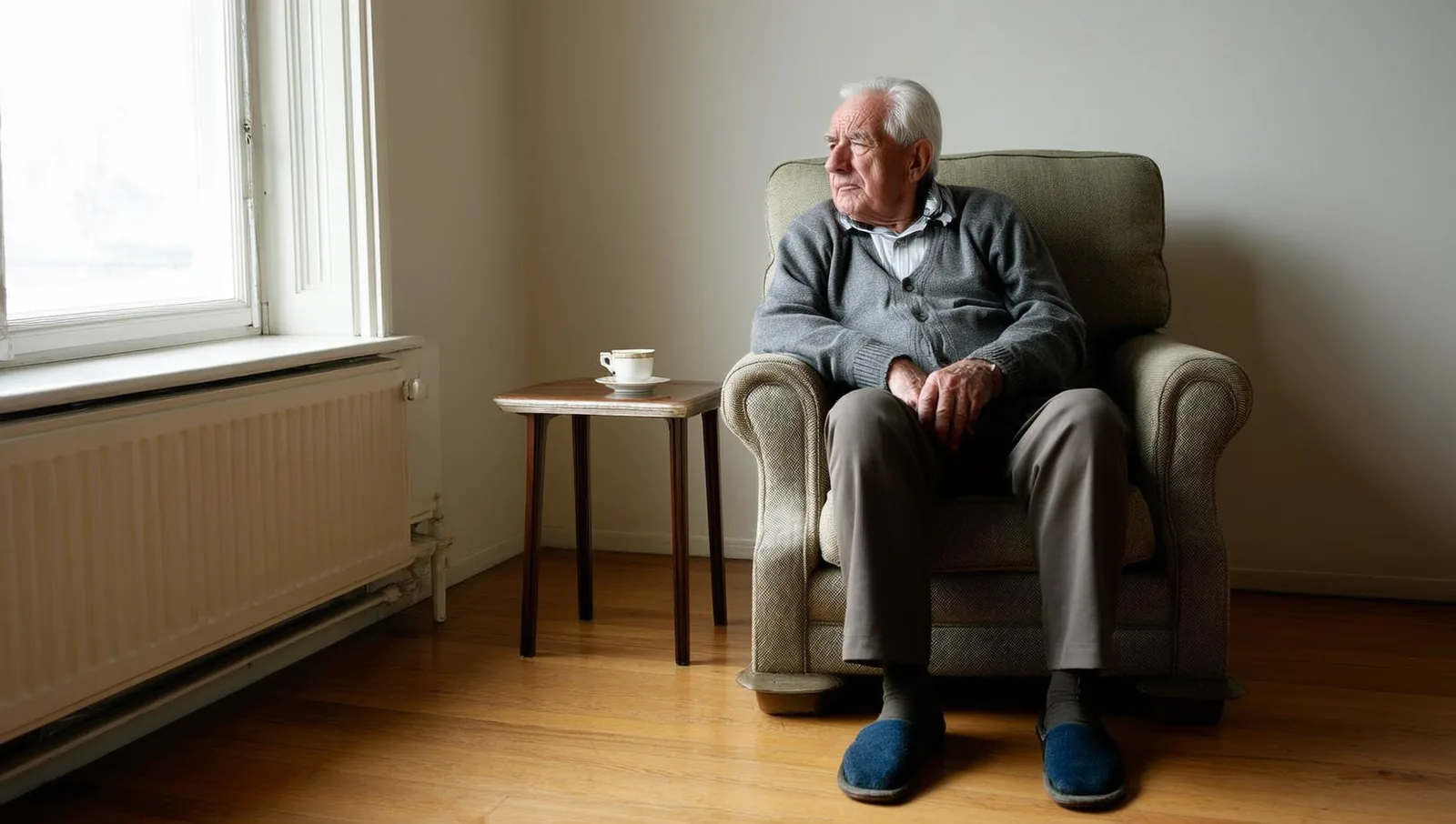
The complication is overlap. NIA also notes that dementia can cause some of the same symptoms as depression, and that depression can be an early warning sign of dementia. So treatment is not a test your parent passes or fails. Treat the depression, reassess thinking once mood has lifted, and plan around the person who is actually there.
Normal Pressure Hydrocephalus: Watch the Walk
Normal pressure hydrocephalus, usually shortened to NPH, is a slow buildup of cerebrospinal fluid in the brain’s ventricles, and it is most common in older adults. The National Institute of Neurological Disorders and Stroke describes its signature combination: problems with walking, problems with bladder control, and difficulty thinking and reasoning. The walk is often the clue families notice first, a gait in which the feet seem stuck to the floor.
It matters because NPH is treatable. Surgeons can place a shunt, a thin tube that drains the excess fluid away from the brain. NINDS notes that NPH is hard to diagnose, that many people never receive proper treatment, and that early diagnosis and treatment improve the chance of a good recovery. Diagnosis starts with brain imaging, usually an MRI, and sometimes includes a spinal tap.
If your parent’s walking changed before or alongside the memory, and bladder urgency or accidents are new, make sure someone has looked at a brain scan with NPH in mind.
The Rest of the List
NIA’s list of other causes of memory problems also includes head injuries, blood clots, tumors or infections in the brain, kidney or liver problems, alcohol or drug misuse, sleep problems and poor nutrition. Two are easy to miss: a head injury from a fall a few weeks earlier that nobody connected to the confusion, and untreated sleep apnea, which the guideline names as a common contributor. The last check is almost embarrassingly practical. Before any memory test, make sure the hearing aids are in and working and the glasses are the right ones. A person who cannot hear the question cannot answer it.
What a Proper Workup Includes
The Alzheimer’s Association guideline, written for primary care doctors as well as specialists, sets out what a structured evaluation should cover. In plain terms:
- A history from someone who knows your parent: when the changes started, whether suddenly or gradually, and what has changed in daily tasks, mood, walking, hearing and vision.
- A review of every medication, including over-the-counter products and supplements.
- A physical and neurological exam and a validated cognitive test, ideally once your parent is medically stable rather than mid-illness.
- A first-tier blood panel: blood count, a metabolic panel with kidney and liver function, thyroid (TSH), vitamin B12 and a few markers of inflammation.
- Brain imaging: MRI, or CT if MRI is not possible.
- Referral to a specialist, such as a neurologist, geriatrician or memory clinic, when the picture is unusual, fast-moving or unclear.

Bring four questions to the appointment. What else could explain this, and what has been ruled out? Was her thinking tested while she was acutely ill, and when should it be retested? Which of her medications could be affecting cognition? Were B12 and thyroid checked, and has anyone reviewed a brain scan? Medicare also covers a separate visit built for exactly this job: a full review of cognitive function to establish or confirm a diagnosis and build a care plan, apart from the yearly wellness visit. The first-year roadmap linked above explains how to ask for one.
How Long to Wait Before You Commit
There is no universal number, but the principle is simple: judge your parent’s thinking once they are medically stable and back on familiar ground, not in the week after a hospital discharge. The timelines above give a sense of scale. Delirium can take weeks or months to clear. A new thyroid prescription is typically rechecked after six to eight weeks. Medication changes take time to wash out, and depression treatment is rarely quick.
That does not mean leaving your parent unsafe while you wait. If she cannot go home alone right now, that is a real problem to solve this week, but it can be solved with arrangements you can walk back:
- A short rehab stay, if her doctor orders skilled care and Medicare’s conditions are met.
- A respite stay in assisted living or memory care, which many communities offer for a few weeks at a time.
- Help at home, whether paid caregivers, a family rotation or an adult day program.
Ask the discharge team to write the plan down as temporary, with a date for reassessing her thinking, and hold that date before any long-term agreement is signed. If a move genuinely cannot wait, ask the community up front whether it will lower her care level once she recovers. A parent who moves straight from a hospital bed is assessed at her worst, and our guide to the senior care assessment explains why care levels set in a bad week rarely come back down on their own.
The counterweight applies here too. Waiting is for getting the answer, not for avoiding it. If the reassessment confirms dementia, or if safety risks such as wandering, falls or a stove left on are already piling up, act on what you know.
Why a Wrong Placement Is Expensive and Hard to Undo
Most of the decisions around a memory care move are one-way doors.
The price is higher. Memory care costs more than standard assisted living because of its staffing and security, and the care level set at move-in drives the monthly bill. Our breakdown of how senior living pricing actually works shows how quickly the layers add up.
The fees do not come back. The one-time community fee, often around a month’s rent, is almost always nonrefundable, even if your parent moves out three weeks later.
The setting is built for someone else. A secured unit is designed for people who can no longer safely come and go, with coded doors and a daily program pitched at later stages of dementia. For someone whose thinking recovers, it is the wrong room, and a lonely one. A second move a few months later then means new faces and routines all over again.
The bridges get burned. Once the apartment lease has ended, the house is listed and the Medicaid spend-down has started, “let’s try home again” stops being a realistic sentence.
None of this means the hospital was wrong. Often a careful workup confirms dementia, and memory care is exactly the right answer. The point is to know that before you sign, not after.
Costs, licensing rules and Medicaid eligibility vary significantly by state. For the medical questions, your parent’s primary care doctor, a geriatrician or a memory clinic is the right place to start. For placement decisions, a certified senior care advisor or geriatric care manager can help, and anything involving contracts, capacity or Medicaid planning belongs with an elder law attorney. Nothing in this article is medical, legal or financial advice.
Further reading (sources)
- National Institute on Aging on the medical conditions that can cause memory problems, and on how depression shows up in older adults
- Atri and colleagues for the Alzheimer’s Association guideline on evaluating suspected dementia in primary care
- MedlinePlus with how delirium starts, fluctuates and resolves
- Inouye and colleagues in a clinical review of delirium in older people
- Cole and colleagues on how often delirium persists after a hospital stay
- Clarfield with a meta-analysis of how often dementia actually reverses
- American Geriatrics Society Beers Criteria panel for its updated list of medications older adults should usually avoid
- Medicare.gov on the free medication reviews offered through Part D plans, and on the separate visit that reviews cognition and confirms a diagnosis
- NIH Office of Dietary Supplements for who runs low on vitamin B12 and what a deficiency does
- National Institute of Diabetes and Digestive and Kidney Diseases on the symptoms, testing and treatment of an underactive thyroid
- National Institute of Neurological Disorders and Stroke covering hydrocephalus, including the normal pressure form seen in older adults