Who Buys the Wheelchair? Medicare Equipment Rules in Assisted Living and Nursing Homes
Published on September 27, 2026

The discharge planner brings it up on the way out: your father will need a walker, a hospital bed, and probably a wheelchair for anything longer than a trip down the hall. Then comes a question that sounds like logistics. Where is he going? Home, an assisted living apartment, or a nursing home bed?
That answer decides who pays for every item on the list. Medicare Part B covers durable medical equipment used in the home, and an assisted living apartment counts as home. A nursing home does not, so there the equipment is the facility’s job. Almost everything else about the bill (the 80 percent, the rent-to-own clock, the bathroom gear Medicare refuses to buy) follows from that one line, and it catches out families who have planned carefully for everything else.
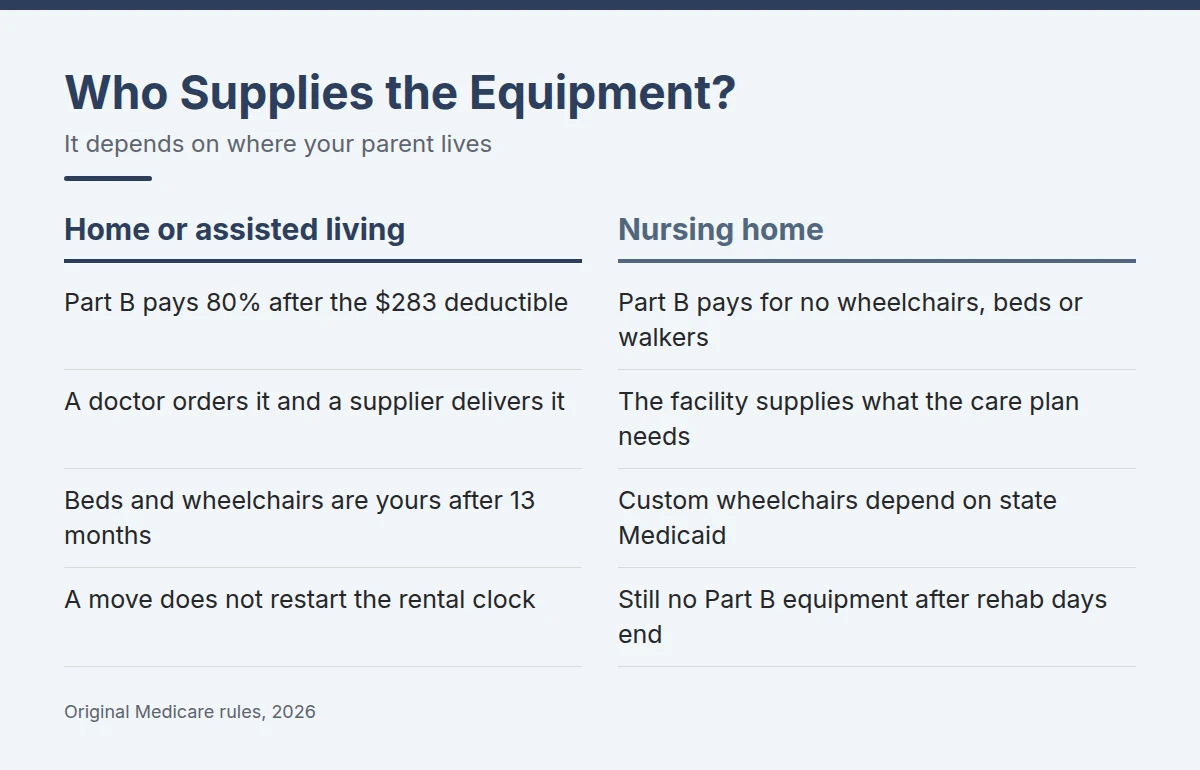
Where Your Parent Lives Decides Who Pays
Durable medical equipment, usually shortened to DME, is Medicare’s term for reusable gear with a medical purpose: canes and walkers, wheelchairs and scooters, hospital beds, patient lifts, commodes, oxygen equipment. Part B covers it when a doctor, nurse practitioner, physician assistant or clinical nurse specialist prescribes it for use in the home. The federal regulation stretches “home” to include “an institution that is used as a home,” then carves out hospitals and skilled nursing facilities.
Medicare’s equipment claims contractors turn that into a list. Coverage can be considered when the place your parent will mainly use the item is a private home, an assisted living facility, a group home or a custodial care facility, among a few others. Independent living apartments and 55+ communities are simply homes. Memory care follows its license: a memory care wing licensed as assisted living counts, while a dementia unit inside a nursing home does not.
Nursing homes land on the other side. For a nursing home resident, the items Part B will even consider shrink to a short list: braces and artificial limbs, ostomy and incontinence supplies, surgical dressings, diabetic shoes, tube feeding and a few drugs. Wheelchairs, hospital beds, walkers and oxygen are not on it.
Here is the part that surprises families: this holds whether or not Medicare is paying for the stay. Medicare’s consumer booklet says a nursing home “that’s providing you with Medicare-covered care” can’t count as home, which can sound as though a long-term resident qualifies once the rehab days run out. The claims rules don’t work that way. On a continuing care campus, coverage depends on which building your parent actually lives in.
Assisted Living: Part B Pays, and the Family Does the Legwork
Once the apartment counts as home, the math is ordinary Part B math. Your parent pays the annual Part B deductible, $283 in 2026, and then 20 percent of the Medicare-approved amount, provided the supplier accepts assignment. If your parent is in the Qualified Medicare Beneficiary program, one of the Medicare Savings Programs you apply for through your state, providers aren’t allowed to bill them for Medicare-covered items at all, deductible and coinsurance included. Medicare Advantage plans must cover the same categories of equipment, but the plan decides which suppliers your parent can use and what they pay, so call the plan before the first order.
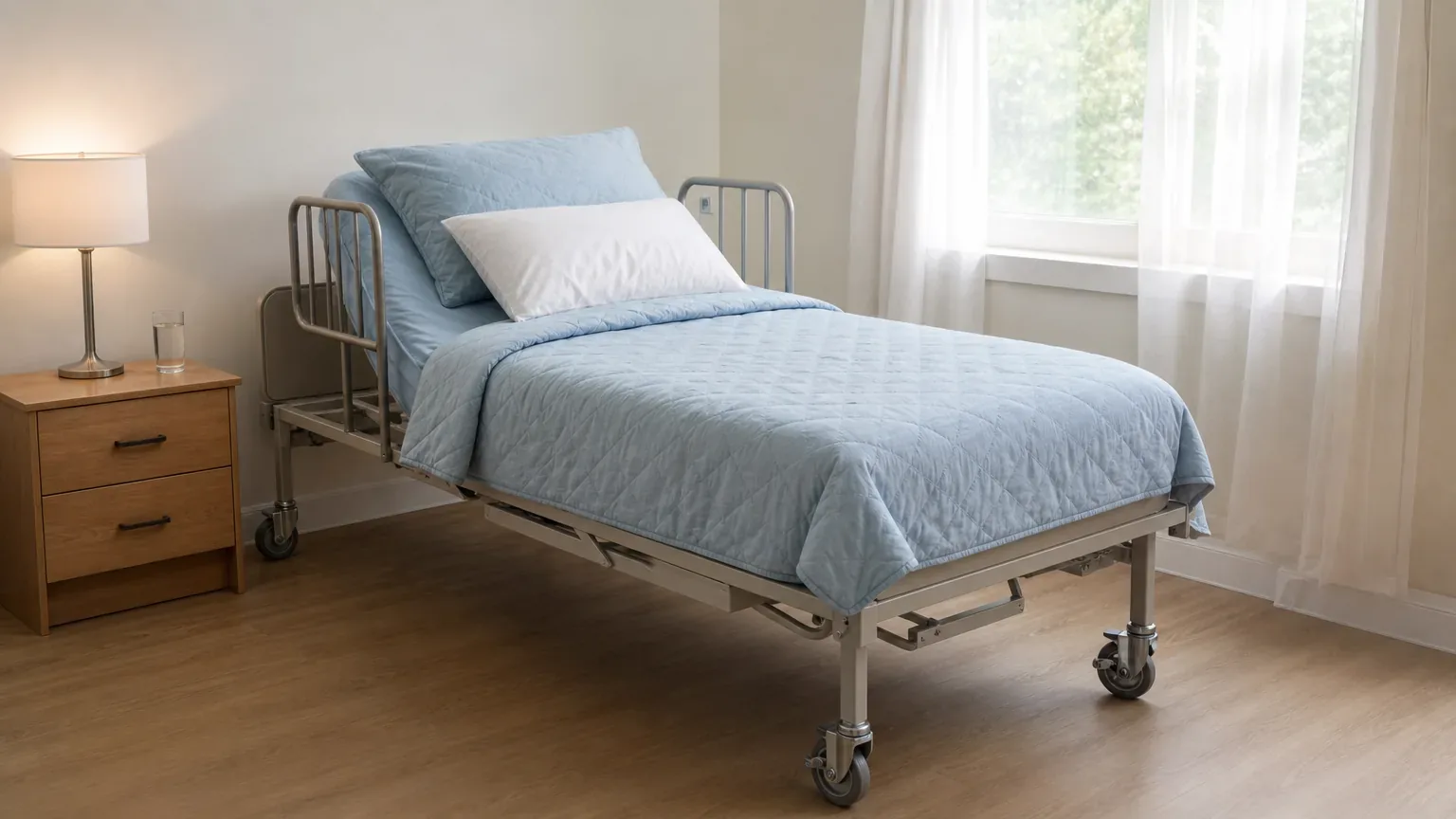
What the community provides is a separate question, and usually the answer is not the equipment. Assisted living is regulated by the states rather than by Medicare, and the wheelchair or bed is normally the resident’s to arrange: the doctor writes the order, a supplier delivers, and staff help your parent use it. Before move-in, ask three things:
- Can staff help with transfers using the equipment your parent has (a mechanical lift, for instance), or is that beyond what the community is licensed and staffed to do?
- Are there house rules about power scooters in the hallways, hospital beds, or bed rails?
- What does the community install or supply itself, such as grab bars or a raised toilet seat, and what falls to the family?
Nursing Homes: The Equipment Comes With the Bed
During a Medicare-covered skilled nursing stay, the rehab benefit of up to 100 days that follows a qualifying hospital stay, the facility is responsible for providing any equipment your parent needs while there. That is why nobody asks the family to rent a wheelchair for rehab.
When the covered days end and your parent stays on as a long-term resident, Part B still does not step in, for the reasons above. The nursing home remains the source, and federal rules limit what it can add to the bill. During a Medicare or Medicaid stay, a facility may charge a resident’s funds for an item only if the resident asked for it, it isn’t needed to meet the goals in the care plan, and the facility said, orally and in writing, that there would be a charge and what it would be. Equipment the care plan depends on is not an optional extra. For a private-pay resident, the admission agreement sets the terms, so read its equipment language before signing.
Custom equipment is where states diverge. Washington’s Medicaid rules are a clear example: the nursing home must provide a “house wheelchair” out of its daily rate, while Medicaid pays separately, with prior authorization, for one manual or power wheelchair for a resident’s exclusive full-time use. Other states draw the line elsewhere, so if your parent needs a fitted chair, ask the facility’s social worker how your state handles it. Our guide to Medicaid eligibility and spend-down explains how residents qualify for that daily rate in the first place.
Hospital beds carry one more protection here. Before installing a bed rail, a nursing home must try alternatives first, assess your parent for the risk of entrapment, check that the bed suits their size and weight, and get informed consent from your parent or their representative.
Planning the trip home. If rehab ends with a move home or into assisted living, order the equipment before discharge day. A supplier may bring it to the facility no earlier than two days before discharge, to fit your parent and train them on it, as long as it ends up at home on the day they leave. If the discharge date itself is the problem, our guide to appealing a Medicare rehab cutoff walks through the fast appeal.
Rent, Buy, or Rent-to-Own
Medicare pays for most equipment as a rental. It buys only inexpensive or routinely bought items, such as canes, walkers and blood sugar monitors, plus complex rehab power wheelchairs. For the inexpensive items, the supplier must tell your parent they can rent or buy, and total rental payments are capped at Medicare’s purchase fee. If the need will last more than a few months, buying is usually the simpler choice.
Wheelchairs and hospital beds are rent-to-own. Medicare rents them for 13 months of continuous use, and once the 13th month ends the supplier must transfer ownership to your parent. During the rental, repairs and replacement parts are the supplier’s responsibility. No later than two months before ownership passes, the supplier must say whether it will keep servicing the item, and it is not required to. After that, Medicare pays 80 percent of the approved cost of repairs on equipment your parent owns, up to the cost of replacing it, and equipment can be replaced if it is lost, stolen, damaged beyond repair, or used past its reasonable useful lifetime, generally five years.
A move doesn’t reset the clock. Medicare’s rules say a permanent or temporary move is not an interruption of a rental, and a break in use counts as temporary if it lasts no longer than 60 consecutive days plus the rest of that rental month, whatever the reason. So a hospital bed rented at home keeps counting toward ownership after a move into assisted living, and a short rehab stay doesn’t send it back to month one. If your parent moves outside the supplier’s service area, or simply prefers a different supplier, the rental can continue with a new one.
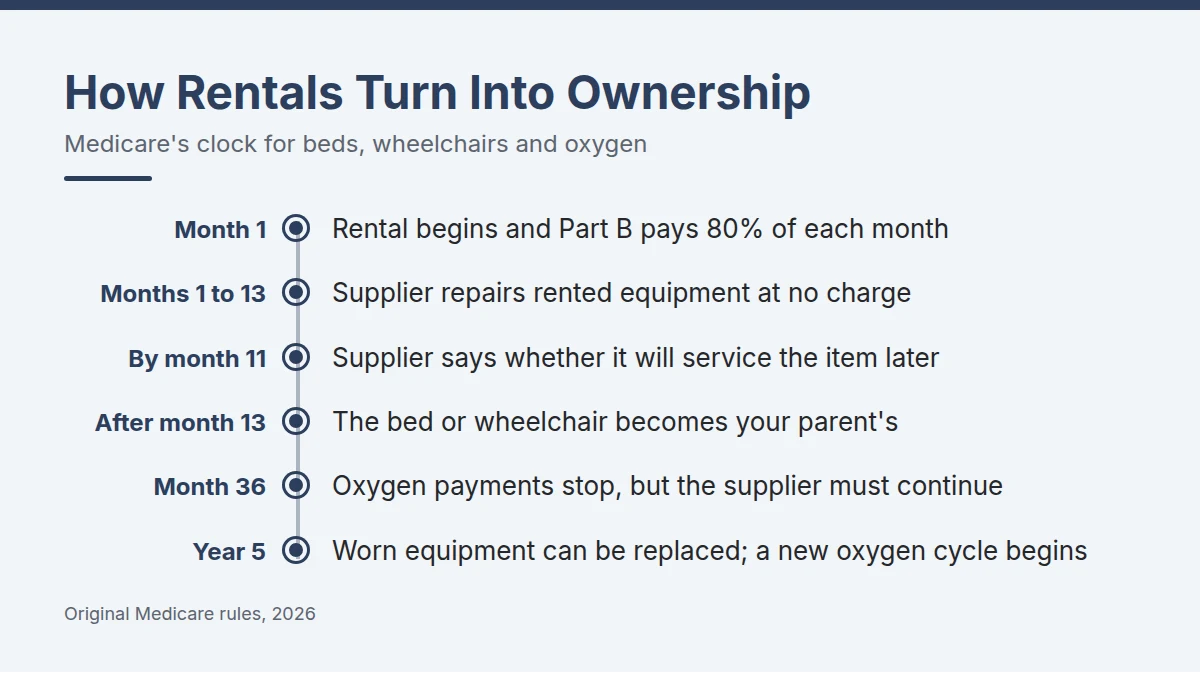
Oxygen runs on its own clock. Medicare pays a monthly rental for 36 months of continuous use, and that payment covers the equipment, oxygen contents, tubing, maintenance and repairs. After month 36, the supplier must keep providing the equipment and supplies for another 24 months, up to five years in all, while your parent needs it. The supplier owns the equipment throughout. If the need continues past five years, your parent can get replacement equipment from any enrolled supplier and a new cycle begins. Tell the supplier before any move so deliveries follow your parent to the new address.
The Home Test, and What Medicare Won’t Buy
Medicare judges mobility equipment by what your parent needs to get through the day at home. Walkers, wheelchairs and scooters are covered when a mobility problem gets in the way of everyday tasks such as toileting, feeding, dressing, grooming and bathing in the usual places at home. A chair wanted mainly for outings, trips or long walks does not meet that test on its own. For a power wheelchair or scooter, the prescriber must also have had a face-to-face visit with your parent, in person or by telehealth, in the six months before writing the order.
The bathroom is where Medicare’s line gets strict. Its national coverage list denies grab bars as self-help devices, and denies bathtub seats, bathtub lifts and raised toilet seats as convenience or hygiene items. Stairway lifts are denied too. A bedside commode is generally covered only if your parent is confined to bed or to one room. In assisted living, that usually means the shower chair and the raised toilet seat come out of the family’s pocket unless the community supplies them. Our aging in place decision guide covers the bigger home modifications, and our overview of what Medicare pays for in senior housing maps the rest of the coverage line.
Hospice changes the rules. Once a parent elects hospice, the hospice provides the equipment related to the terminal illness, and it may also supply self-help and comfort items that Part B would refuse. Our guide to hospice across settings covers how that works in assisted living and nursing homes.
Choosing the Supplier
A supplier has to be enrolled in Medicare, with a Medicare supplier number, or Medicare won’t pay the claim at all. Medicare.gov has a supplier directory, and before anyone delivers, it is worth asking a short list of questions: Are you enrolled in Medicare? Do you accept assignment? If not, will you accept it in this case? What will you charge if you won’t? A supplier that doesn’t accept assignment can cost your parent more. Before delivering a rent-to-own item, the supplier must also say whether it will accept assignment for every month of the rental.

Federal supplier standards give your parent real protections. The supplier must deliver the item and show your parent how to use it safely, honor its warranties, repair or replace rented equipment at no charge, and take back an item that is substandard or unsuitable for your parent. It also may not phone your parent about a Medicare-covered item unless they gave written permission or the supplier has recently furnished them one, so an unsolicited call offering equipment is a reason to hang up.
Competitive bidding, the program that has at times restricted certain items to contract suppliers in parts of the country, is not a factor right now. It has been in a temporary gap period since January 1, 2024, and CMS is preparing a new round for 2028. Until then, any enrolled supplier can furnish the equipment.
Veterans have one more route. If your parent is enrolled in VA health care, ask their VA care team about the Prosthetic and Sensory Aids Service, which handles wheelchairs, home oxygen and other medical equipment.
Questions to Settle Before the Move
- Will my parent live somewhere Medicare treats as home for equipment, or in a nursing home that supplies it?
- Which items does the community or facility provide, and which are the family’s to arrange?
- Is the supplier enrolled in Medicare, and will it accept assignment for every rental month?
- Who services a bed or wheelchair after it becomes my parent’s property?
- If rehab is ending, can the supplier deliver for fitting before discharge?
Coverage rules change, Medicaid equipment policy varies by state, and assisted living licensing is a matter of state law, so confirm the specifics for your parent with Medicare, your State Health Insurance Assistance Program, or an elder law attorney when a large purchase is at stake. Nothing here is legal or financial advice. The aim is simpler: to have the answer ready when the discharge planner asks where your father is going, because that answer decides who buys the wheelchair.
Further reading (sources)
- Medicare in its booklet on how Part B covers, rents and repairs medical equipment, including oxygen
- Medicare.gov for the Qualified Medicare Beneficiary billing protection
- DME MAC Jurisdiction C Supplier Manual, a Medicare claims contractor’s guide, with the places that count as home and the two-day pre-discharge delivery rule
- CMS listing which equipment Medicare covers and which it denies
- CMS on the competitive bidding program’s temporary gap period
- Federal Register for the 2026 Part B premium and deductible notice
- 42 CFR 410.38 defining equipment used in a home or an institution used as one
- 42 CFR 414.229 on the 13-month rental cap and the transfer of ownership
- 42 CFR 414.230 explaining why a move or a short break does not restart a rental
- 42 CFR 424.57 with the standards every equipment supplier must meet
- 42 CFR 483.10 on what a nursing home may charge a resident for
- 42 CFR 483.25 covering bed rail safety requirements in nursing homes
- 42 CFR 418.202 for the equipment and supplies a hospice must provide
- Washington Administrative Code on wheelchairs for nursing home residents on Medicaid
- VA Prosthetic and Sensory Aids Service for equipment and home oxygen for enrolled veterans