Moving a Parent to Your State: What Breaks When Senior Care Crosses a State Line
Published on September 12, 2026

Somewhere in the second year of managing a parent’s care from four states away, almost every family arrives at the same sentence: we should just bring her here. It is usually the right instinct. Proximity solves the 2 a.m. phone call, the neighbor who has stopped answering, the sense that you are always reacting to a crisis you heard about three days late.
What nobody mentions is that a state line is a hard boundary for most of the programs paying for your parent’s care. Medicare crosses it. Social Security crosses it. Medicaid does not, waiver waitlist positions do not, and the license category that lets your mother’s current community keep her may not exist where you live. Families discover this after the truck is unloaded, when the new state’s caseworker explains that the clock starts over.
This is the mechanics guide: what actually breaks, what to line up before the move, how to sequence it so coverage does not lapse, and the cases where the honest answer is that she should stay where she is.
Medicare Travels. Almost Nothing Else Does.
Start with the good news, because it is short.
Original Medicare (Parts A and B) works anywhere in the country with any provider who accepts Medicare. Move from Boise to Richmond and nothing happens to it. Social Security follows an address change and nothing more. A standard Medigap supplement also travels, because it pays alongside Original Medicare rather than through a network.
The exceptions matter. Medicare Advantage and Part D drug plans are built around county-level service areas and local networks. Move outside that area and the plan no longer works, which triggers a Special Enrollment Period. The timing rewards telling the plan first: notify them before the move and the window opens the month before you move and runs two full months after. Wait until afterward and it starts the month you tell them, plus two more months. Let the window close without acting and your parent is dropped into Original Medicare with no drug coverage, which is an expensive way to learn the rule.
Two smaller traps. Medicare SELECT policies are network-based and do stop working out of area, though that gives your parent a guaranteed issue right to buy a standard supplement. And Medigap pricing and issue rules are set state by state, so a policy that was affordable in one state may have no equivalent at the same price in another, and switching outside a guaranteed issue window can mean medical underwriting.
Medicaid Does Not Transfer, and That Is the Big One
There is no interstate Medicaid transfer. Each state runs its own program under federal rules, and a person cannot hold Medicaid in two states at once. Your parent has to close the case in the old state and apply in the new one as a brand new applicant, with the full document package all over again.
Residency itself is not the obstacle. States cannot impose a waiting period before someone may apply, so a parent who has moved with the intent to stay can file immediately. The obstacle is processing time. Federal rules give states up to 45 days for a standard application and up to 90 days for one based on disability, and many states routinely use all of it.
That is the gap families fall into. Old coverage ends, new coverage has not started, and the community expects payment on the first of the month regardless. Three things reduce the damage: apply in the new state the week residency is established rather than after the boxes are unpacked, ask the old state to terminate at the end of a month rather than mid-month, and find out whether the new state still offers retroactive coverage, which historically reaches back up to three months but has been curtailed in several states. Budget for a private-pay bridge of two to three months and treat it as the cost of the move.
Expect the rules themselves to be different on arrival. Income limits, asset limits, spousal protections, and estate recovery practice all vary, so a parent who qualified comfortably in one state may be over the line in another, or may face a spend-down that was never necessary before. Our guide to Medicaid eligibility and spend-down covers the mechanics; the point here is simply that you are re-running that analysis against a different rulebook.

The Waiver Waitlist Is the Trap Nobody Sees Coming
Nursing home coverage is an entitlement under Medicaid. Home and community based services, the waivers that pay for in-home aides, adult day programs, and the care portion of assisted living, are not. States cap enrollment, and when the slots are full, people wait.
The scale is easy to underestimate. KFF counted more than 600,000 people on HCBS waiting or interest lists in 2025, with 41 states maintaining one. People who came off those lists in 2025 had waited an average of 32 months. Waivers serving older adults and people with physical disabilities move faster than the average, at roughly 15 months, which is still more than a year.
A waitlist position does not travel. A parent who spent two years climbing an in-home services queue and finally has an active waiver slot gives it up by moving, then joins the back of a different line in the new state. In the meantime the services the waiver was paying for become out of pocket.
This single fact reverses more relocation decisions than cost does. If your parent holds an active waiver slot today, find out what the equivalent program in your state is called, whether it has a waitlist, and how long that list currently runs, before anyone signs a lease. Call the new state’s Area Agency on Aging and ask directly. The answer is often a number nobody volunteers.
A License in One State Is Not a License in Another
There is no federal assisted living standard. Each state writes its own, and a national survey by the assisted living trade association identified at least 34 distinct licensing categories doing the job that “assisted living” does colloquially. The same building might be licensed as a residential care facility, an adult care home, a personal care home, or a board and care home depending on where it sits.
The naming is cosmetic. What matters underneath is scope of care, and that genuinely differs:
- Size and setting tiers. Louisiana, for example, licenses adult residential care in four levels running from small homes of two to eight residents up to large apartment communities of seventeen or more, each with its own rules.
- Add-on licenses for heavier care. Florida issues separate extended congregate care, limited nursing services, and limited mental health licenses that let a community do things a base license does not permit.
- Nurse delegation rules. Whether an unlicensed caregiver may administer insulin, manage a catheter, or give injections is a state decision, and it sets the real ceiling on who a community can keep.
- Discharge triggers. Every state defines the conditions that legally require a resident to move to a higher level of care. Those thresholds do not line up.
The practical consequence: a parent who is stable and well cared for in one state’s assisted living may be inadmissible, or admissible but not retainable, in another. Somebody with a feeding tube, two-person transfer needs, or a wandering history can sit comfortably inside one state’s rules and outside another’s. Before you tour anything, ask a prospective community to read your parent’s current care plan and say plainly whether their license permits all of it. Our complete guide to assisted living explains how to read a license category once you know which one you are looking at.

What the Insurance Policy Thinks “Assisted Living” Means
Long-term care insurance is generally portable across state lines. The risk is not geography, it is definitions. Policies pay for care delivered in facilities that meet the policy’s own description, and older contracts often specify a minimum bed count, a particular licensure status, or round-the-clock licensed nursing on site. A small adult family home in the new state may deliver exactly the care your parent needs and still fail the policy’s test, leaving the family paying privately for a benefit they bought decades ago.
Get the policy’s facility definition in writing and hand it to any community you are considering before a deposit changes hands.
Partnership policies add a second layer. These are state-endorsed long-term care policies that let a buyer shield a dollar of assets from Medicaid for every dollar the policy pays out. Most participating states honor each other’s policies, so the asset protection usually survives a move, though California is the notable partnership state that does not offer reciprocity. Even where reciprocity applies, the protected amount is applied against the new state’s Medicaid rules, not the rules where the policy was sold.
The Programs Tied to a Map
Some benefits are attached to a service area rather than to your parent.
PACE is the clearest example. It bundles a participant’s doctors, therapy, day program, and transportation, and it is defined by a geographic service area. Moving outside that area means disenrollment, and whether anything comparable exists at the destination depends entirely on whether a program operates there. If your parent is enrolled in a PACE program, check for a program near you before anything else, because losing PACE without a replacement is a large step down.
VA benefits split in two. Aid and Attendance is a federal pension benefit and moves with your parent. State veterans homes are state institutions, with their own residency requirements and their own waiting lists, and eligibility earned in one state means nothing at another state’s home.
Legal documents mostly follow, imperfectly. A durable power of attorney signed in one state is generally honored in another, but banks and communities in the new state may balk at an unfamiliar form and ask for their own. POLST forms are state-specific and should be re-executed with a clinician after the move. This is a good moment to review the whole file, and our guide to the paperwork before a senior move lists what belongs in it.

When Staying Put Is the Cheaper Answer
Relocation is often right. It is not automatically right, and the math deserves an honest look.
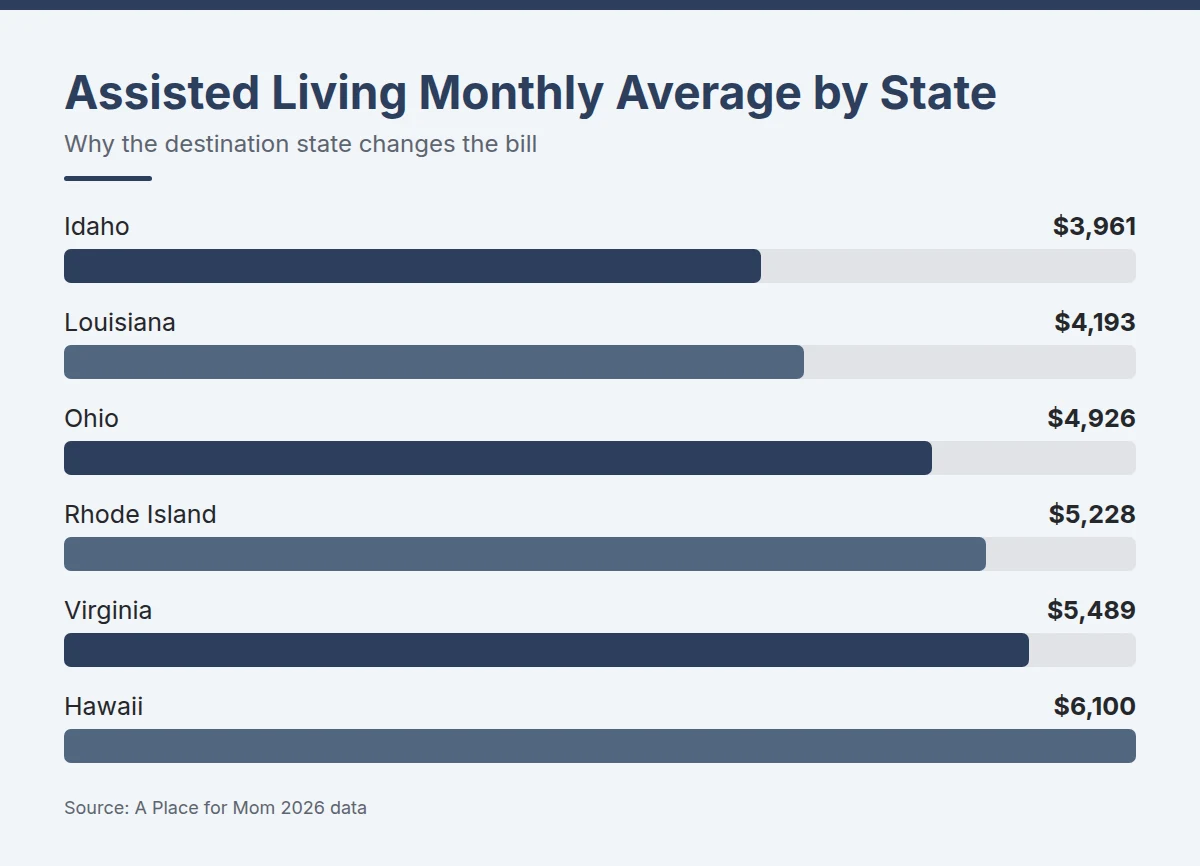
Assisted living prices vary enormously by state. Monthly averages run near $4,000 in the least expensive states and above $6,000 in the most expensive, with much of the Midwest and South falling in the $4,200 to $5,500 band. Moving a parent from a low-cost state to a high-cost one can add thirty thousand dollars a year to the bill, which buys a great deal of travel and paid in-home help back where she already lives.
Stack the reset costs on top: two or three months of private pay while Medicaid reprocesses, the surrendered waiver slot and the wait for a new one, possibly a lost PACE enrollment, and new provider relationships built from zero at an age when continuity has real clinical value.
Staying put deserves serious weight when your parent already holds an active Medicaid waiver slot, when she is medically stable with physicians who know her, when the destination state’s license rules would not accommodate her care needs, or when the cost difference is large and the family support she already has locally is real. Our aging in place versus senior living decision guide works through that comparison in more depth.
Moving wins when the current arrangement is genuinely unsafe, when there is no local support and no money to buy it, when your parent is still private pay so no benefit is being surrendered, or when she is heading into a stage where a family member physically present is worth more than any program.
Do This Before the Truck
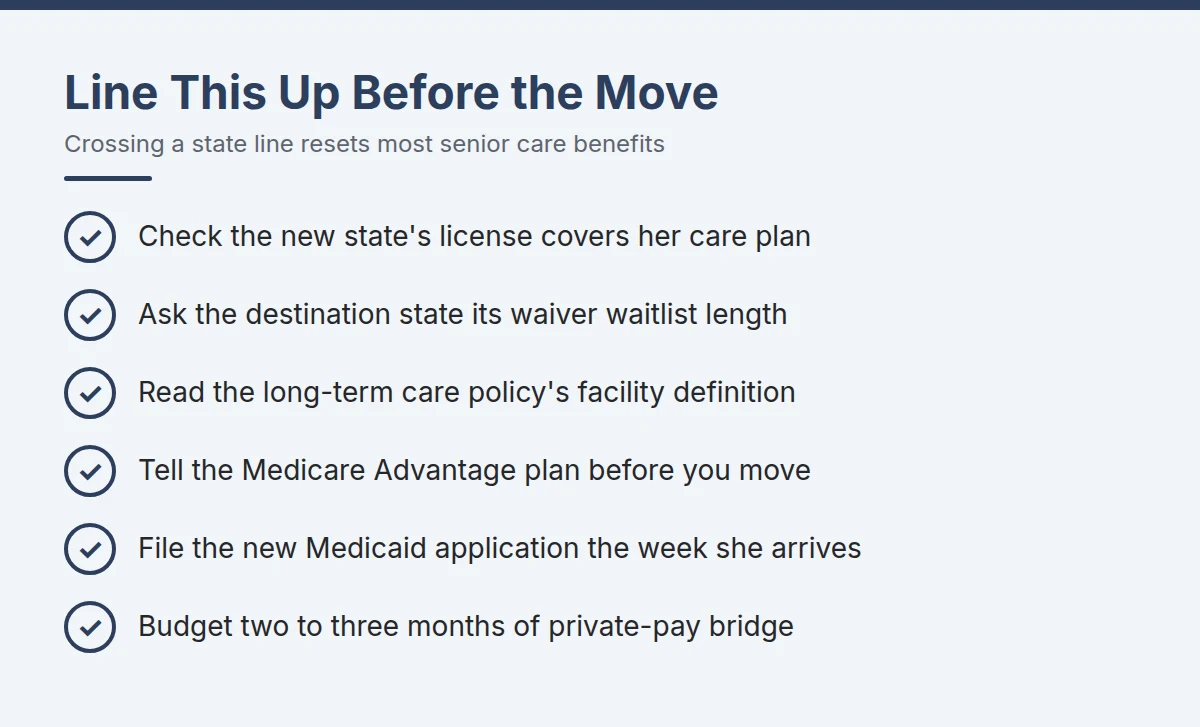
Three months of lead time turns most of this from a crisis into an errand. Confirm what the destination state calls its assisted living licenses and whether one covers your parent’s care plan. Call the new Area Agency on Aging and get the waiver waitlist length out loud. Read the long-term care policy’s facility definition. Notify the Medicare Advantage or Part D plan before the move, not after. Have the Medicaid application ready to file the week residency begins, and budget a private-pay bridge for the gap.
None of this is legal or financial advice, and every rule described here varies by state. Before you commit to a move, spend an hour with an elder law attorney licensed in the destination state and a call with that state’s Area Agency on Aging. A parent’s location is one of the few decisions in senior care that is genuinely hard to reverse, and it is worth being slow about.
Further reading (sources)
- Medicaid.gov on why eligibility is determined state by state, so coverage must be closed and reopened
- KFF for how long people actually wait on home and community based services lists
- Medicare.gov with the enrollment window that opens when a plan’s service area no longer covers you
- AHCA/NCAL covering how each state writes its own assisted living rules
- Centers for Medicare & Medicaid Services on how Long-Term Care Partnership asset protection works across states
- Medicare.gov for how PACE enrollment depends on living inside a service area
- U.S. Department of Veterans Affairs with the pension benefit that travels wherever a veteran lives
- Administration for Community Living for what long-term care costs and who pays for it
- Eldercare Locator for reaching the Area Agency on Aging in the state you are moving to