Part D and the Long-Term Care Pharmacy: How Drug Coverage Changes After a Move
Published on September 20, 2026

The first statement after a move usually holds a surprise. Somewhere under the rent and the care level there is a line for a pharmacy nobody in the family chose, from a company nobody has heard of, and the pills now arrive in sealed cards of thirty bubbles instead of the amber bottles that used to sit on the kitchen windowsill. Nobody explained this at the tour. It just started happening.
What happened is that your parent’s prescription drug coverage got rewired. The insurance plan is usually the same one they had last month. The pharmacy filling it almost never is, and that single change moves the formulary math, the refill schedule, and the share of the bill that Medicare refuses to touch. A nursing home admission also opens an enrollment period most families never learn about, which is the one piece of good news in this article.
Here is what changes, what should never appear on the private bill, and the questions worth asking in the week before move-in rather than the month after.
Part D Is the Piece That Follows Your Parent
Medicare Part D is the drug benefit, and unlike hospital and doctor coverage it is not run by the government. It is optional, and it is sold by private insurers approved by Medicare, either as a standalone drug plan that sits alongside Original Medicare or as the drug portion built into a Medicare Advantage plan.
For 2026 the benefit has a shape worth knowing, because a resident on a dozen prescriptions will travel the whole thing. A plan may charge a deductible of up to $615. After that the enrollee pays 25 percent coinsurance on covered drugs until out-of-pocket spending reaches $2,100 for the year. From that point the plan pays everything and cost sharing drops to zero. That annual cap is the single most useful number for a family budgeting a senior living move, because it puts a ceiling on the covered-drug portion of the bill that did not exist a few years ago.
What a move does not change is the plan itself. Nobody is automatically switched, the formulary does not adjust to the new address, and coverage does not lapse. What changes is the store.
The Pharmacy Changes, Usually on Day One
Assisted living communities and nursing homes almost never fill prescriptions through a retail chain. They contract with a long-term care pharmacy: a closed operation with no storefront, which delivers on a route, packages doses to match a medication cart, keeps an emergency supply on site, and answers a phone at three in the morning. That model exists for good operational reasons, and it is the reason the pills changed shape.
Medicare requires drug plans to make room for these pharmacies. A Part D sponsor must offer standard contracting terms and conditions, including the performance and service criteria CMS specifies for long-term care pharmacies, to every such pharmacy in its service area, and must provide convenient access to them. Read that carefully, though. The plan has to make the offer. The pharmacy does not have to accept it. Mismatches are entirely possible, and the consequence is expensive: fill a prescription at a pharmacy outside the plan’s network and your parent will generally pay the full price.

Two more rules explain things families otherwise misread as billing errors.
Short fills are deliberate. In a long-term care facility, brand-name solid oral doses have to be dispensed in increments of no more than 14 days at a time. The point is waste: when a drug is stopped after four days, a 14-day card wastes far less than a 90-day bottle. The side effect is that statements show more frequent fills than the family is used to seeing.
A new plan gives you a grace period, not a solution. During the first 90 days under a new plan, the plan must cover a temporary supply of a drug that is not on its list, generally at least a month’s worth. That buys time to file an exception request. It does not mean the drug is covered going forward.
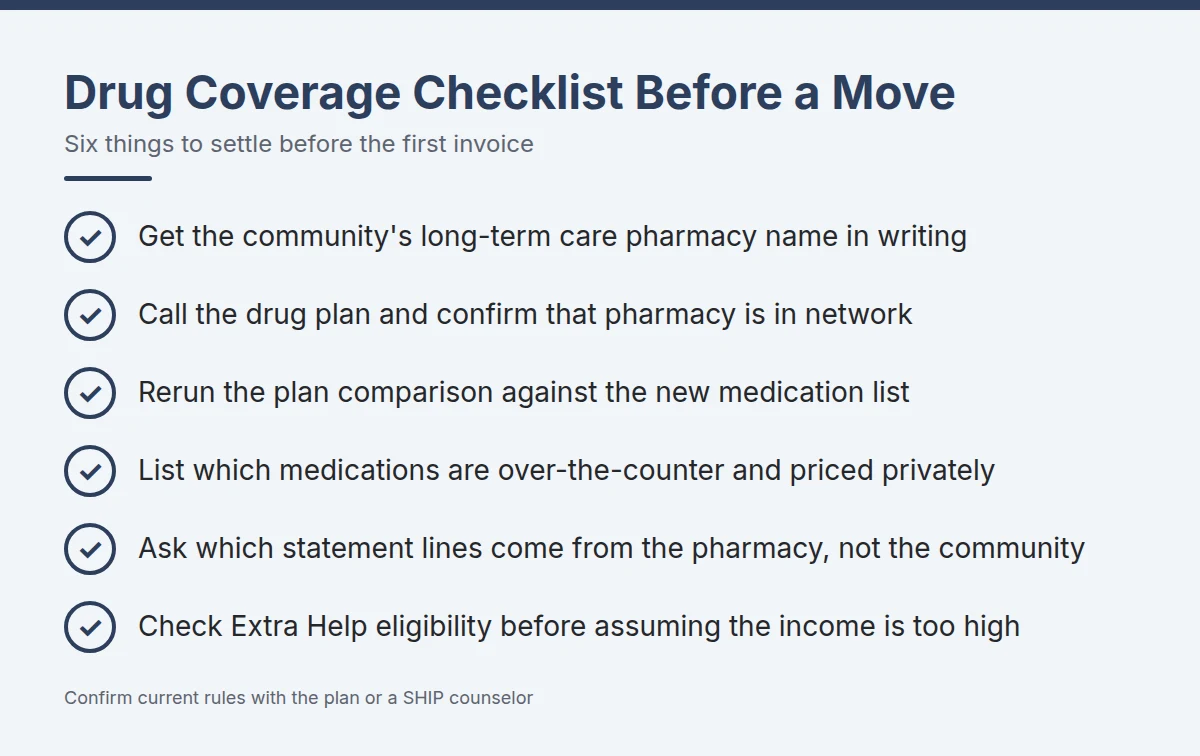
The practical move is to get the pharmacy’s name in writing before move-in, call the drug plan, and confirm the contract exists. Ask before the first fill, not after the first invoice.
What Lands on the Private Bill
Three separate things end up on the family’s side of the ledger, and they get conflated constantly.
Drugs Part D is not allowed to cover. Federal law lets drug plans exclude whole categories, including over-the-counter products, vitamins and minerals, drugs used for weight loss or weight gain, fertility drugs, drugs for cosmetic purposes, and drugs for the symptomatic relief of coughs and colds. This is not a plan being stingy. A resident taking a daily multivitamin, a stool softener, and an over-the-counter pain reliever is buying all three privately, and at facility markup those small items add up faster than families expect.
Drugs the plan covers but its rules block. Prior authorization, step therapy, tier placement, and mid-year formulary changes all still apply inside a nursing home. A drug your parent has taken for nine years can land in a higher tier in January.
Facility charges that are not drug charges at all. The fee for staff actually handing over the medication is a care charge, priced off the care assessment, and it is separate from anything the pharmacy bills. Our guides to medication management in assisted living and to how the care assessment sets the price cover that side of it.
Packaging and delivery are the category worth pushing on. Under Medicare’s rules the negotiated price of a covered Part D drug already includes any dispensing fees, and special packaging and delivery are exactly the kind of pharmacy overhead a dispensing fee exists to cover. So a separate packaging or delivery charge attached to a covered drug deserves a written explanation before anyone pays it. In a nursing home you have standing to demand one: the facility must tell a resident, orally and in writing, that an item or service carries a charge and what that charge will be. Assisted living has no federal equivalent, so there the protection is whatever the residency agreement and your state’s licensing rules say.
A Nursing Home Admission Opens a Door Most Families Never Use
Here is the part almost nobody uses. Moving into, living in, or moving out of an institution triggers a special enrollment period for Part D. Your parent can join a plan, switch plans, or drop coverage outside the normal season. The window runs for as long as they live there and for two full months after the month they move out.
That matters because the plan chosen for someone living at home was chosen against a different drug list and a corner drugstore. After a nursing home admission the drug list often changes substantially within weeks. Rerunning the plan comparison with the new medication list, and with the facility’s pharmacy as the pharmacy, is one of the highest-value hours a family can spend.
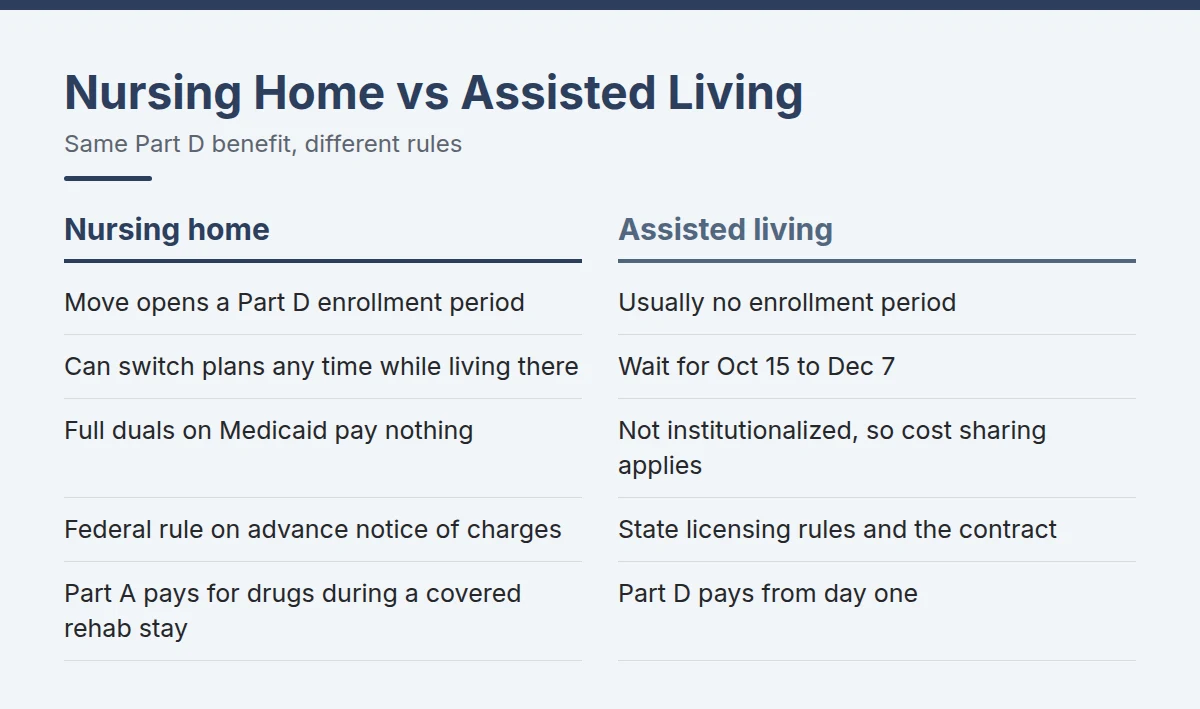
Now the trap. Medicare’s own description of this enrollment period names nursing homes and rehabilitation hospitals. Assisted living does not appear. An assisted living move opens an enrollment period only if it carries your parent outside the plan’s service area or otherwise changes the plan options available to them, and since drug plan regions are typically statewide, a move across town usually does neither. For most assisted living families the next chance to change plans is Medicare’s regular Open Enrollment, October 15 through December 7. The exception is anyone with Medicaid or Extra Help, who can generally change drug coverage once a month.
During a Rehab Stay, Part D Steps Aside
A large share of senior living moves start with a hospital stay and a rehab stint, and that sequence hides the drug bill for a while.
During a Medicare-covered skilled nursing stay, medications are part of what Part A pays for, alongside the room, the meals, and the therapy. In 2026 that means $0 a day for days 1 through 20 after the $1,736 deductible, and $217 a day for days 21 through 100. Part D cannot pay for a drug already covered under Part A or Part B for that person, so during those covered days the drug plan is simply idle.
The moment Part A coverage ends, whether at day 100 or at a cutoff the facility announces on a Wednesday, Part D wakes up and the drug charges appear. Families read the jump as a price increase. It is a change of payer. If a cutoff is what triggered it, our guide to appealing a Medicare rehab cutoff explains the fast appeal, and our overview of what Medicare actually pays for in senior housing maps the rest of the boundary.
The Penalty for the Parent Who Never Took Anything
Part D carries a late enrollment penalty, and it is built to catch exactly the person who ends up in assisted living.
The math is 1 percent of the national base beneficiary premium, which is $38.99 in 2026, multiplied by the number of full months your parent went without Part D or other creditable drug coverage after becoming eligible, rounded to the nearest ten cents. Fourteen uncovered months means a 14 percent surcharge. It is added to the monthly premium, it lasts for as long as they hold Part D coverage, and because the base premium is reset annually, the dollar amount can climb over time.
The scenario writes itself. A healthy 65-year-old takes nothing, skips the drug plan, and feels vindicated for years. At 82 they enter assisted living on nine prescriptions and enroll, carrying a permanent surcharge into the most expensive chapter of their life. Creditable coverage from an employer, a retiree plan, the VA, or TRICARE prevents this, which is why those annual creditable coverage notices are worth keeping in the move file rather than the recycling.
If the Numbers Do Not Work
Three programs are worth checking before anyone concludes the drugs are unaffordable.
Extra Help lowers premiums, deductibles, and copays for people with limited income and resources. For 2026 the income limits are $23,940 for an individual and $32,460 for a married couple living together, with resource limits of $18,090 and $36,100. Many families assume they earn too much and never apply.
Full Medicaid plus institutional status eliminates drug cost sharing outright. Full-benefit dual eligible individuals who are institutionalized, or who are receiving home and community-based services, have no cost sharing for Part D drugs. Read “institutionalized” narrowly: it means an inpatient in a medical institution or nursing facility that Medicaid is paying for throughout a month. An assisted living apartment is not that, which is one more way the two settings diverge on paper. Our guide to Medicaid eligibility and spend-down covers how a parent reaches full-benefit status in the first place.
The Medicare Prescription Payment Plan lets any enrollee spread out-of-pocket drug costs across the calendar year in capped monthly payments instead of paying at the counter. Every drug plan must offer it and it costs nothing to join. Be clear about what it does: it smooths the cash flow, it does not reduce the total. It helps most when the costs land early in the year, which is common when a January deductible collides with a new long-term care pharmacy.
What to Ask Before the Move
Take this list to the admissions conversation:
- Which long-term care pharmacy do you use, and is it in my parent’s drug plan’s network?
- Can my parent keep using a different pharmacy, and what would that pharmacy have to do to meet your packaging requirements?
- Which charges on the monthly statement come from the pharmacy and which come from you?
- Is there any packaging, delivery, or handling fee, and what covered drug is it attached to?
- Which of my parent’s current medications are over-the-counter, and what do they cost here?
- Who reviews the medication list after admission, and who tells me when something changes?
Then, separately from the community, sit down with the current medication list and rerun the plan comparison. If your parent is entering a nursing home, you have an enrollment period to use. If they are entering assisted living, you probably do not, so the comparison needs to happen before the December 7 deadline.
Plan rules, formularies, and dollar figures change every year, and state law governs much of what an assisted living community may require. Confirm the specifics with the drug plan, with your State Health Insurance Assistance Program, which offers free and unbiased Medicare counseling, or with an elder law attorney when the money at stake is large. Nothing here is legal or financial advice. What it is meant to do is make the first statement after the move readable, so that the line nobody explained turns into a question somebody can answer.
Further reading (sources)
- Medicare.gov on how the late enrollment penalty is calculated and the 2026 base premium
- Medicare.gov for the 2026 Extra Help income and resource limits
- CMS with the CY 2026 deductible ceiling, coinsurance, and out-of-pocket threshold
- CMS explaining capped monthly payments under the Medicare Prescription Payment Plan
- 42 CFR 423.120 for long-term care pharmacy network access and the 90-day transition supply
- 42 CFR 423.154 on 14-day dispensing and uniform packaging in long-term care facilities
- 42 CFR 423.100 covering what a negotiated price must already include
- 42 CFR 423.38 with the enrollment periods a move can open
- 42 CFR 423.782 for zero cost sharing for institutionalized dual eligible residents
- 42 CFR 423.772 defining who counts as institutionalized, and who does not
- 42 CFR 483.10 on a nursing home resident’s right to be told about a charge in advance
- 42 USC 1395w-102 listing the drug categories Part D is permitted to exclude
- State Health Insurance Assistance Programs for a state-by-state directory of local Medicare counseling offices