Warning Signs a Senior Living Community Is in Financial Trouble, and What Families Can Do Before a Sale or Closure
Published on September 29, 2026

The letter usually comes with little warning. It is slipped under apartment doors and emailed to whoever is listed as the responsible party, and it says one of two things: the community has signed an agreement with a new owner, or the community is going to close. Either way, it thanks residents for their patience during the transition. For most families, that letter is the first official word that anything was wrong.
It is rarely the first sign. By the time a struggling community is sold or shut, the evidence has usually been in plain view for months: the ceiling stain nobody fixed, the third executive director in two years, the agency aides who do not know your mother’s name, the banner out front offering months of free rent. This guide covers how to read those signals, which public records can confirm or rule them out, and what to do at each stage before anyone announces anything. What happens after an announcement is a separate subject, and our guide to resident rights, contracts and recourse covers it.
A Full Market Does Not Mean a Healthy Building
Senior housing is filling up. NIC MAP, which tracks occupancy for the industry, put average occupancy across its 31 primary markets, the country’s largest metro areas, at 89.9% in the second quarter of 2026. That was the 20th straight quarter of gains, and 15 of those markets were at or above 90%.
That average hides a widening split. When the National Investment Center for Seniors Housing & Care compared operating margins property by property, it found the typical community had recovered to roughly its 2018 profitability, but the gap between the strongest and weakest performers was “considerably wider” than it was in 2018. In assisted living, the top quarter of properties earned margins above 40% in 2025, while the bottom quarter was still losing money. Labor is the largest expense in senior housing, and assisted living, being more care-intensive, feels it most. Two buildings in the same town, drawing on the same demand, can be heading in opposite directions.
Buildings are also changing hands at a remarkable pace. MSCI counted more than $12.1 billion in U.S. senior living property sales in the first quarter of this year, the most in any quarter in at least 20 years, according to figures it gave Bisnow. Many of those deals say nothing bad about the buildings; deal announcements from a single week in late August described communities sold as “top-performing” and “premier.” But part of the market specializes in the other kind. One operator that grows by taking over struggling communities told Senior Housing News in August that its model is to “go into broken communities, broken assets, and turn them around.”
A sale, in other words, can be the rescue rather than the problem. What matters for your parent is whether the building was failing before anyone bought it, and failure shows up in daily life long before it shows up in a press release.
The Signals You Can See From the Hallway
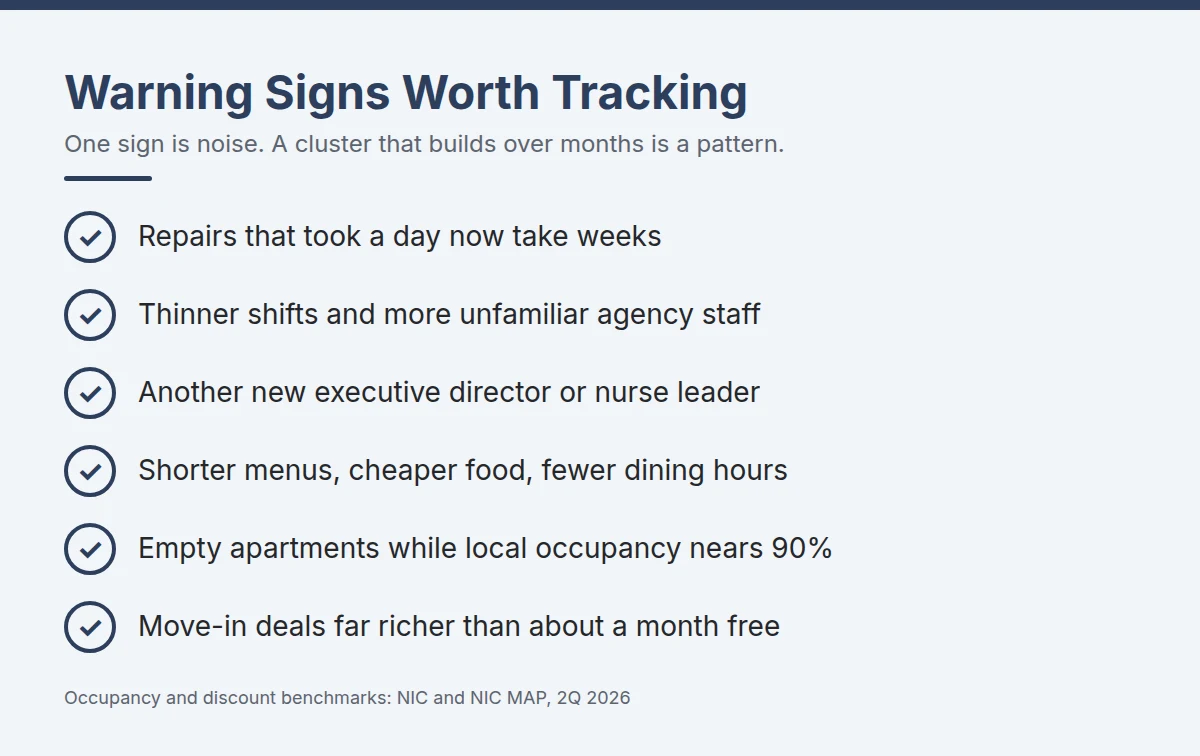
No single observation proves a community is in trouble. Buildings have bad months, good staff leave for ordinary reasons, and a stained ceiling tile is sometimes just a stained ceiling tile. What you are looking for is a cluster of changes moving in the same direction over several months. These tend to show up first.
Repairs slow down. Maintenance is one of the easiest costs to postpone, because the damage builds quietly. Watch for repair requests that used to take a day and now take weeks, an elevator or dining room air conditioner that stays broken, worn carpet and dead light bulbs in common areas, and a renovation that stops halfway.
Shifts thin out and the faces keep changing. Fewer aides on evenings and weekends, slower answers to call buttons, a shrinking activities calendar, and more temporary agency workers who do not know the residents. The churn itself matters. Tracking roughly 14,000 nursing homes, Shen and colleagues found that when staff turnover rose within the same facility, inspectors issued more citations and quality measures slipped.
Leadership keeps turning over. Watch three jobs in particular: the executive director, the nurse or wellness director who runs care, and the director of sales. The turnaround operator quoted above named those same executive director, clinical and sales roles as vital to a recovery. In nursing homes, Pradhan and colleagues found that one administrator departure in a year lowered the likelihood of a higher quality star rating by 14%, and several departures by 25%, an effect that ran through the nurse turnover that followed.
The dining room changes. Shorter menus, cheaper substitutions, fewer choices at dinner, shorter serving hours, or a switch to an outside food contractor. Food service is one of the five complaint categories that long-term care ombudsmen handle most often in assisted living and board and care homes, along with staffing and discharge.
Vendors come and go. A new pharmacy, therapy company or supply vendor every few months can mean unpaid bills. So can running short of routine supplies such as gloves or incontinence products, or staff mentioning late paychecks or cut benefits. The staff usually know before anyone else.
The building empties while the market fills. Dark windows at night, closed-off hallways, a thinner dining room, and move-outs that are not being replaced. In a market running near 90% occupancy, a community that is losing residents has a problem the market does not explain. Ask the executive director what occupancy is today and what it was a year ago.

The discounts get deep. Move-in specials are normal. NIC’s rate data for June 2026 put the gap between the advertised rate and what new residents actually paid at about 1.1 months of rent a year in assisted living and 1.3 months in independent living. A community offering several months free in a strong market, or a steep discount for paying a year up front, may be short of cash rather than generous.
None of these is a warning sign on its own: not a sale, not a new name on the sign, not one poor inspection, not a well-liked director moving on, not a routine month-free special. Each has innocent explanations. The pattern is what counts.
The Public Records That Confirm It or Rule It Out
Families tend to assume a community’s finances are private, and many details are. But a surprising amount sits on the public record, and what exists depends on the kind of community. Independent living, which generally is not licensed because it does not provide care, leaves the thinnest trail. Licensed care settings, nursing homes and bond-financed nonprofits leave much more.
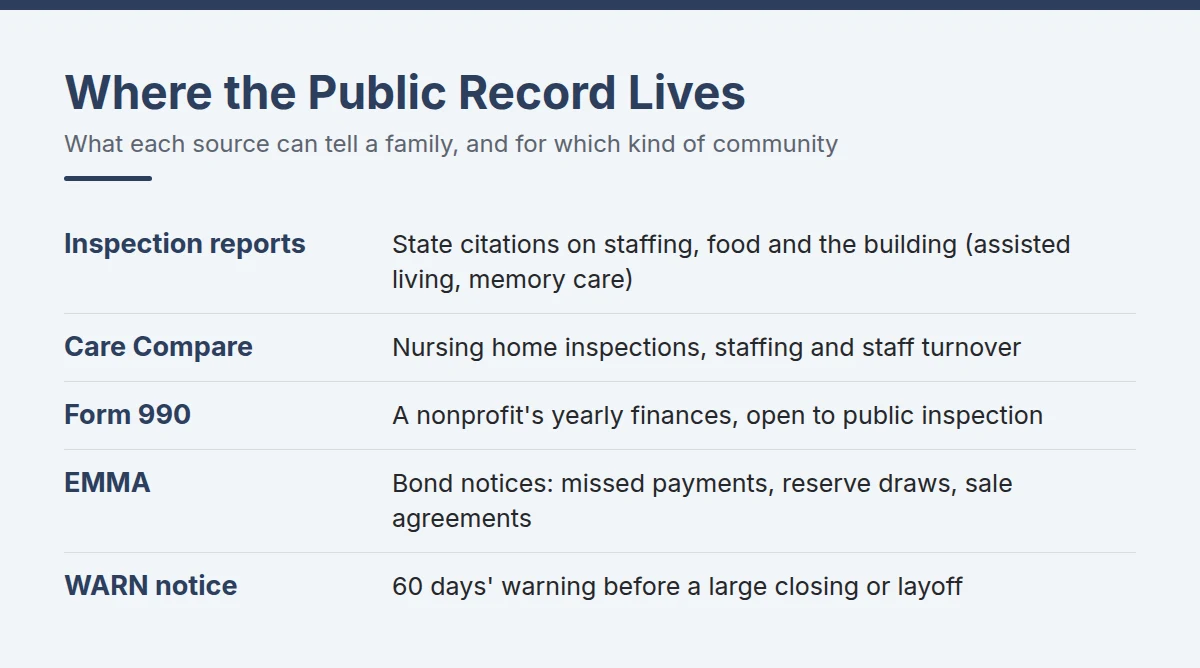
Assisted living and memory care. States license and inspect these communities, and many post inspection reports and complaint findings online, though how easy they are to find varies widely. Read the last two or three years. Look for citations involving staffing, food service and the condition of the building, and for enforcement actions such as fines or a freeze on new admissions. This is more than a quality check. When June and colleagues followed 1,939 Florida assisted living facilities, 7.3% closed within two years, and facilities with more deficiencies, fewer beds or no Medicaid acceptance were more likely to be among them.
Nursing homes, including the skilled nursing wing of a continuing care campus. Medicare’s Care Compare site shows inspection results, staffing levels and, since 2022, the annual turnover of nurses and administrators. CMS also publishes change-of-ownership records for skilled nursing facilities back to 2016, so you can see how often a building has been sold. The research on closures points to familiar risk factors. In Castle and colleagues’ national study, nursing homes with more deficiency citations, fewer beds or heavy local competition were more likely to close. And a 2026 study of 40 years of federal records by Chung and colleagues found that closure often comes as one step in a longer run of ownership changes and shifts in bed capacity, rather than as a single event.
Nonprofit communities, including many life plan communities (also called CCRCs). A tax-exempt organization must make its annual Form 990 available for public inspection for three years. Read several years side by side to see whether revenue covers expenses and whether net assets are shrinking.
Communities financed with tax-exempt bonds, which includes many nonprofit life plan communities. Their filings are free to read on EMMA, the Municipal Securities Rulemaking Board’s disclosure website. Under the SEC rule that governs most publicly sold municipal bonds, the borrower commits to post notice within ten business days of specific events, including missed payments, unscheduled draws on reserve funds that reflect financial difficulty, rating changes, bankruptcy or receivership, and, where material, a signed agreement to sell substantially all its assets. Annual financial statements go there too. Search the community’s name and read the most recent event notices first.
Local records and WARN notices. County recorder and court websites can turn up liens filed by unpaid contractors, lawsuits by vendors and foreclosure filings, and the county tax office can tell you whether property taxes are current. A large community planning to close usually has to warn the state, too. The federal WARN Act requires employers with 100 or more full-time employees to give 60 days’ written notice to workers, the state’s dislocated worker unit and the local government before a shutdown that will cost 50 or more jobs at one site. Many states post the notices they receive online.
What to Do at Each Stage
When something feels off. Start a dated log: staffing on the shifts you visit, repair requests and how long they took, menu changes, and anything your parent mentions. Photos help. Compare notes with other families, and go to resident council or family council meetings, where these patterns tend to surface first. Then put the questions that matter to the executive director in writing. Is the community for sale or under contract? Is the management company changing? What is occupancy now compared with a year ago? How many executive directors and nursing directors has the building had in two years? A community does not have to answer everything, but a straight answer, an evasive one and a refusal each tell you something.
When the signs pile up. Check the records above. Reread the residency agreement for four things: how much notice the community owes before closing or ending a service, what happens to the contract if the building is sold, which deposits and fees are refundable and when, and the discharge terms. Keep payments monthly and turn down offers to prepay. If your parent holds a refundable entrance fee at a continuing care community, take the risk seriously. The Government Accountability Office found that residents could lose the refundable portion, which can run to hundreds of thousands of dollars, if the community ran into financial trouble, because in a bankruptcy their claims rank behind secured creditors such as bondholders and mortgage lenders. That is a question for an elder law attorney.
This is also the moment to build a quiet backup plan:
- Gather the file. Copies of the care plan, the latest assessment, the medication list and physician orders, plus signed powers of attorney and health care directives. Our guide to the paperwork to have in place before a senior move explains what each document does.
- Sort out the equipment. Know which wheelchairs, beds and oxygen equipment belong to your parent or a supplier and which belong to the community. Our guide to who pays for medical equipment in senior housing explains why a move does not restart a Medicare rental.
- Shortlist the alternatives. Tour two or three communities and put your parent’s name on a waitlist where it costs little or nothing. In a market this tight, as our look at the senior housing supply crunch shows, the families already in line get the openings.

When care starts to slip. Care problems are reportable whatever the building’s finances. Call your state’s long-term care ombudsman, a free advocate for residents of nursing homes, assisted living and board and care homes, and file a complaint with the state licensing agency when the problem involves care or safety. Your log becomes evidence. Ombudsman programs worked on nearly 203,000 complaints in federal fiscal year 2023 and resolved or partly resolved 71% of them to the satisfaction of the resident or the person who complained.
If the owner files for bankruptcy. Federal bankruptcy law counts assisted living facilities, nursing homes and homes for the aged as health care businesses. When one files, the court must appoint a patient care ombudsman within 30 days unless it decides one is not needed, and the state long-term care ombudsman can be named to the role. That ombudsman monitors care and reports to the court at least every 60 days. If the business is closing, the trustee must use “all reasonable and best efforts” to move residents to an appropriate facility nearby that offers substantially similar services.
When a sale or closure is announced. A sale is not automatically bad news, and a buyer that specializes in turnarounds may be the best thing to happen to a struggling building in years. Ask the new operator about its plans for rates, staffing and services, and get any promises in writing. A closure starts a clock. A nursing home must give residents, their representatives, the state and the long-term care ombudsman at least 60 days’ written notice, stop admitting new residents, and follow a state-approved relocation plan. Assisted living notice rules are set by each state and vary widely. Sixty days sounds like plenty until you are hunting for a memory care bed in a market that is 90% full, which is the whole case for noticing sooner.

The Families Who Come Through It Best
Most communities that change hands are healthy, and many that struggle recover or find a buyer without ever closing. But the families who come through a sale or closure best tend to be the ones who saw it coming. They kept records, knew their contract and had a second option lined up before the letter arrived.
Licensing, inspection reporting and closure notice rules vary significantly by state, and independent living, assisted living, memory care, nursing homes and continuing care communities are each regulated differently. If your parent has significant money at stake, such as an entrance fee or a large deposit, have the contract reviewed by an elder law attorney, and consider a certified senior care advisor for help weighing a move. Nothing in this article is legal or financial advice.
Further reading (sources)
- NIC MAP on second-quarter 2026 occupancy across its 31 primary markets
- National Investment Center for Seniors Housing & Care for why strong occupancy has not lifted every building’s margins, and for how far move-in rates ran below asking rates in mid-2026
- Bisnow with a record first quarter for senior living property sales
- Senior Housing News on an operator that grows by turning around struggling communities, and on late-August sales of communities billed as top-performing
- June and colleagues for which Florida assisted living facilities closed, and what they had in common
- Castle and colleagues on the factors behind rising nursing home closures
- Chung and colleagues with four decades of nursing home closures and ownership changes
- Shen and colleagues on staff turnover and quality of care in nursing homes
- Pradhan and colleagues for administrator turnover and nursing home star ratings
- Centers for Medicare & Medicaid Services on adding nurse and administrator turnover to nursing home ratings, with its change-of-ownership records for skilled nursing facilities
- Internal Revenue Service for which nonprofit tax returns must be open to public inspection
- Municipal Securities Rulemaking Board on continuing disclosure and the EMMA website, alongside SEC Rule 15c2-12 and its list of reportable events
- U.S. Government Accountability Office with the risks continuing care residents carry, including entrance fees
- WARN Act text for who counts as a covered employer and the 60-day notice rule
- U.S. Bankruptcy Code on what counts as a health care business, the patient care ombudsman and the trustee’s duty to relocate patients
- Code of Federal Regulations for the 60-day nursing home closure notice
- Administration for Community Living on what long-term care ombudsman programs do