How Much Help Does Your Parent Actually Need? ADLs, IADLs, and the Care Assessment
Published on September 19, 2026

The Evaluation That Happens Before the Price
Most families start a senior housing search by touring. The tour is not where the decision gets made. Somewhere between the second visit and the signature, a nurse spends three quarters of an hour with your parent, fills in a form, and produces a number. That number settles two things: whether the community will accept your parent at all, and what the monthly bill looks like on top of rent.
You cannot stop that assessment from happening, and you should not want to. What you can do is walk in already knowing roughly what it will say. Families who arrive with their own written picture of what a parent can and cannot do get fewer surprises, notice when a score reads too low or too high, and have something concrete to point at when a reassessment letter arrives eight months later. Families who arrive with “she’s doing pretty well, mostly” get whatever the form says.
The Six ADLs, and Why Two Is the Number That Matters
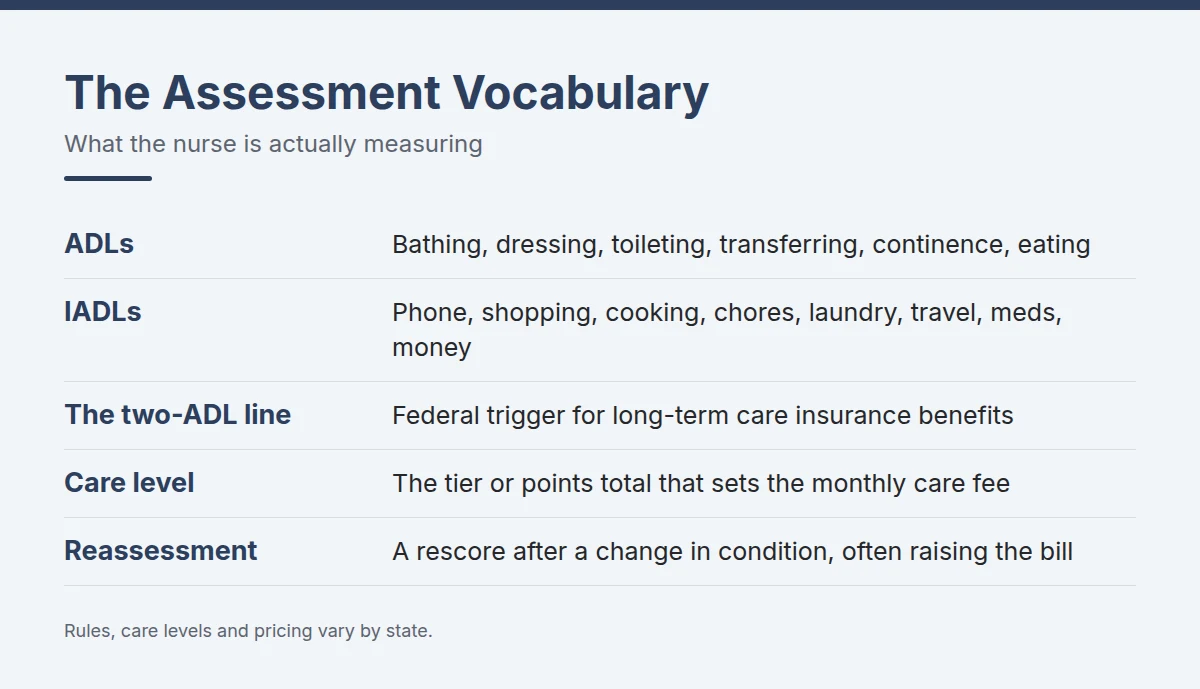
Activities of daily living are the basic physical tasks of caring for your own body. The list has been standardized since 1963, when Sidney Katz and colleagues published the Index of ADL, still the instrument most care assessments descend from. Six items: bathing, dressing, toileting, transferring, continence, and eating. The Katz version scores each one as independent or not, so 6 means full function, around 4 means moderate impairment, and 2 or less means severe functional impairment.
Two is the threshold that moves money. Federal tax law defines a “chronically ill individual” as someone certified by a licensed health care practitioner as unable to perform at least two of those six activities without substantial assistance for at least 90 days, or who needs substantial supervision because of severe cognitive impairment. That definition is the payout switch written into tax-qualified long-term care insurance policies, which is why “help with two ADLs” turns up in benefit letters and in community sales conversations alike. It is also the rough line where independent living stops being a realistic option.
Two items on the list get overlooked by families doing their own math. Transferring means moving safely between a bed, a chair, and standing, and it is the single biggest driver of staff time. Continence is a separate item from toileting: managing the function is not the same as getting to the bathroom and back. Communities price those two carefully because they know what they cost.
The IADLs: What Goes Wrong First
Instrumental activities of daily living are the more complex skills that running a household requires. The reference scale here is Lawton and Brody’s, published in 1969, which covers eight domains: using the telephone, shopping, preparing food, housekeeping, laundry, transportation, managing medications, and handling finances. It scores 0 to 8 and, importantly, is designed to be filled in either by the person or by someone who knows them.
IADLs almost always fail before ADLs do. A father who showers, dresses, and walks without help may have stopped opening the mail, stopped driving at night, and stopped cooking anything that is not toast. That is the early signal, and it is easy to miss because none of it looks like a medical emergency.
It is worth knowing that the standard base package in assisted living is largely an IADL package: meals, housekeeping, laundry, scheduled transportation, and medication management. Hands-on ADL help is what gets priced separately on top. So a parent with eight IADL problems and no ADL problems may need a move without needing much care, and their bill will look very different from a neighbor’s who needs the reverse.
Observing at Home Without Starting a Fight
The instinct is to sit a parent down and ask. Asking produces an argument and bad data. Look for evidence instead, over a few ordinary visits.
- The bathroom. Grab bars installed but unused, a tub nobody has stepped into in months, a towel that is always dry. Bathing is usually the first ADL to go and the most concealed.
- The kitchen. Expired food, an untouched stack of delivered meals, a weight change, scorched pans. Check the freezer, not the fridge.
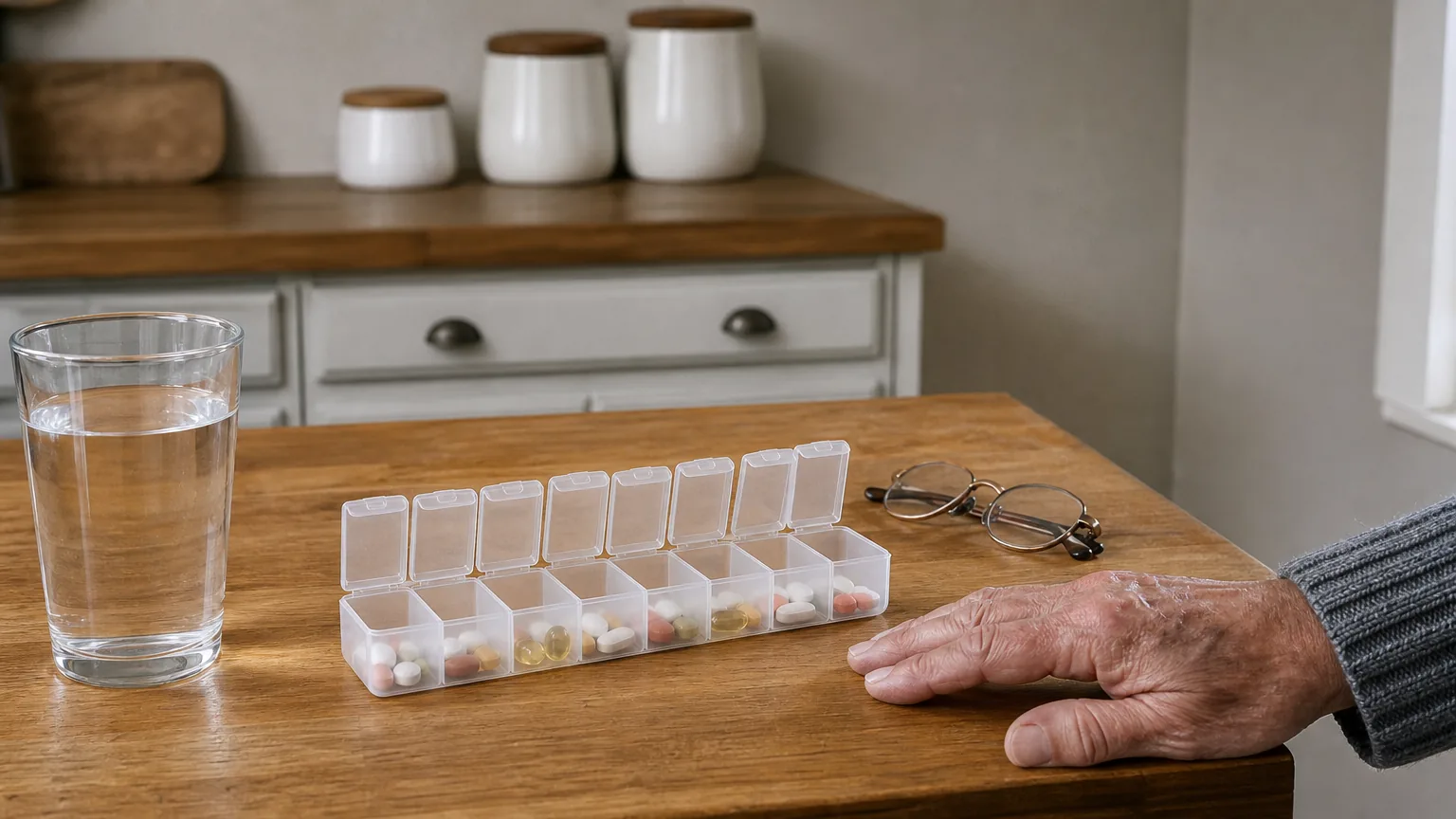
- The pill organizer. Count the leftovers midweek. This is the most objective single data point in the house.
- The mail and the bills. Unopened statements, second notices, duplicate payments, new charities.
- A transfer, watched not asked about. When your mother gets out of a low armchair, does she push off both arms, rock forward to build momentum, or reach for a hand? That is the difference between two care levels.
There is a good reason not to rely on anyone’s account, including your own. In Maturitas, Siordia catalogued the ways older adults and their informants disagree about the same person’s daily functioning, and the disagreement runs in both directions: parents under-report, and stressed adult children sometimes over-report. Research in the Journal of the American Medical Directors Association by Jang, Brodaty and colleagues went further, following 307 older adults for four years and finding that a performance-based IADL measure predicted who went on to develop dementia over and above what informants reported. Watching a task get done tells you things no interview does.
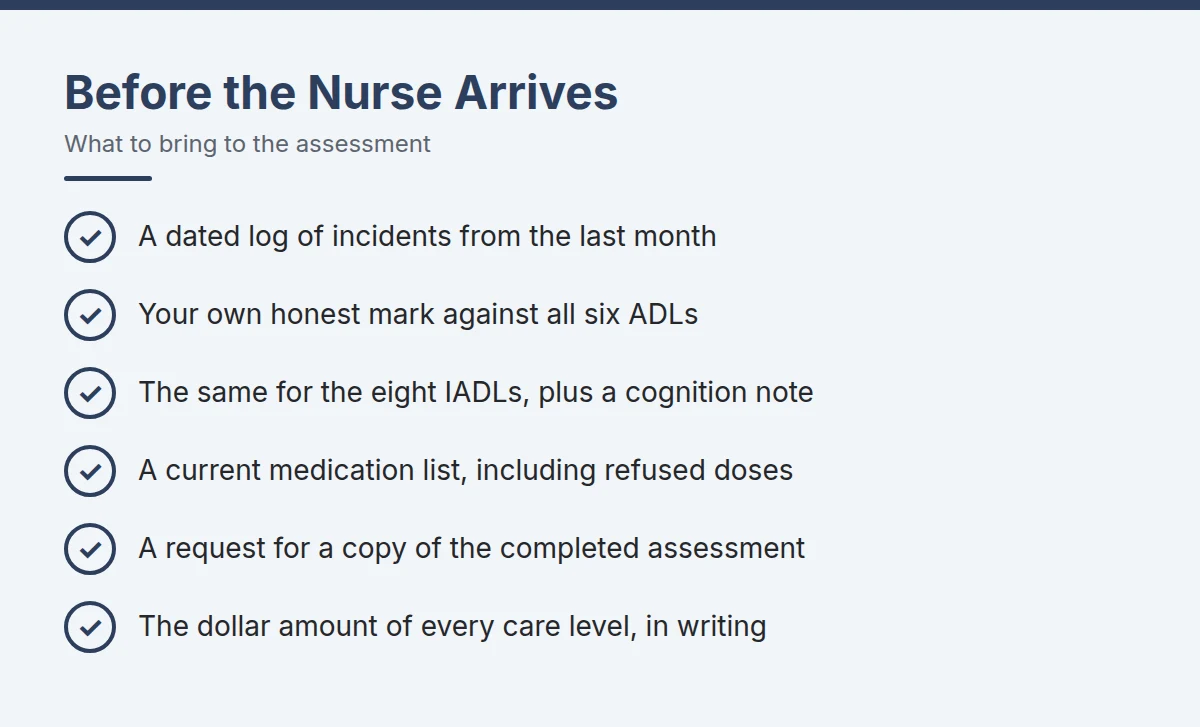
Then write it down as it happens. A dated log kept for two to four weeks, recording incidents rather than impressions, is worth more at the assessment than any amount of recollection. “September 4, needed help with the shower. September 11, missed the evening pills again” is evidence. “She’s been struggling” is not.
What the Community Nurse Actually Checks
The pre-move assessment covers the six ADLs and then keeps going, because ADLs alone do not predict staffing. Expect a nurse to work through:
- Transfers and mobility. Independent, one-person assist, two-person assist, or a mechanical lift. A lift requirement often exceeds what an assisted living license permits at all.
- Continence. Reminders, a scheduled toileting program, or full incontinence management, including who supplies the products.
- Cognition and safety awareness. Orientation, judgment, and whether a resident would try to leave the building. This is not a small subgroup: federal survey data from 2022 found 44.1% of residential care community residents had been diagnosed with Alzheimer’s disease or another dementia. If cognition is in play, what you ask on the tour changes.
- Behavioral expressions. Resistance to care, agitation at the end of the day, calling out at night. This category, more than any other, is what gets applications quietly declined.
- Medication complexity. Injections, blood thinners, eye drops, controlled substances, and whether your parent refuses doses.
- Skilled nursing tasks. Wound care, oxygen, catheters, feeding tubes, diabetic management.
- Evacuation capability. Most states require that a resident be able to leave the building with limited assistance.

Two decisions are being made at once here, and they pull in different directions: can we legally and practically serve this person, and what do we charge. It is worth remembering that the same visit answers both.
The floor under all of it is state law, and it varies. Florida requires a face-to-face medical examination on AHCA Form 1823, completed by a health care practitioner within 60 days before or 30 days after admission, covering functional limitations, medications, and the practitioner’s own opinion that the person’s needs can be met in an assisted living facility. California requires a written pre-admission appraisal of a prospective resident’s functional capabilities, mental condition, and social factors before the facility accepts them. Skilled nursing facilities do not improvise at all: they complete a federally standardized instrument, the MDS 3.0, whose Section GG scores self-care and mobility performance. Those same Section GG scores feed the therapy documentation behind a rehab stay, which is why they matter if you are ever told that Medicare coverage is ending on Friday.
From Score to Care Level to Dollars
The assessment output becomes a care level, usually either a named tier or a points total converted into a band, and that level carries a monthly charge added to base rent. Industry estimates of what each tier costs vary widely by operator and state, and our breakdown of how base rent and care levels stack up walks through the four pricing models communities use.
Three questions turn the score into something you can check:
- What is the score, and which specific items produced it? Ask for a copy of the completed assessment. A community that will not share it is telling you something.
- What exact change moves my parent to the next level, and what does that level cost in dollars? Both answers belong in writing, in the residency agreement rather than a brochure.
- Who does the scoring, and is that person compensated on move-ins? Usually the nurse and the sales director are different people, and it is a fair question to ask.
Reassessment: The Clause That Moves the Bill
The first assessment is not the last one. California requires the pre-admission appraisal to be updated in writing as often as necessary or at least once every 12 months, whichever comes first, documenting significant changes in physical, mental, cognitive, behavioral, or functional condition. Florida requires a repeat face-to-face medical examination at least every three years, or sooner after a significant change.
Those are legal minimums, not the operative rule. Almost every residency agreement permits the community to reassess whenever a resident’s condition changes, and the moment it usually happens is a return from the hospital, when your parent is temporarily at their worst. Families routinely get a care-level increase dated to a week when their mother was still recovering, and it does not automatically come back down.
So ask three more things before signing: how much written notice precedes a care-level increase, whether the family can request a downward reassessment after a recovery, and whether there is any appeal short of moving out. Get the answers in the agreement.
Bring Your Own Assessment
None of this requires clinical training. It requires a page of paper: the six ADLs with an honest mark against each, the eight IADLs the same way, a note on cognition, and a dated log of the last month. Take it to the assessment. Most nurses welcome it, because families are the only people who have watched the last two years.
The assessment is not adversarial, but it is not neutral either, and it is also not the whole picture. For a formal functional and cognitive evaluation, start with your parent’s physician or a geriatric care manager. A certified senior care advisor can help translate a score into a housing type, and an elder law attorney should read the residency agreement before anyone signs. Costs, license categories, and assessment rules differ substantially from state to state, so confirm the specifics where your parent actually lives. If you are at the very beginning of this, our guide on where to start a senior living search sets out the order to do things in. Nothing here is medical, legal, or financial advice.
Further reading (sources)
- Hartford Institute for Geriatric Nursing on the Katz Index and how its six items are scored
- Hartford Institute for Geriatric Nursing for the Lawton IADL scale and its eight domains
- 26 U.S. Code § 7702B defines the six ADLs and the two-activity threshold in federal law
- Florida Administrative Code with the pre-admission health assessment assisted living facilities must obtain
- California Code of Regulations on what a pre-admission appraisal must cover and how often it must be redone
- National Center for Health Statistics for how much help residential care residents actually need
- CMS publishes the MDS 3.0 manual behind Section GG functional scoring
- Siordia in Maturitas on how self-reports and informant reports of daily function diverge
- Jang and colleagues in JAMDA found watching a task beats asking about it when predicting dementia