What Medicare Actually Pays For in Senior Housing: A Complete Guide to the Coverage Families Assume They Have
Published on August 10, 2026

The Most Expensive Assumption in Senior Care
Almost every family that calls a senior living community for the first time arrives carrying the same belief: Mom has Medicare, so this will be covered. It is the single most expensive misunderstanding in this field, and it is not the family’s fault. Medicare pays for the surgeries, the hospital stays, the specialists. Assuming it also pays for the place where a parent lives afterward is a reasonable leap for anyone who has never had to read the rules.
The federal government’s own auditors flagged this. In a 2026 report on public spending in assisted living, the Government Accountability Office noted the concern that many consumers are simply unaware that Medicare generally does not cover assisted living services. Medicare may pay for medical care delivered inside an assisted living apartment. It does not pay the rent, and it does not pay for the help with bathing and dressing that is the entire reason most people move there.
That does not mean Medicare is irrelevant. It covers a great deal, and families routinely leave real benefits unclaimed because they gave up after hearing “Medicare doesn’t pay for that.” This guide walks the boundary line carefully: what Medicare pays, what it refuses, and who covers the rest.
The Line Medicare Draws: Skilled Care vs. Custodial Care
Every coverage decision in this article traces back to one distinction.
Skilled care is care that must be delivered or supervised by licensed professionals: wound care, IV medication, injections, physical or occupational therapy, monitoring an unstable condition. Medicare covers skilled care, in the right setting, for a limited time.
Custodial care is help with the activities of daily living: bathing, dressing, toileting, transferring, eating, moving safely around a room. It requires patience, training, and presence, but not a nursing license. Medicare does not cover custodial care. Not at home, not in assisted living, not in a nursing home, no matter how genuinely a person needs it.
Custodial care is precisely what senior housing sells. That is the whole gap, in one sentence.

The 100-Day Skilled Nursing Benefit and Its Fine Print
The benefit families have usually heard about is real, and it is narrower than the headline number suggests. Medicare Part A covers up to 100 days in a skilled nursing facility per benefit period. Four conditions have to line up.
A qualifying inpatient hospital stay. The patient must have been formally admitted as an inpatient for at least three consecutive midnights, not counting the day of discharge. This is where families get ambushed. A parent can spend four nights in a hospital bed, receiving tests and treatment, and still be classified as an outpatient under observation, which does not qualify. Hospitals must give a written Medicare Outpatient Observation Notice to patients kept in observation more than 24 hours, but the notice arrives in a stack of admission paperwork nobody reads. Ask the question out loud, every day: “Is my parent admitted as an inpatient, or under observation?”
Admission within 30 days, generally, to a Medicare-certified facility for a condition related to the hospital stay.
A daily need for skilled care. Once the patient no longer requires skilled nursing or therapy, coverage ends, even on day 12 of 100.
The cost sharing. Days 1 through 20 cost nothing. Days 21 through 100 carry a daily coinsurance charge, more than $200 a day in recent years, which Medicare resets annually. Most Medigap supplement plans cover that coinsurance, which is one of the strongest practical arguments for holding a supplement. Day 101 is entirely on the family.
Two more things are worth knowing. A benefit period ends after 60 consecutive days out of a hospital or skilled nursing facility, and a new one brings a fresh 100 days along with a fresh deductible. And the “improvement standard” is a myth. Under the 2013 Jimmo v. Sebelius settlement, Medicare cannot deny skilled coverage simply because a patient has plateaued. Skilled care to maintain function or slow decline is covered when it is genuinely needed. If a facility says your parent is being cut off because they have stopped progressing, that is an appealable decision, and appeals succeed more often than families expect.
Home Health: Real Coverage, Narrow Rules
Medicare’s home health benefit is generous within its boundaries and widely underused. If a doctor certifies that your parent is homebound, meaning leaving home requires considerable effort or help, and needs intermittent skilled nursing or therapy, Medicare covers home visits at no cost to the patient: skilled nursing, physical and occupational therapy, speech therapy, medical social services, and a home health aide for personal care.

The catch comes down to two limits. Intermittent means part-time visits, not continuous coverage. The aide is also available only alongside a skilled need. When the skilled need ends, the aide ends with it. Medicare will not fund 24-hour care at home, meal delivery, homemaker services, or an aide whose only job is help with daily living. Families who need that hire it privately, which is a major factor in the stay home or move calculation.
Hospice, Therapy, and Equipment
Hospice is the most comprehensive benefit in the program. For a patient certified with a prognosis of six months or less who elects comfort care over curative treatment, Medicare Part A covers the interdisciplinary team, medications for the terminal illness, equipment, and bereavement support, usually with no copays. It still does not cover room and board, so an assisted living bill continues in full. Our guide to hospice across settings covers how that plays out.
Outpatient therapy under Part B has no hard dollar cap anymore. Past an annual threshold, the therapist simply has to document that continued therapy is medically necessary. Patients pay 20 percent after the Part B deductible.
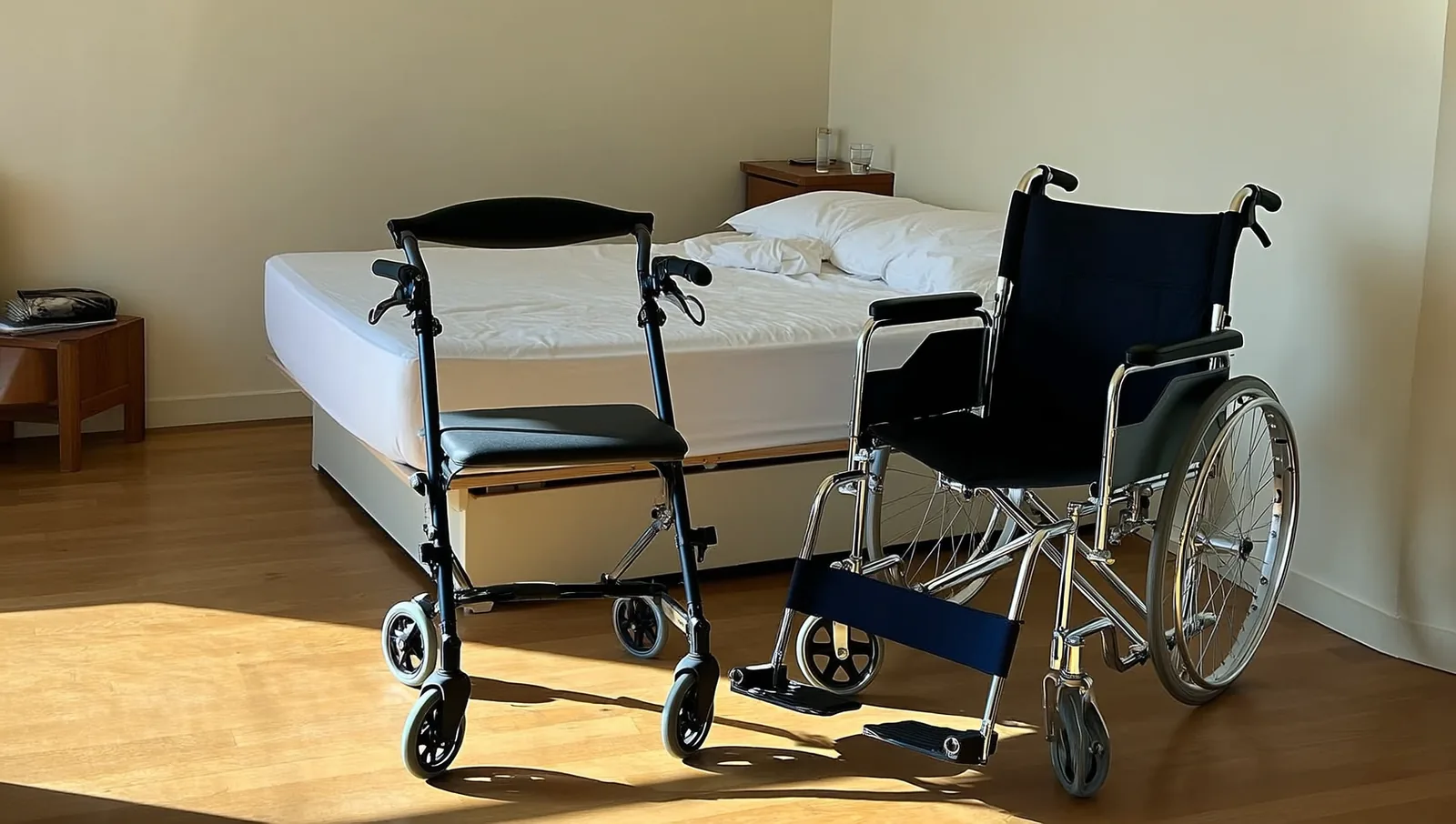
Durable medical equipment is a quiet win. Part B pays 80 percent of wheelchairs, walkers, hospital beds, oxygen, and similar equipment prescribed for use in the home, and for this purpose an assisted living apartment counts as the home. A skilled nursing facility does not, because the facility is expected to supply equipment itself. Note what is excluded: grab bars, stair lifts, walk-in tubs, and ramps are considered home modifications rather than medical equipment, and Medicare pays for none of them.
Medicare Advantage: Real Extras, Not a Long-Term Care Plan
Since 2019, Medicare Advantage plans have been allowed to offer supplemental benefits that traditional Medicare cannot, and for chronically ill enrollees the list can include in-home support services, adult day programs, caregiver support, home-delivered meals, transportation to appointments, and even safety modifications like grab bars.
Treat these as helpful, not foundational. They vary enormously by plan and by county, they are usually capped as a modest annual allowance rather than an open benefit, and plans can add or drop them each year, which several carriers have been doing as margins tighten. Claim what your parent’s plan offers and verify it in the Evidence of Coverage. Just do not mistake it for a long-term care plan: no Medicare Advantage plan pays assisted living room and board.
What Medicaid Does That Medicare Does Not
The program that actually funds long-term care is Medicaid, and the scale is now substantial. The GAO found that Medicaid and Medicare together spent at least $12 billion on assisted living services in 2024, that 44 states cover assisted living services in some form, and that 29 use Home and Community-Based Services waivers to do it. Combined federal and state Medicaid spending averaged roughly $23,000 per beneficiary receiving services in assisted living.
The persistent limit is the same one Medicare has: Medicaid generally cannot pay room and board in assisted living. National organizations told GAO that this makes Medicaid access to assisted living real “on paper, but not in practice.” Waivers also cap enrollment, which is why waitlists are common. For seniors who qualify for both programs, a PACE program can bundle the two into one coordinated benefit where it operates.
The Gap Families Fund Themselves
Put the pieces together and the shape is clear. Medicare pays for episodes: a rehab stay after a hip fracture, a run of home health visits after a hospitalization, hospice at the end, equipment along the way. Senior housing is not an episode. It is years of daily help, and the money for it comes from savings, home equity, long-term care insurance, veterans benefits, or eventually Medicaid. Our guide to every funding option in 2026 maps that stack in detail.
Two practical moves are worth making now. Confirm inpatient status out loud at every hospitalization, because three midnights is the difference between a covered rehab stay and a five-figure bill. And appeal denials rather than accepting them, especially any denial that rests on a lack of improvement.
Coverage rules, state Medicaid programs, and plan benefits all vary and change yearly, so confirm the specifics for your parent’s state and plan with a certified senior care advisor, a State Health Insurance Assistance Program counselor, or an elder law attorney. The families who navigate this well are not the ones who find a loophole. They are the ones who learn where the line sits before the hospital calls.
Further reading (sources)
- Senior Housing News on the GAO finding that public programs spent $12 billion on assisted living
- USA Today for the oversight gap in federal spending on senior housing
- Medicare.gov with the qualifying rules for skilled nursing facility coverage
- Center for Medicare Advocacy with why the improvement standard is not a legal requirement
- Medicaid.gov on how long-term services and supports actually work
- Medicare & You, the annual handbook, for current cost sharing and plan rules