After a Parent Dies in Senior Living: Refunds, Clearing the Apartment, and the Calls That Stop the Bills
Published on October 31, 2026

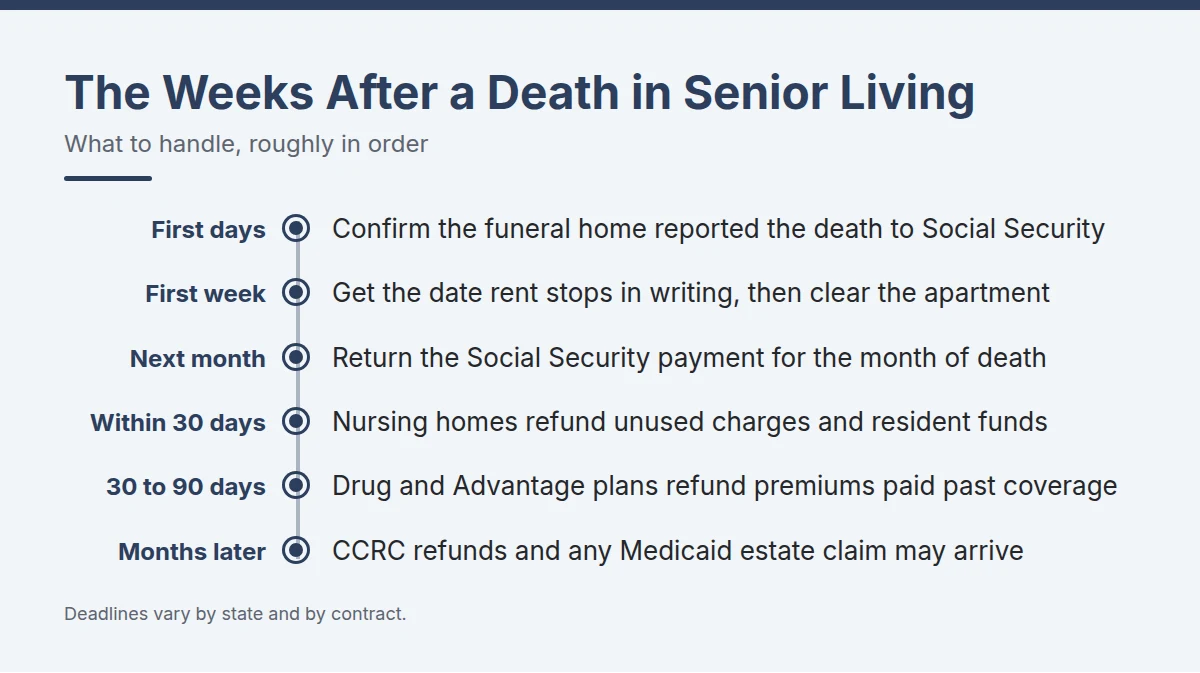
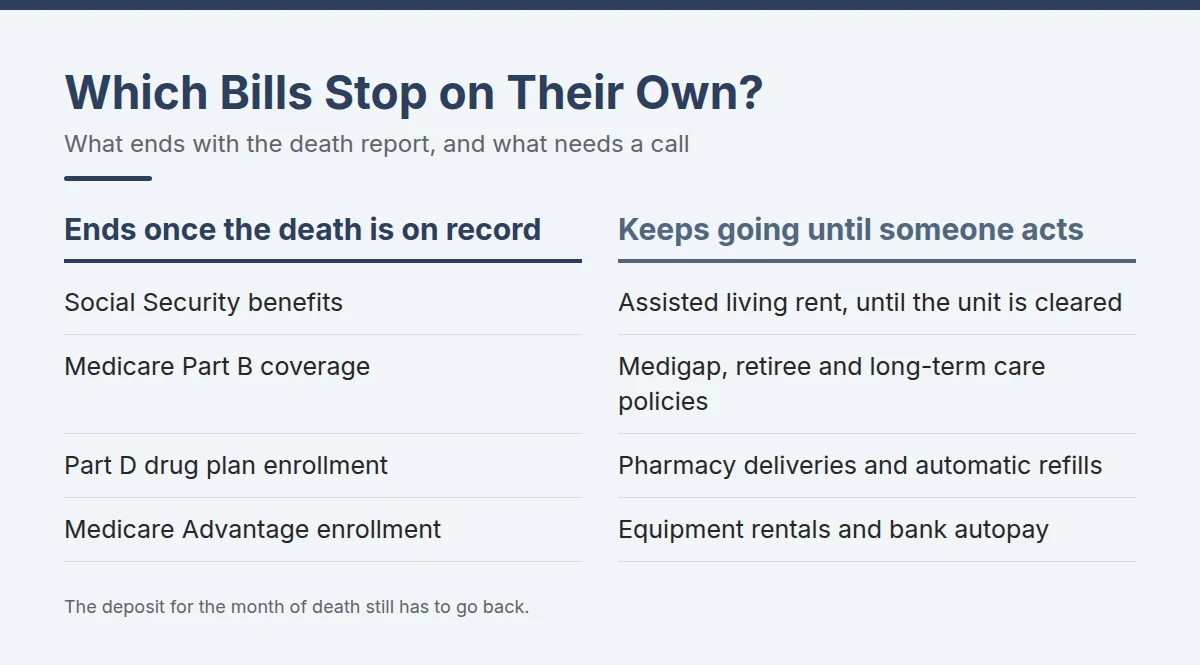
Within a day or two of a death in senior living, someone from the business office usually calls. They are sorry for your loss, and they would like to know when the family can clear the apartment. It is often the first sign that the paperwork has not paused for grief. Rent may still be running. A Social Security deposit will land next month that is not your parent’s to keep. Some charges end on their own once the death is on record, while others, like the pharmacy account and the equipment rental, keep going until somebody calls.
This guide covers that administrative stretch, roughly in the order it arrives, and picks up where our guide to hospice in assisted living, nursing homes, and at home leaves off. The rules depend on the setting. A nursing home answers to federal rules, assisted living and memory care to state law, a rental independent living apartment to its lease, and a continuing care retirement community (CCRC) to its entrance fee contract and a state regulator.
First, Who Can Act: The Power of Attorney Has Ended
Start with authority, because it decides who can sign. A power of attorney does not outlive the person who granted it. The Consumer Financial Protection Bureau’s guide for agents puts it plainly: the agent’s authority ends when the principal dies, and even bills the agent could easily pay are no longer theirs to pay. From here on, the estate acts through the executor named in the will, or through an administrator the probate court appoints.
The community will usually keep dealing with the family member named as the responsible party in the admission agreement, but a refund owed to the estate may need the estate’s representative to claim it. Order several certified copies of the death certificate through the funeral home, because insurers, banks and the community may each ask for one. If the documents were never signed, our guide to the paperwork before a senior move explains what each one does, and a probate or elder law attorney can tell you what your state requires to open an estate.
The Rent Clock: What the Bill Does After a Death
Find two sections of the residency agreement: termination and refunds. Many contracts require written notice, often 30 days, before a resident moves out, and some apply that notice to a death. Others charge until the apartment is empty. Which version your parent signed, and what your state allows, can be worth thousands of dollars.
Nursing homes. A nursing home certified by Medicare or Medicaid is bound by federal rules that override its admission contract. When a resident dies, the facility must refund any deposit or charges already paid, minus its daily rate for the days your parent actually lived there or held a bed, “regardless of any minimum stay or discharge notice requirements.” Refunds are due within 30 days. If your parent kept a personal fund with the facility, it must send that money and a final accounting within 30 days to whoever is administering the estate, as state law directs.
Assisted living and memory care. The states license these, so state law decides, and the details vary widely. Two large states show what protection can look like:
- Florida requires every assisted living contract to include a refund policy for a resident’s death. Charges run until the termination date, defined as the day the unit is vacated and cleared of belongings, and the contract’s notice period does not apply when the resident has died. The estate or responsible party gets a prorated refund of unused payments, less any damage beyond normal use, within 45 days. The facility may instead clear the unit itself and charge its actual moving and storage cost, capped at 20 percent of the regular rate, after 14 days’ written notice, and it may dispose of anything still unclaimed 45 days after notifying the family. A facility that breaks the refund rules faces a fine of three times the amount owed, half of it paid to the resident’s estate.
- California bars residential care facilities for the elderly, the state’s assisted living license, from requiring any advance notice to end the agreement after a death. Fees stop once all of the resident’s belongings are out of the unit, and anything paid in advance for the time after that must be refunded within 15 days. The facility may not obstruct removal of belongings during reasonable hours, and if it charges while belongings remain, it must give the family its written termination and refund policies within three days of learning of the death.
In both states the clock follows the belongings, not a notice letter. Other states may leave the question largely to the contract. Whatever yours says, ask the business office to confirm three things in writing: the date charges stop, whether that is the day the belongings are out and the keys are back, and what will be deducted for cleaning or repairs. At $6,000 a month, every extra week the apartment stays full costs roughly $1,400.
Independent living. A rental independent living apartment usually runs on a lease, so the lease and your state’s landlord and tenant law decide. A CCRC is different again because of the entrance fee, and it gets its own section below.
Clearing the Apartment Without Paying for Extra Weeks
Because the bill usually follows the belongings, speed matters more than sorting. Move first and decide later: a relative’s garage or a month of self-storage generally costs less than another week of senior living rent. Photograph every room before you start and again once it is empty, in case the final statement includes damage charges. Return keys, door fobs and the emergency call pendant, and note the date.

Three kinds of things need their own plan.
Medications. Call the long-term care pharmacy to stop scheduled deliveries and automatic refills, and ask for a final statement. Do not pack leftover medicine into a box of belongings. The FDA’s preferred disposal route is a drug take-back location or a prepaid mail-back envelope, and some pharmacies have drop-off kiosks. If neither is practical, medicines on the FDA’s flush list should be flushed. Almost everything else can go in the household trash, mixed with used coffee grounds, dirt or cat litter and sealed in a bag or container. Scratch the personal details off the empty bottles before throwing them away.
Equipment. A hospital bed, oxygen or wheelchair that came through hospice was supplied under the hospice benefit, so call the hospice to collect it. Medicare rentals from an equipment supplier work differently. A capped rental item such as a standard hospital bed or wheelchair becomes the patient’s property after 13 continuous months of rental payments, so something your parent rented for longer than that may now belong to the estate, while anything newer goes back. Call each supplier with the date of death so it can schedule pickup and close the account. Our guide to Medicare equipment rules in assisted living and nursing homes explains how those rentals work.
What the staff are holding. Ask whether the nursing station or the business office has anything of your parent’s: hearing aids, glasses, dentures, cash in a resident account.
What Comes Back, and What Does Not
The community fee is gone. The one-time fee a rental community charges at move-in is nonrefundable under most contracts, and a death does not change that.
Prepaid rent and deposits. Rent paid for days after the charges stop should come back, prorated, along with any security deposit, minus legitimate deductions. Ask for an itemized final statement before you accept the check.
CCRC entrance fees. This is where the largest sums sit, and the contract decides almost everything. Some contracts promise back a set share of the fee, such as a plan sold as 90 percent refundable. Others shrink the refundable portion with each month of residence, and some return little or nothing after the first months. The timing is what families are rarely ready for. When the Government Accountability Office examined CCRCs in 2010, after the housing downturn, it found that refunds “were usually contingent on having a new resident move into the vacated unit,” and that they were taking several months longer than in stronger markets.
State law can set a floor. Vermont, for example, requires a full refund within 10 days if a resident dies within 90 days of moving in, and a refund of at least half the entrance fee for a death later in the first year. GAO reported that 38 states had some regulation aimed specifically at CCRCs, run in some states by the insurance or financial regulator and in others by social services or aging agencies. Read the contract and its disclosure statement for three things: what share comes back, whether payment waits for a new resident, and whether there is an outside deadline. A large refund with unclear terms is worth an attorney’s review.

The Calls: Social Security, Medicare, and the Plans
Social Security. The funeral director usually reports the death to Social Security, as long as you provide your parent’s Social Security number. Confirm that it happened. If no funeral home is involved, or the report did not go through, call Social Security at 1-800-772-1213 (TTY 1-800-325-0778). There is no separate call to make to Medicare: Medicare’s own instructions for reporting the death of someone with Medicare are to call Social Security.
The deposit that has to go back. Social Security pays each month’s benefit the following month, and it cannot pay for the month of death. If your father died on July 20, the deposit that arrives in August is his July benefit, and it has to be returned, along with anything paid later. With direct deposit, tell the bank so it can send the money back. If a paper check arrives, do not cash it. Leave the account open, and the money in it, until the return has gone through. A surviving spouse who lived with your parent may be eligible for a one-time $255 death payment, and some family members qualify for monthly survivors benefits, so ask while you are on the phone.

Medicare Part B. Part B coverage ends on the last day of the month in which your parent died. The standard premium is $202.90 a month in 2026, higher for some incomes, and it is owed for every month of coverage whether or not your parent used any services. If your parent paid Medicare directly rather than through Social Security, make sure no automatic payment goes out for a later month.
Part D and Medicare Advantage. Once the death is on record, the plan must disenroll your parent, effective the first day of the following month. Coverage ends without a form from you, but call to confirm the date of death and stop any automatic premium payment. In the model letter CMS gives plans to send a member’s estate, the plan promises to refund any premium paid for a month after coverage ended within 30 days of the letter. If the premium came out of Social Security, the letter says to allow up to three months for that refund, then call 1-800-MEDICARE.
Everything outside Social Security’s records. A Medigap policy, a retiree health plan, long-term care insurance and life insurance may not learn of the death unless someone tells them. Call each one, send a death certificate, stop automatic payments, and ask what is owed back. If your parent had long-term care insurance, file the claim for the final weeks of care. The same goes for smaller recurring bills, from the phone line to the salon tab the community adds to the monthly statement.
Medicaid Estate Recovery: The Letter That Can Arrive Months Later
If Medicaid paid for your parent’s long-term care, the state may file a claim against the estate, sometimes long after the funeral. Federal law requires states to seek recovery from the estates of people who received Medicaid at age 55 or older, at a minimum for nursing facility care, home and community-based services (including assisted living services paid through a waiver), and related hospital and prescription drug costs.
The law builds in limits. No recovery may be made while a surviving spouse is alive, or while there is a surviving child under 21 or a child of any age who is blind or disabled, and every state must have a process to waive recovery when it would cause undue hardship. Beyond that floor, states differ sharply in what counts as the estate and how hard they pursue it. Help your parent received from a Medicare Savings Program toward Medicare premiums and cost sharing is not part of the claim.
Before distributing anything or transferring the house, ask the estate’s attorney whether a state claim is likely and how your state handles it, and answer any notice from the state by its deadline. Our guide to Medicaid eligibility and spend-down explains how recovery fits into the rest of the program.
When the Calls Are Done
None of this has to happen in a single week, even if it feels that way. The rent and the late Social Security deposit are the two items with a clock on them, and the rest can follow over the next month. If your parent was on hospice, the hospice must make bereavement support available to the family for up to a year after the death, and it is worth taking up.
Refund rules, notice periods and estate recovery all vary by state and by contract, so treat this as a map rather than advice for your situation. For a large refund, a house, or a Medicaid claim, an elder law or probate attorney is worth the fee. And when the business office calls about the apartment, it is fine to ask for the stop date in writing before you agree to anything.
Further reading (sources)
- Medicare.gov on who reports a death and the number to call
- Medicare.gov for the 2026 Part B premium and how it is charged
- Social Security Administration with its July 2026 leaflet on what to do when a family member dies
- Social Security Administration on the payment for the month of death, in its 2026 guide for beneficiaries
- 42 CFR 407.27 setting the end of Part B coverage after a death
- 42 CFR 423.44 for the Part D disenrollment date after a death
- 42 CFR 422.74 with the same rule for Medicare Advantage plans
- CMS covering the model letter plans send an estate, with its refund timelines
- 42 CFR 483.10 on nursing home refunds after a death and the return of resident funds
- Florida Statutes, section 429.24 for assisted living refunds and the cleared-unit termination date
- California Health and Safety Code, section 1569.652 on no notice period after a death and the 15-day refund
- Vermont Statutes, 8 V.S.A. § 8007 with minimum entrance fee refunds after an early death
- U.S. Government Accountability Office on CCRC refunds that wait for a new resident, and how states regulate them
- 42 CFR 418.202 covering the equipment the hospice benefit supplies
- 42 CFR 414.229 for when a rented bed or wheelchair becomes the patient’s property
- FDA with take-back, mail-back and household disposal of leftover medicines
- Consumer Financial Protection Bureau on why an agent’s authority ends at the principal’s death
- 42 U.S.C. 1396p for Medicaid estate recovery, its deferrals and hardship waivers
- 42 CFR 418.64 on hospice bereavement support for up to a year