Medicare Savings Programs and Extra Help: How QMB, SLMB, and QI Cut a Senior Living Resident's Medicare Bills
Published on October 29, 2026

The Social Security deposit that reaches your mother’s account each month is not her whole benefit. Medicare’s Part B premium, $202.90 a month in 2026, has already come out of it. Then come the 20 percent coinsurance bills from the doctor who visits her building and the copays at the pharmacy. When most of what is left goes to assisted living rent, and the savings that cover the gap shrink every quarter, those Medicare costs can look like the one part of the budget nobody can touch.
Often they can be cut. Every state runs Medicare Savings Programs (MSPs), which use Medicaid funds to pay Medicare premiums and, for the lowest-income group, Medicare’s deductibles and coinsurance as well. Qualifying for one also brings Extra Help with drug costs. CMS reported in 2023 that these programs pay the Part B premium each month for more than 10 million people, and it also cited a 2017 study done for MACPAC, Congress’s Medicaid advisory commission, which estimated that only about half of eligible people were enrolled. Two assumptions keep families away: that anything with Medicaid in its name means a nursing home, and that a parent with money in the bank must earn too much. Neither holds up.
One boundary before the details. None of these programs pays rent, meals or personal care. They pay Medicare’s own costs, which frees up income for everything else, and our guide to what Medicare actually pays for in senior housing maps where Medicare’s coverage stops.
Four Programs, One State Application
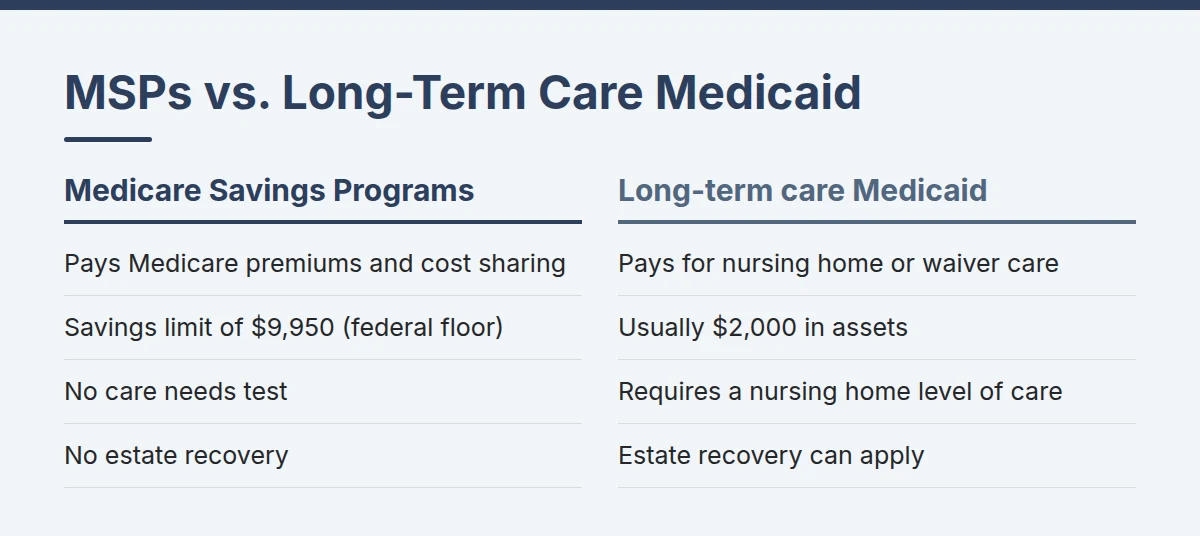
Medicare Savings Programs are Medicaid eligibility groups, but they are not long-term care Medicaid. There is no care assessment, the money goes to Medicare costs rather than to a facility, and the state works out which program fits once your parent applies. There are four:
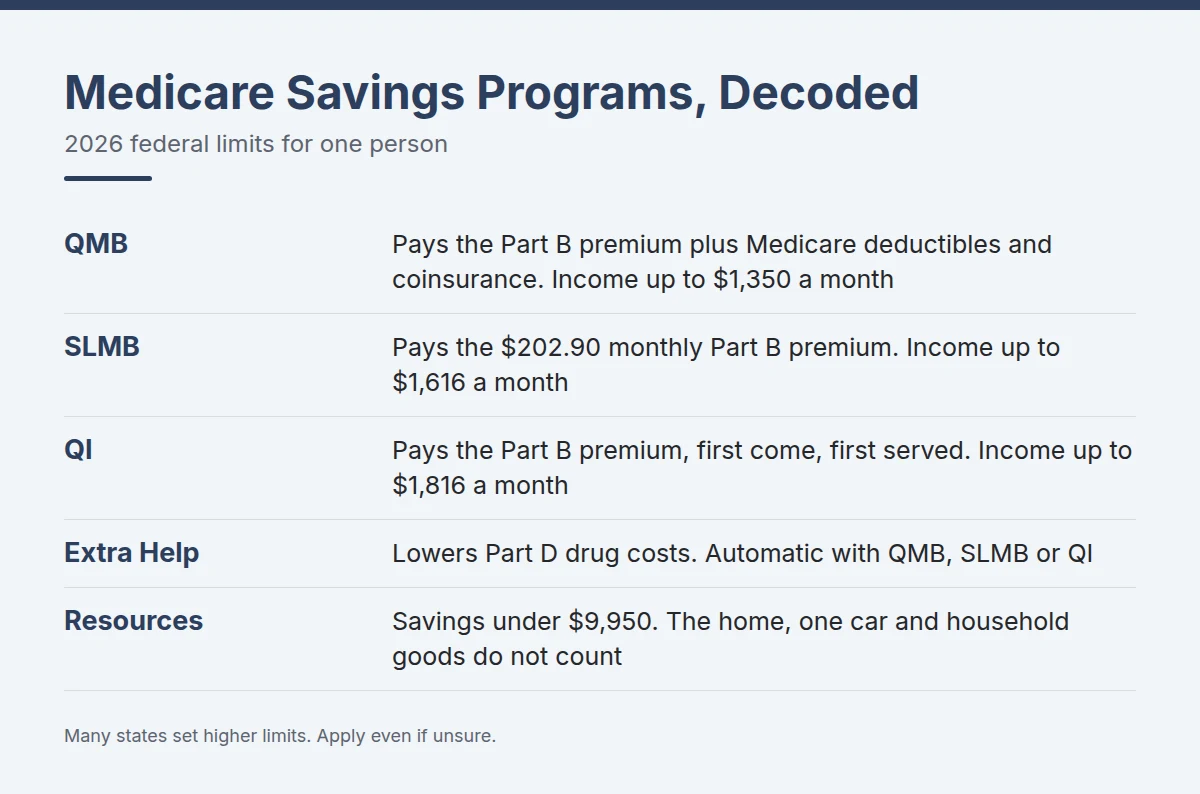
- Qualified Medicare Beneficiary (QMB). The broadest. The state pays the Part B premium (and the Part A premium, for the few people who owe one), plus Medicare deductibles, coinsurance and copayments for covered services.
- Specified Low-Income Medicare Beneficiary (SLMB). Pays the Part B premium only.
- Qualifying Individual (QI). Also pays only the Part B premium, for incomes a step higher. States approve QI applications first come, first served, with priority for people who had it the year before. Your parent must reapply every year, and QI cannot be combined with any other Medicaid coverage.
- Qualified Disabled and Working Individual (QDWI). Pays the Part A premium for certain people under 65 who lost premium-free Part A after going back to work, so it rarely applies to a senior living resident.
All three of the programs a retiree is likely to use come with Extra Help for Part D automatically. That pairing is where much of the value sits, as the sections below show.
Who Qualifies in 2026
Federal law sets a floor, and states may go higher. Medicare lists these 2026 federal monthly income limits:
- QMB: $1,350 for one person, $1,824 for a married couple
- SLMB: $1,616 and $2,184
- QI: $1,816 and $2,455
The resource limit is the same for all three: $9,950 for one person and $14,910 for a couple. Income limits run slightly higher in Alaska and Hawaii.
Resources means money in checking, savings and retirement accounts, plus stocks and bonds. The home, one car, a burial plot, up to $1,500 set aside for burial expenses, furniture, and other household and personal items are not counted. Expect a question about whole life insurance too: CMS’s model application asks for the cash value of policies whose combined face value tops $1,500.
Two details trip families up. The first is that the state counts income before deductions. CMS’s model application asks for income “before any deductions such as taxes or insurance premiums are taken out,” so work from the gross amount on your parent’s yearly Social Security benefit notice, not the smaller deposit with the Part B premium already removed. The second is that the test looks at income, not at what is left after the rent. A parent with $2,400 a month from Social Security and a pension can be squeezed hard by a $6,000 assisted living bill and still be over every federal limit.

Then check your own state, because the federal figures are a minimum. KFF’s 2026 survey of state Medicaid programs found that 18 states set more generous MSP eligibility than the federal rules, while 33 use the federal criteria. California dropped its asset test entirely in 2024, then brought one back on January 1, 2026, at $130,000 for an individual. Medicare’s own advice is to apply even if you don’t think your parent qualifies.
Here is how it plays out. A widowed mother has a gross Social Security benefit of $1,550 a month and $8,000 left in savings after two years of assisted living. She is over the QMB income limit but under SLMB’s, and under the resource limit. SLMB stops the $202.90 premium deduction, putting about $2,435 a year back in her account, and Extra Help arrives with it.
QMB: The Billing Ban Behind the Lowest Limit
For a parent in the QMB group, the program does more than cover a premium. Federal law bars Medicare providers and suppliers from billing anyone in QMB for Medicare deductibles, coinsurance or copayments. The ban covers providers in Original Medicare and in Medicare Advantage plans, not only those that accept Medicaid. It holds even when Medicaid pays the provider nothing, and even when the QMB benefit comes from a different state than the one where the care happens, which matters for a parent who has just moved closer to family. The only charge that may remain is a small Medicaid copayment in states that use one.
In a senior living budget, that protection is worth real money. The 20 percent coinsurance on the visiting doctor, a course of therapy, a wheelchair, or the pump and drugs for IV treatment in the apartment is not your parent’s to pay. Neither is Part A cost sharing: the $1,736 hospital deductible in 2026, or the $217 a day that a skilled nursing rehab stay costs from day 21 through day 100. Eighty days of that coinsurance would come to $17,360.

The ban only works if providers know about it. Show both cards, Medicare and Medicaid (or the state’s QMB card), at every visit; with Original Medicare, the Medicare Summary Notice also shows QMB status. CMS acknowledges that many enrollees pay anyway, either because they don’t know the rule or because they worry about their relationship with a doctor. If a bill for Medicare cost sharing arrives, Medicare’s instructions are to:
- Tell the provider or debt collector that your parent is in QMB and cannot be charged
- Ask the Medicare Advantage plan, if your parent has one, to stop the charges
- Contact the state Medicaid office about a refund of anything already paid
- Call 1-800-MEDICARE if the billing does not stop
Providers that collected must refund the money. Our guide to who pays first explains how a claim moves from Medicare to Medicaid behind the scenes.
Extra Help Comes With It
Extra Help is Medicare’s low-income subsidy for Part D drug coverage. Anyone approved for QMB, SLMB or QI gets it automatically, as does anyone with full Medicaid or Supplemental Security Income. A parent can also qualify on their own. The 2026 limits are $23,940 a year in income for one person ($32,460 for a married couple), with resources up to $18,090 ($36,100 for a couple). That resource limit is nearly double the MSP limit, so some parents qualify for Extra Help even when their savings rule out the state programs.
What it buys: in 2026, someone in a Medicare Savings Program pays no more than $12.65 for each drug the plan covers. For 2027, Medicare lists a $0 plan premium and a $0 deductible under Extra Help, with copays of up to $5.80 for a generic and $14.40 for a brand-name drug, and nothing once drug costs reach the yearly $2,400 cap. The $0 premium comes with a condition: the subsidy covers premiums only up to a regional benchmark, so a pricier plan leaves your parent paying the difference.

Extra Help also cancels the Part D late enrollment penalty for as long as your parent has it, which rescues the parent who went years without drug coverage. And it may let your parent change drug plans once a month instead of waiting for Open Enrollment, which this year runs through December 7. Our guide to Part D after a senior living move covers the long-term care pharmacy side.
How the Programs Fit With Medicaid, Waivers, and Spend-Down
These programs are the lowest rungs on the Medicaid ladder, and a parent paying privately usually reaches them first.
During a private-pay spend-down. Long-term care Medicaid requires a nursing home level of care, and KFF found that most states hold it to $2,000 in assets per person. The federal MSP limit is $9,950, with no care test at all. For a parent whose income is under the MSP limits, that gap means help with Medicare costs can start long before help with care. Rerun the numbers each time the savings drop by a few thousand dollars, not only when the money is gone. Our guide to Medicaid eligibility and spend-down covers the bigger step.
On a waiver or in a nursing home. A parent who gets assisted living services through a Medicaid home and community-based services waiver, or who lives in a nursing home on Medicaid, generally has full Medicaid, and CMS lists waiver participants among the groups states may cover with full benefits. That brings Extra Help automatically. Full-benefit dual eligibles receiving waiver services, and nursing home residents whose stay Medicaid pays for, owe nothing for covered Part D drugs. What full Medicaid does not guarantee is that the Part B premium gets paid: for people who qualify for full Medicaid but not for an MSP, CMS says states “may” pay it. If the premium is still coming out of the Social Security check, ask the caseworker whether your parent also qualifies for QMB or SLMB on top of Medicaid (QMB Plus and SLMB Plus, in CMS’s terms). QI is the exception, since it cannot be combined with Medicaid.
Under a medically needy spend-down. In the 34 states with medically needy coverage, a parent whose income is too high for regular Medicaid can qualify once medical bills bring it below the state’s limit. Federal Part D rules count anyone eligible this way for any part of a month as a full-benefit dual eligible for that month, and such a person is treated as qualifying for Extra Help without applying: through December if eligibility begins between January and June, and through the end of the following year if it begins in July or later. One month of met spend-down in the fall can carry drug help well into the next year.
Estate recovery. Families who hesitate because Medicaid can claim against an estate can set that worry aside for these programs. Federal law excludes Medicare cost sharing paid through them from estate recovery, and CMS’s model application tells applicants they will not need to pay back any help they receive through a Medicare Savings Program. Long-term care Medicaid is a separate matter.
How to Apply
- Gather the paperwork. CMS’s model application lists the usual items: proof of income such as benefit letters, proof of assets such as bank statements and life insurance policies, proof of Medicare, and proof of address such as a rent receipt or utility bill.
- Apply to the state, or start with Social Security. Applications go to the state Medicaid agency, online, by mail or in person. Your parent can instead apply for Extra Help through Social Security (online or at 1-800-772-1213), and Social Security sends the information to the state to start an MSP application unless your parent opts out on the form. KFF found that most responding states use that data to enroll people without a separate application. Not every state does, and in 2025 Congress barred federal officials, until September 30, 2034, from implementing or enforcing a rule that spelled out how states must use it. Follow up with the state either way.
- Watch the calendar. The model application tells applicants to expect a decision within 45 days and to contact the agency if none arrives. QMB starts with the month after the state approves it and does not reach back to earlier bills, so each month of delay is a month of cost sharing your parent pays.
- Check the deposit. Once your parent is approved, the Part B premium stops coming out of their Social Security, Railroad Retirement or civil service benefit, and Extra Help begins. If the deduction continues, call the state Medicaid office.
- Renew every year. States generally recheck eligibility once every 12 months, QI must be reapplied for annually, and changes in income or savings should be reported when they happen.
If the forms are confusing, the State Health Insurance Assistance Program (SHIP) in your parent’s state offers free, unbiased Medicare counseling and can help with the application. CMS lists the national SHIP line as 877-839-2675.
Income limits change every year, states set their own rules above the federal floor, and how these programs interact with a waiver or a nursing home’s Medicaid budget depends on the state. Confirm the details with the state Medicaid office or a SHIP counselor, and bring in an elder law attorney when larger Medicaid questions come up, such as transfers, the house or a spouse at home. Nothing here is legal or financial advice. What it should do is turn $202.90 a month, and sometimes much more, back into money your parent can spend on the life they are living now.
Further reading (sources)
- Medicare.gov on 2026 income and resource limits for QMB, SLMB, QI and QDWI, and what to do about a QMB bill
- Medicare.gov for who gets Extra Help automatically, the 2026 limits and the 2027 copays
- CMS with its fact sheet on dual eligibility groups and the QMB billing ban
- CMS covering the model MSP application, its document list and its estate recovery notice
- KFF on state MSP and long-term care Medicaid limits in 2026, and how states use Extra Help data
- Federal Register for the 2023 MSP enrollment rule and its estimate that about half of eligible people enroll
- Public Law 119-21, section 71101 on the pause on that rule through September 30, 2034
- CMS notice on 2026 Part B amounts with the $202.90 premium and $283 deductible
- CMS notice on 2026 Part A amounts for the hospital deductible and skilled nursing coinsurance
- 42 U.S.C. 1396a(e)(8) setting when QMB coverage begins
- 42 U.S.C. 1396p(b) with the estate recovery exclusion for Medicare cost sharing
- 42 CFR 423.772 defining medically needy enrollees as full-benefit dual eligibles
- 42 CFR 423.773 on automatic Extra Help and how long it lasts
- 42 CFR 423.780 covering the regional benchmark that caps the premium subsidy
- 42 CFR 423.782 for zero drug cost sharing for waiver participants and nursing home residents