Senior Co-Living: The Private Room, Shared Kitchen Model Behind LA's Affordable Assisted Living Towers
Published on October 7, 2026
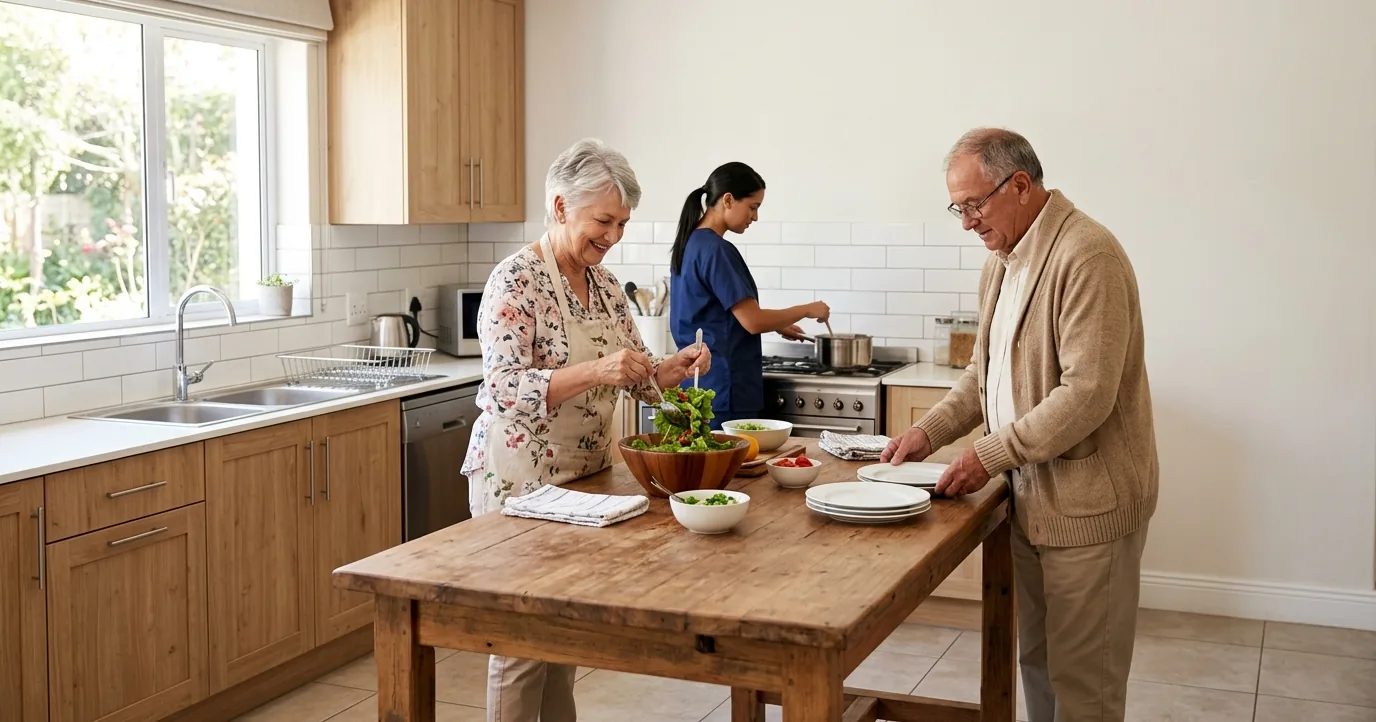
In August 2026, a California senior housing company unveiled plans for Viva L.A. at Warner Center: four towers of 34 to 42 stories in the San Fernando Valley, holding 3,192 affordable homes for older adults. They are not apartments in the usual sense. Each resident over 50 gets a private room with a private bathroom, then shares a kitchen and living room with the other residents of a “neighborhood,” two of them to a floor. Staff cook in those kitchens and help residents with daily needs such as bathing and getting dressed, and there is no central dining hall. The developer puts the rent at about $1,749 a month for households earning around 60 percent of the area median income.
The towers are years away. Construction is expected to start by the end of 2027, and the complex will go up in phases. But the housing type behind them, senior co-living, is new to most families, and it raises the same questions wherever a building like this opens. Here is what co-living is, how it compares with the options you already know, what the LA plans do and do not tell you about care, and what to ask before you put a parent’s name on a list.
What “Senior Co-Living” Actually Means
Co-living describes the floor plan, not the care. Every version gives each person a private bedroom, often with a private bathroom, and puts the kitchen and living room in common. What changes from one version to the next is who else lives there and whether anyone is paid to help.
- Home sharing. A homeowner with a spare room is matched with someone who needs a place to live, in exchange for rent and sometimes help around the house. Nonprofit homeshare programs arrange these matches, and a 2025 commentary by social work researchers argued they are an underused way to keep older adults from losing their housing. Nobody on staff provides care.
- Shared houses. A few older adults rent or buy a house together and split the bills. They run it themselves, and any care is arranged person by person, as it would be in any private home.
- Staffed co-living. The household comes with employees who cook, clean and help residents with personal care. This is the version planned in Los Angeles, and the one that overlaps with assisted living.
When a building or a brochure uses the word, ask which of the three it means. A shared kitchen tells you nothing about whether anyone will be awake down the hall at 3 a.m.
An Old Idea in a Very Tall Building
The staffed version borrows from an idea long-term care has been testing for two decades: the small household. Green House homes, a nursing home design, are small buildings for no more than 12 residents, built to fit the look of the surrounding neighborhood, where residents and direct care staff have more control over the day. When Afendulis and colleagues compared 15 nursing homes that adopted the model with 223 matched homes that had not, people living in the small homes had fewer hospital readmissions and lower rates of being confined to bed, catheter use and pressure ulcers.
The research came with a caution that applies to any co-living building. Reviewing the evidence, Zimmerman and colleagues found that homes did not always run the model the way it was designed. The floor plan creates an opportunity; daily practice decides whether residents get the benefit.
The LA plan takes the household idea to a scale no small house has tried. Its developer runs small care homes in single-family houses and describes the towers as that model rebuilt vertically. The published plans do not say how many residents will share each kitchen. Spread 3,192 units across four towers of 34 to 42 stories, at two neighborhoods per floor, and the arithmetic points to roughly a dozen.

How Co-Living Compares With the Housing You Already Know
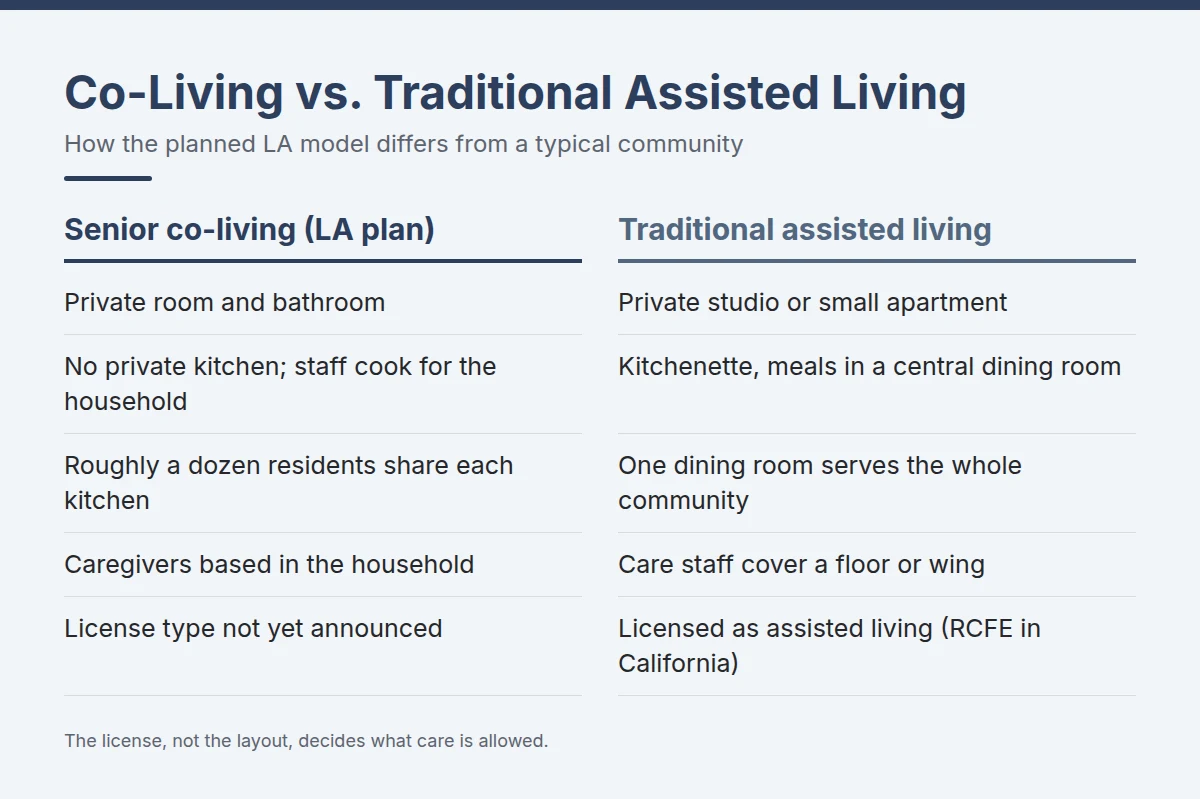
Traditional assisted living. Most assisted living gives each resident a studio or small apartment, often with a kitchenette, and serves meals in a central dining room, with care staff covering a floor or a wing. In the LA model, the private space shrinks to a room and a bathroom, meals move into a household kitchen shared with a small group, and staff are based in that household. A shared kitchen does not make a building assisted living, though. The license does, and our complete guide to assisted living explains what that license requires.
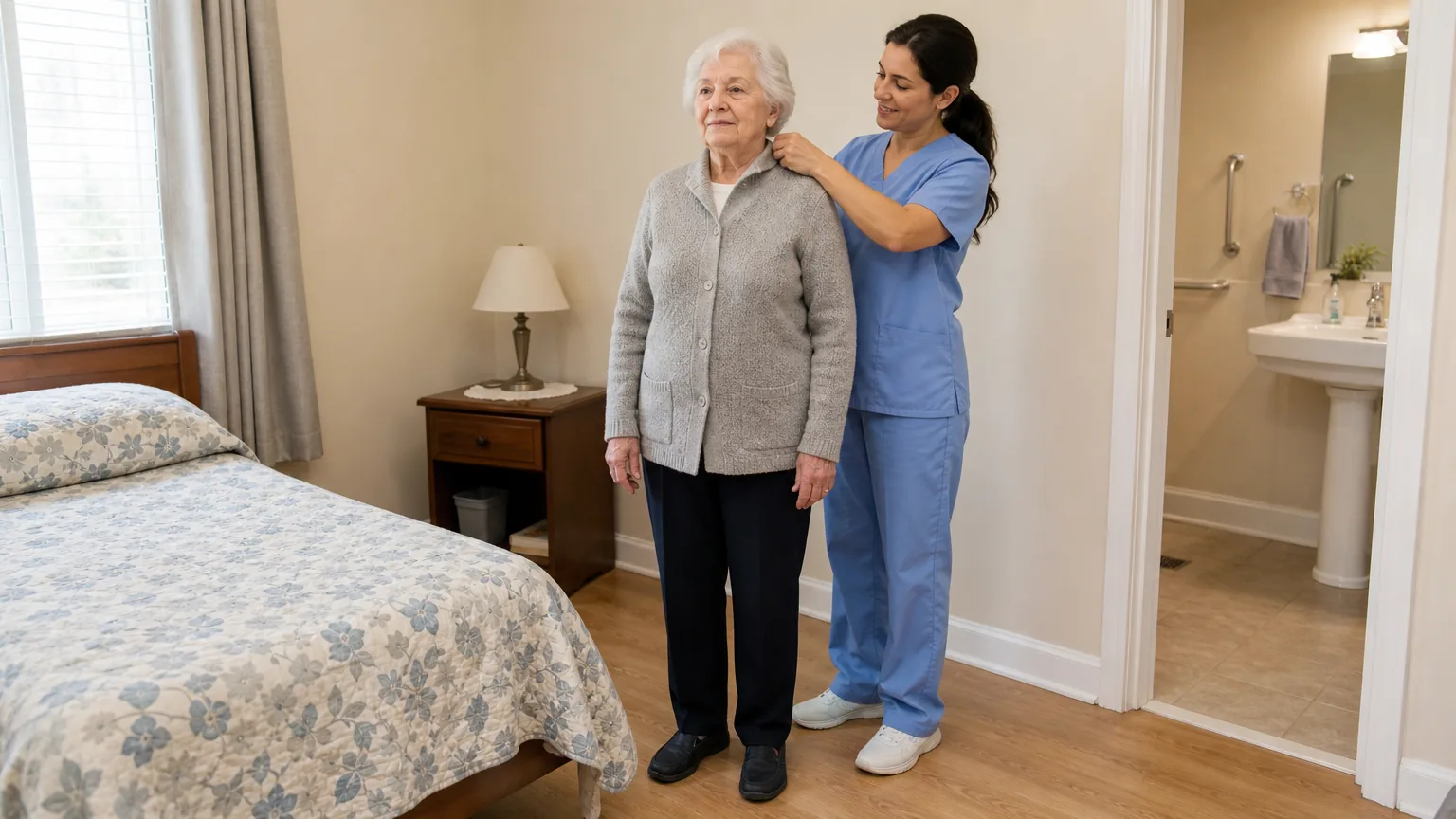
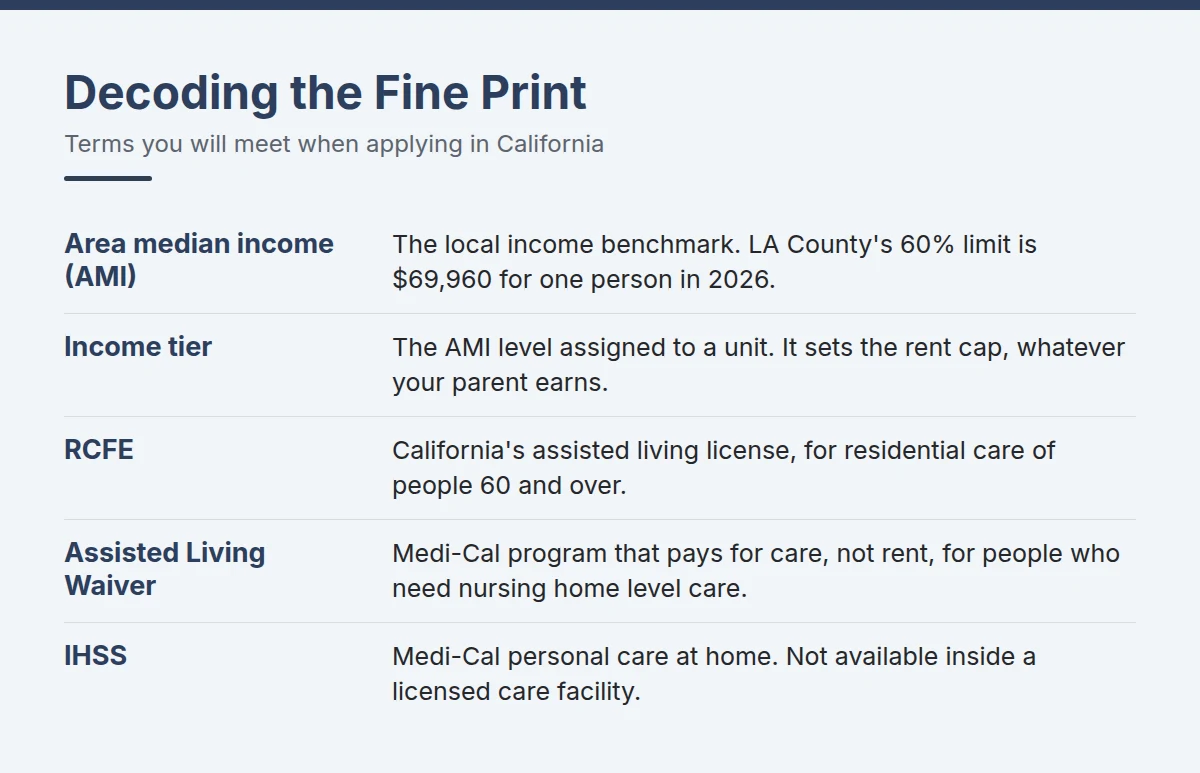
Board and care homes. Co-living’s closest relative is the small residential care home: a handful of residents in an ordinary house, a family-style kitchen, and staff who both cook and help with care. In California, small homes and large communities that provide this care hold the same license, residential care facility for the elderly (RCFE), which the state describes as housing for people 60 and over with round-the-clock non-medical care and supervision, often called assisted living or board and care. Co-living stacks that household into a tower. It gains what a house cannot offer (the LA plans include ground-floor shops, a pool and gardens, and an outdoor deck for every neighborhood), but it loses the scale at which one owner knows every resident. The four towers expect more than 2,000 workers once all are built. Our guide to small care homes covers the house-sized version.
Income-restricted senior apartments. A tax credit senior apartment gives your parent a full apartment with a kitchen and a lease, but no meals and no personal care. Co-living gives up the private kitchen in exchange for staff. The LA developer plans to finance the towers the way affordable housing usually is, with tax credits, private activity bonds and other debt, so its rent and income rules work much like a tax credit apartment’s. Our explainer on affordable assisted living built with tax credits and Medicaid walks through that financing in detail.
What the $1,749 Covers, and What Nobody Has Said Yet
The rent figure is not arbitrary. California’s 2026 tax credit tables cap rent for a one-person unit at 60 percent of area median income in Los Angeles County at exactly $1,749 a month, and that cap applies to rent and utilities combined. The number quoted, in other words, is a housing rent set by housing rules.
Beyond the room, the plans describe staff who cook in each neighborhood kitchen, help with bathing and dressing, and provide service around the clock in what the developer calls “a highly-staffed model.” What they do not yet say:
- Whether meals and personal care are included in the $1,749 or billed on top of it.
- How many caregivers will work in each neighborhood, by day and overnight.
- Whether the neighborhoods will be licensed as assisted living, or run as housing with care brought in.
That last question matters more than it seems, because it changes who can pay for care. California’s In-Home Supportive Services (IHSS) program pays for personal care for Medi-Cal members in their own homes, but the state does not count a licensed community care facility as a home. Medi-Cal’s Assisted Living Waiver pays for care, not room and board, in licensed residential care and in some publicly funded senior housing, for members with no share of cost who need a nursing home level of care. It operates in Los Angeles County, but at the end of 2025 it had 18,365 people on its waiting list, more than the 14,847 it was serving.
Who Qualifies, and Who “Affordable” Leaves Out
The plans name two requirements so far: residents must be over 50, and tenant incomes must average about 60 percent of the area median. In Los Angeles County for 2026, the 60 percent limit is $69,960 a year for one person and $79,980 for a couple.

“Average” is the word to notice. Federal tax credit rules let an owner assign each unit an income tier, from 20 to 80 percent of area median income, as long as the tiers average no more than 60 percent. That is why the developer said rent could be higher or lower depending on a tenant’s income. In Los Angeles County this year, the cap on a one-person unit runs from $874 a month at the 30 percent tier to $2,332 at the 80 percent tier.
The catch for many families is that rent follows the unit’s tier, not your parent’s actual income. A parent living on a modest Social Security check can qualify on income and still find a 60 percent rent out of reach. Ask whether lower-tier units exist, how they are assigned, and whether any units come with rental assistance. If your parent already holds a Housing Choice Voucher, federal law bars a tax credit owner from turning them away because of it.
Questions to Ask Before You Get on a List
The LA details will firm up over the next few years, and these questions apply to any co-living building, in Los Angeles or anywhere else.
- Is the neighborhood licensed, and as what? Ask for the license type and number, then read the inspection history. Our guide to the free government tools for researching senior care shows where those records live; in California, the Department of Social Services publishes them on its facility search site.
- What does the monthly charge include? Get it in writing: meals, personal care, medication help, laundry and utilities, plus the price of anything extra.
- Who works in my parent’s neighborhood overnight? Ask how many caregivers are on each shift for how many residents, and whether the same staff stay with the same household. Our guide to staffing ratios and turnover has the follow-up questions.
- How private is the private room? Can your parent lock the door, keep food in the room, and use the kitchen at night? Can visitors come at any hour? Where Medicaid waiver money pays for care, federal rules require a door the resident can lock, access to food at any time and visitors at any time, and any restriction has to be justified in that resident’s own service plan.
- Who are the neighbors, and what happens when it does not work? Ask how residents are matched to a household, how conflicts are handled, and whether a resident can move to a different neighborhood. A shared kitchen is a pleasure with good company and a daily strain without it.
- What happens when care needs outgrow the model? Ask what level of dementia, mobility loss or nursing need a household can support, who decides when a resident has to move, and where past residents have gone. Every assisted living setting has a ceiling; learn this one before move-in.
Is Co-Living Right for Your Parent?
Co-living suits an older adult who wants company at breakfast, needs a hand with daily tasks rather than nursing care, and would trade a private kitchen for a lower rent with staff down the hall. It is a harder fit for someone who guards their privacy, has a history of clashing with housemates, or already needs skilled nursing around the clock.
For the LA towers, timing is the practical limit. Construction is not expected to begin before the end of 2027, so a parent who needs help this year needs another plan now. If the model appeals, watch for the application process to open and bring the questions above when it does.
Moving a parent into any shared setting is an emotional decision as much as a financial one, and a private room with a shared kitchen can feel like either a new start or a loss, depending on the person. Costs, eligibility rules and licensing vary significantly by state and change from year to year, so confirm every figure with the agencies involved. A certified senior care advisor can help you compare options, and an elder law attorney can advise on Medi-Cal or Medicaid eligibility before you apply. Nothing in this guide is legal or financial advice.
Further reading (sources)
- Los Angeles Times on plans for four co-living senior towers in Warner Center
- California Department of Housing and Community Development with 2026 tax credit income and rent limits by county
- 26 U.S.C. § 42 for the income averaging test and the voucher protection in tax credit housing
- Afendulis and colleagues on quality outcomes after nursing homes adopted the Green House model
- Zimmerman and colleagues with a synthesis of Green House research, including uneven implementation
- Perone and colleagues on nonprofit homesharing programs for older adults
- California Department of Social Services for how the state defines residential care for the elderly and who qualifies for In-Home Supportive Services
- California Department of Health Care Services covering who the Assisted Living Waiver serves and its enrollment and waiting list through 2025
- 42 CFR 441.301 on privacy, food access and visitor rights in waiver-funded settings