Researching Senior Care Without a Sales Funnel: The Free Government Tools Families Miss
Published on October 5, 2026

It happens fast. You type “assisted living near Mom” into a search bar, click a result that looks like a directory, and a form asks for your name, your phone number and how soon you need a place. Before dinner, an advisor calls. Nothing about this is a scam, and the advisor may be genuinely helpful. But the service is paid for by the communities on the other side, usually through a commission when someone moves in, which is why it is worth knowing how free placement services actually earn their money. Many of the “best senior living” badges you will meet along the way come out of the same business model.
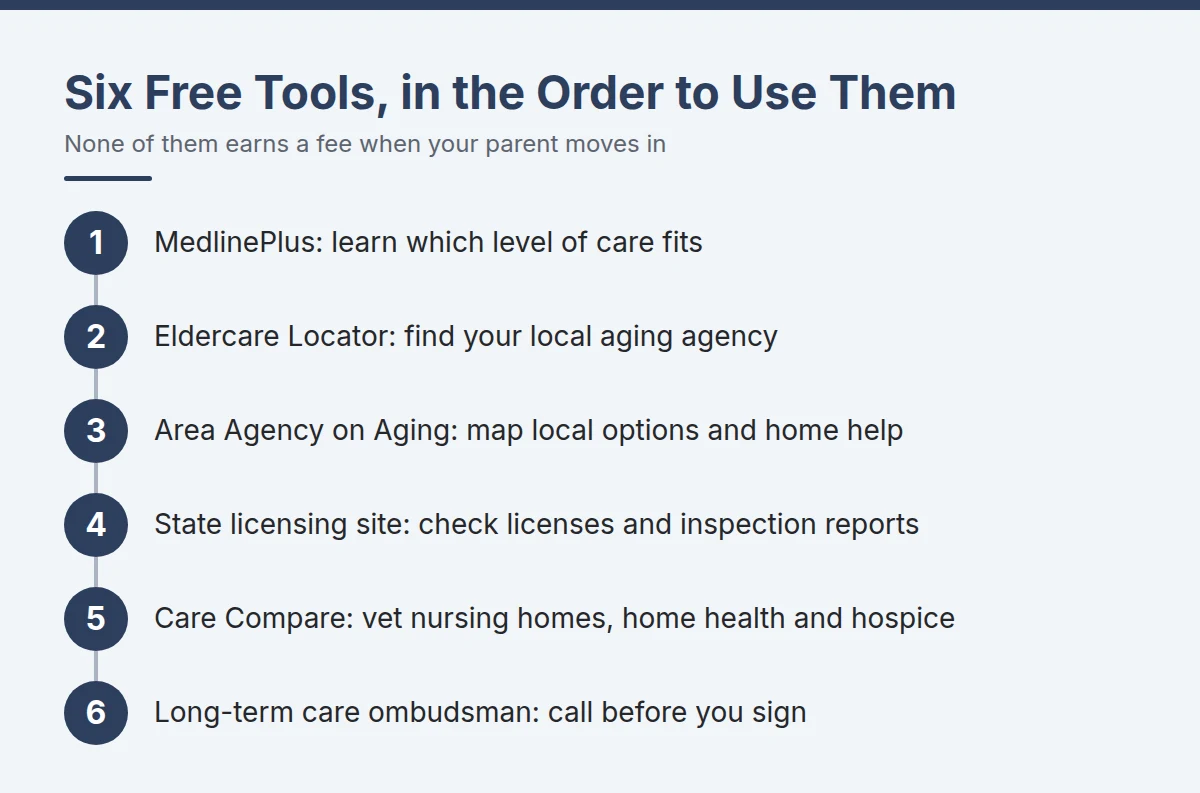
There is a second set of tools, paid for largely with public money, that sells no leads and earns nothing when your parent signs a lease. MedlinePlus, the Eldercare Locator, your local Area Agency on Aging, your state’s licensing and inspection records, Medicare’s Care Compare and the long-term care ombudsman answer most of the questions a referral directory answers, and several it never will. Here is what each one tells you, what it cannot, and the order that gets the most out of them.
Why the Neutral Tools Sit Unused
The tools are not hidden. They are just quiet, with no advertising budget and nobody calling you back. In a study published in 2016, Konetzka and Perraillon interviewed people who had recently placed a family member or friend in a nursing home, and the families reacted well when shown Medicare’s nursing home ratings, then called Nursing Home Compare and now part of Care Compare. What held them back was mostly not knowing the site existed and, for some, an initial mistrust of the data.
The hospital is often where the gap opens. In a 2017 study, Tyler and colleagues interviewed 138 staff members at 16 hospitals and 25 skilled nursing facilities, along with 98 patients. Most patients described receiving nothing more than a list of facilities, and staff said they did not share quality data because they believed patient choice rules prevented it. Federal discharge planning rules now require hospitals to help patients and families choose a skilled nursing facility, home health agency or other post-acute provider by using and sharing quality data that fits the patient’s goals of care. If a discharge planner hands you a bare list, ask for the quality data that is supposed to come with it.
The tools also work best in sequence. Learn the vocabulary first, so nobody can sell you a level of care your parent does not need. Then map what exists locally, verify the specific buildings on your shortlist, and finish with the one advocate whose mandate is the resident.
MedlinePlus: Learn the Vocabulary Before Anyone Sells You Anything
MedlinePlus is a service of the National Library of Medicine, the world’s largest medical library and part of the National Institutes of Health. It carries no advertising, does not endorse any company or product, and builds each health topic page from links to NIH and other sources chosen under published selection criteria.
Three of its topic pages do most of the work for a family at the start: assisted living, nursing homes and dementia. The assisted living page defines the category in plain words: housing and services for people who need some help with daily care, such as dressing, bathing, taking medicines and cleaning, but who do not need the medical care a nursing home provides. It notes that services differ from state to state, which becomes important later. And its “Find an Expert” links include a directory of Area Agencies on Aging and a locator for your state’s long-term care ombudsman, the same two calls this guide recommends.
Use it to name the need before you shop for it. If the search began with a dementia label applied during a hospital stay, read about the reversible conditions that can look like dementia before you book a memory care tour.
What it cannot tell you: anything local. MedlinePlus lists no communities, prices or inspection results, and it cannot say whether a particular building suits your parent.
The Eldercare Locator: One Number That Finds Your Local Agency
The Eldercare Locator, at eldercare.acl.gov or 1-800-677-1116, lets you call or text, chat online or email trained staff for free. Launched in 1991, it is funded by the federal Administration for Community Living and run by USAging, the national association for Area Agencies on Aging. It handles about 400,000 requests a year and refers most of them to one of more than 600 Area Agencies on Aging or nearly 300 Title VI Native American aging programs.
Its real job is answering one question well: who handles this where my parent lives? That matters more than it sounds, because the agency you need may operate under a name you would never think to search for.
What it cannot tell you: anything about quality. The Locator points you to agencies and programs. It does not rate communities or compare one building with another.
Your Area Agency on Aging: A Local Map With No Commission Attached
An Area Agency on Aging, or AAA, is a public or private nonprofit agency that your state designates to address the needs of older adults across a city, a county or a group of counties. Names vary, so yours may be called a council on aging or a department of senior services.
AAAs coordinate services that help older adults stay in their own homes, such as home-delivered meals and homemaker help, so that people can choose the services and living arrangements that suit them best. That makes the AAA the right call before anyone has decided on a move, not only after. No commission rides on what it tells you, so options that never pay a referral fee stay on the table.

Questions worth asking:
- What in-home help is available here, and is there a waiting list?
- Which local assisted living communities accept Medicaid?
- Are there adult day programs, small residential care homes or a PACE program nearby?
- What support is available for a family caregiver who is wearing thin?
What it cannot tell you: which building is best. Expect options and explanations rather than a ranking, and expect the services on offer, and the waits for them, to differ a great deal from one area to the next.
State Licensing and Inspection Records: Assisted Living’s Only Report Card
There is no federal star rating for assisted living. States license it, inspect it and decide what to publish, and what they publish varies enormously.
In a review published in 2020, Roberts, Peterson and Hyer checked the assisted living websites of all 50 states and the District of Columbia for 39 kinds of consumer information. Nearly 70 percent posted inspection results. Only 43 percent offered information about complaints, 35 percent said which payments a community accepted, such as Medicaid, and 31 percent said whether it offered memory care. On many sites, finding what was there took several steps, and none was written at or below a fifth-grade reading level.
A 2019 survey of state oversight officials in 48 states, analyzed by Kaskie and colleagues, found the same patchwork from the inside. In half of those states, oversight of assisted living was split across three or more agencies. Fewer than half compiled data on inspections, violations and penalties, and fewer than 10 states shared it in a way the public could easily use.
Some states go much further. Minnesota’s Assisted Living Report Card, which every licensed community in the state must take part in, rates each one from one to five stars on quality measures built from resident and family surveys and from state inspection results.
When you find your state’s records, read past the headline:
- The license type. Confirm the community is licensed for the care your parent needs, including memory care if dementia is part of the picture.
- The date of the last inspection. A clean page can simply mean nobody has inspected in a while.
- The citations themselves. One serious finding about medications or supervision outweighs several about paperwork.
- Complaints and repeats. The same problem cited on two visits tells you the fix did not hold.
Nursing homes offer a shortcut you can use on the tour. Federal rules require every nursing home certified by Medicare or Medicaid to post the results of its most recent inspection where residents and families can easily see them, and to let anyone review its inspection, certification and complaint investigation reports from the past three years on request.
What it cannot tell you: in some states, very much at all. If your state posts little online, ask the licensing agency for the reports directly; your AAA or the ombudsman can tell you which agency that is. A reference librarian at your public library is another free, neutral pair of hands for a clumsy government website.
Medicare Care Compare: Nursing Homes, Rehab, Home Health and Hospice
Care Compare, on Medicare.gov, covers nursing homes, including short-term rehab, along with home health agencies, hospices and other Medicare providers. For each nursing home it shows an overall rating of one to five stars, plus separate ratings for health inspections, staffing and quality measures.
The overall rating starts from the health inspection rating, which draws on the home’s two most recent annual inspections and three years of complaint investigations and infection control inspections. Those inspections are unannounced and last several days, carried out by a team of health professionals. A home then gains a star for a five-star staffing rating or loses one for a one-star rating, and the same again for quality measures. The staffing measures come from payroll data each home submits every quarter; our guide to staffing ratios, turnover and agency fill-ins explains how to read them.
Two flags deserve a closer look. An abuse icon marks a home cited for abuse that harmed a resident on a recent inspection, or cited repeatedly for abuse that put residents at risk. It caps the inspection rating at two stars, so the best overall rating such a home can show is four. A warning sign in place of the stars means the home is in CMS’s Special Focus Facility program, which is reserved for homes with a history of serious quality problems, and it shows no ratings at all.
What it cannot tell you:
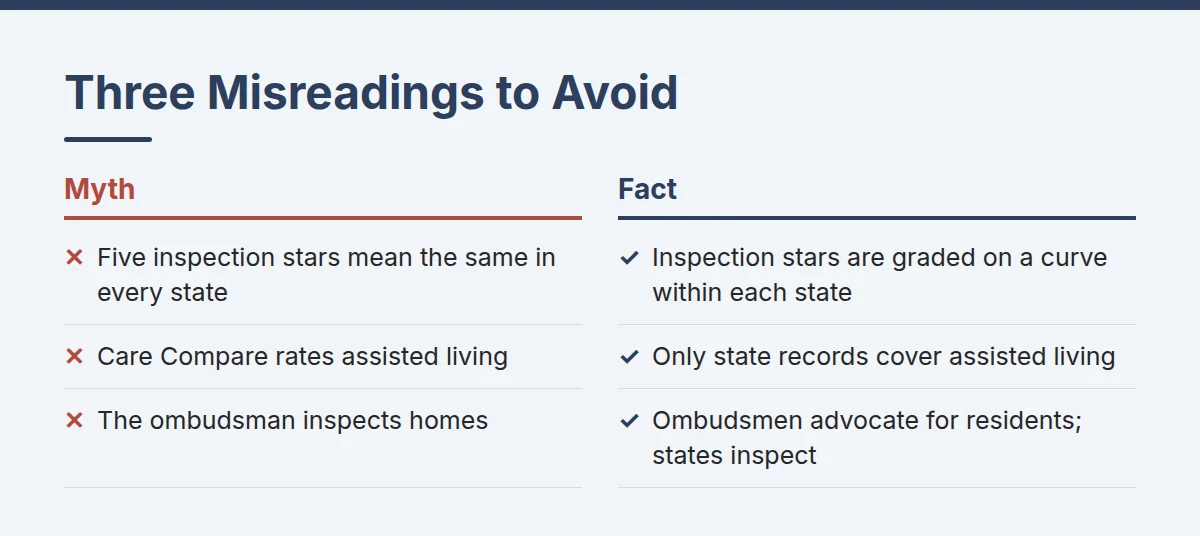
- How a home compares nationally. Inspection stars are graded on a curve within each state: the top 10 percent of homes get five stars and the bottom 20 percent get one. Three stars in your parent’s state and three stars in yours are not the same measurement.
- What the home did not report. Many quality measures come from the home’s own resident assessments. Using Medicare data from 2011 to 2017, Sanghavi and Chen found that nursing homes had recorded only 60 percent of major-injury falls that sent a resident to the hospital and 68 percent of hospitalized stage 3 or 4 pressure ulcers, and about 7 in 10 homes recorded fewer than 80 percent of such events. CMS has had its own doubts: in 2023 it began auditing schizophrenia diagnoses in these assessments, since residents with schizophrenia are left out of the measure of antipsychotic drug use, and said it would adjust the quality ratings of homes whose coding proved inaccurate.
- Anything about assisted living. Care Compare lists no assisted living or independent living communities. A campus that advertises skilled nursing appears only for its certified nursing home wing.
CMS says much of this itself. Its guidance warns that no rating system can capture everything that matters, such as specialized dementia care or how easily family can visit, and tells families to pair the site with a visit and with state or local organizations such as the State Ombudsman program. Medicare’s own step-by-step guide to choosing a nursing home puts the visit before the decision and offers a printable checklist to take along.
The Long-Term Care Ombudsman: The Advocate Nobody Pays For
Every state, along with Washington, D.C., Puerto Rico and Guam, runs a long-term care ombudsman program under the federal Older Americans Act. Ombudsmen advocate for residents of nursing homes, board and care homes and assisted living, and their services are free and confidential. In federal fiscal year 2023, more than 1,500 full-time-equivalent staff and 3,443 trained volunteers worked to resolve 202,894 complaints, settling 71 percent fully or partly to the satisfaction of the resident or whoever raised them, and provided information and assistance 502,484 times.

Most families find the ombudsman after something has gone wrong. Call before you sign instead. Giving the public information about long-term care facilities and residents’ rights is part of the program’s job, and its complaint data shows where trouble usually starts. The five most frequent complaints it handles in assisted living and similar homes involve discharge or eviction, medications, food service, physical abuse and staffing. That makes a good agenda for the call: what to look for in an admission agreement’s discharge terms, which rights apply in your state, and what the program wishes more families asked before move-in.
What it cannot tell you: everything it knows. Ombudsmen do not carry out licensing inspections or adult protective services investigations, and they act at the resident’s direction: the program needs a resident’s consent before it investigates a complaint, and federal rules strictly limit what it can disclose. How much a program will say about one specific building varies. Its view of assisted living is thinner, too: in 2023, ombudsmen visited 60 percent of nursing homes at least quarterly, but only 24 percent of assisted living, board and care and similar homes. Keep the number after move-in, when you may need the program most.
Where the Paid Help Still Fits
None of this means you must avoid placement advisors or ignore every award badge. A good advisor can save weeks of legwork, and family reviews capture things no inspector records. The difference is that you now have records to check them against: a license, an inspection history, ratings built on a published method, and an advocate with no stake in where your parent lands. A recommendation that survives all of that deserves serious attention. If you are just starting out, our guide to beginning a senior living search covers the assessment, budget and touring steps that sit around this research.
Licensing rules, inspection practices and what states publish vary significantly, so the same search will look different in Ohio than in Oregon. For the decisions with real money or legal weight, a certified senior care advisor you pay directly can help you compare options, and an elder law attorney can review the admission agreement and any Medicaid planning. Nothing in this article is legal or financial advice.
Further reading (sources)
- Konetzka and Perraillon on what kept families from using Medicare’s nursing home ratings
- Tyler and colleagues for what hospital patients are, and are not, told about nursing facility quality
- Code of Federal Regulations with the hospital duty to share post-acute quality data at discharge, and the nursing home duty to post inspection results and show three years of reports
- MedlinePlus on who runs the site and its no-advertising policy, and its plain-language assisted living topic page
- USAging for how the Eldercare Locator works and where it sends callers
- Administration for Community Living on what an Area Agency on Aging is and does, and the ombudsman program’s duties and 2023 caseload
- Roberts, Peterson and Hyer with a review of what state assisted living websites tell consumers
- Kaskie and colleagues on how states monitor assisted living and report what they find
- Minnesota Department of Human Services for how the state’s assisted living report card builds its ratings
- Centers for Medicare & Medicaid Services with its caution on what nursing home star ratings cannot capture, and the technical guide to how the stars are calculated
- Sanghavi and Chen on how often nursing homes underreport falls and pressure ulcers
- Medicare.gov covering the four steps of choosing a nursing home
- National Long-Term Care Ombudsman Resource Center with what the ombudsman program does and does not do