Who Will Actually Care for Your Parent? A Family's Guide to Staffing Ratios, Turnover, and Agency Fill-Ins
Published on October 2, 2026

The tour usually happens at eleven on a weekday morning. The lobby is bright, the activity calendar is full, and the person showing you around introduces the nurse, the activities director and two caregivers by name. Nobody is hiding anything. But you are seeing the building at its best-staffed hour, and the hours that will matter most for your parent are the ones nobody tours: three in the morning on a Tuesday, a Sunday afternoon on a holiday weekend, the evening shift after two aides have called in sick.
Staffing is what families most want to know about and the hardest thing to see. In Massachusetts, operators are bracing to lose some of the roughly 2,000 workers in the state’s senior care facilities who are Haitian immigrants with temporary protected status, in a sector already short of staff. But a national shortage tells you little about one building. When Dys and Tunalilar tracked 535 assisted living and residential care communities in Oregon from 2017 to 2023, most of the variation in staffing came from differences between communities, not from changes over time. This guide is the building-level version: who works each shift, what the rules require, why nights and weekends are the real test, how to read turnover and agency staffing, and what to check before you sign.
Who Is Actually in the Building
Start with job titles, because a staffing number means little until you know who is being counted. The names vary from company to company, but the jobs do not.
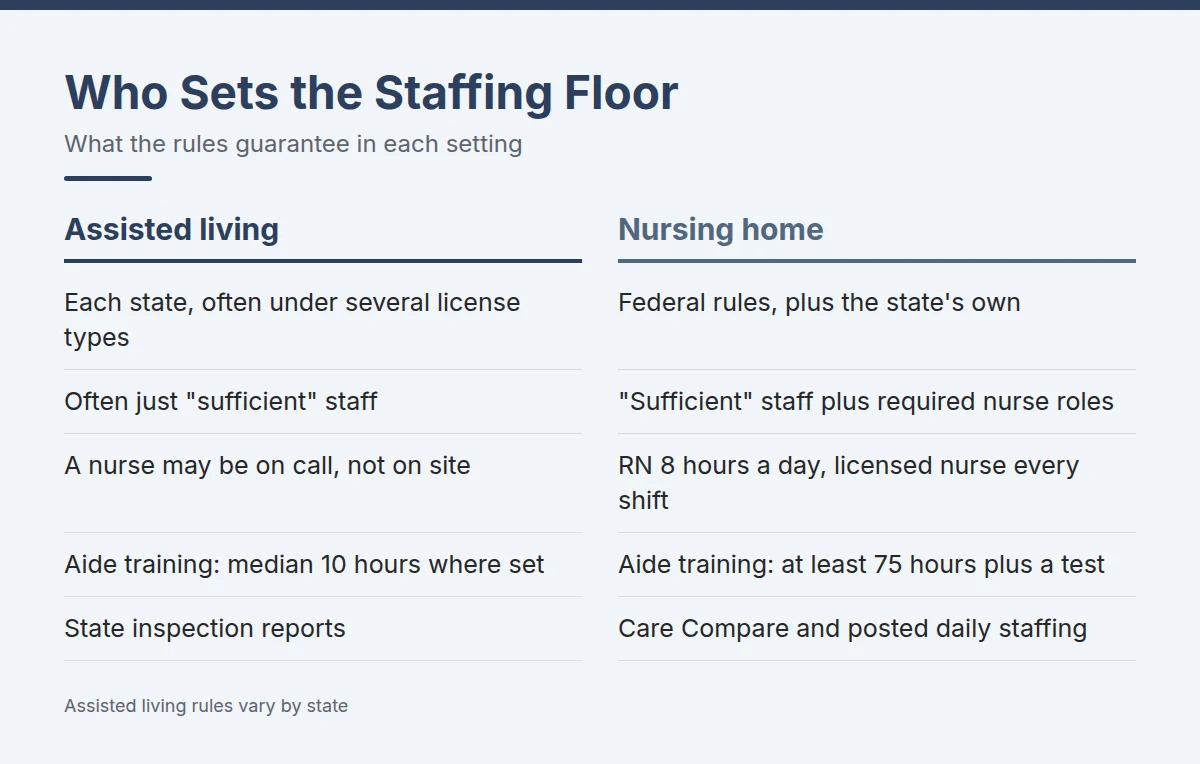
- Caregivers. Called resident assistants, care partners or personal care aides, they do the hands-on work: bathing, dressing, toileting, transfers, meals and overnight checks. In a nursing home they are certified nurse aides, with at least 75 hours of federally required training and a competency evaluation. Assisted living has no federal standard. Hsu and colleagues found that in 2023, 43 states required some caregiver training, but only 28 set a number of hours, with a median of 10.
- Medication aides. Usually called med techs, these unlicensed staff hand out medications in assisted living in most states, working under a nurse’s delegation. Our guide to medication management in assisted living covers what to ask about them.
- Licensed practical nurses. LPNs, called licensed vocational nurses in Texas and California, are often the most senior clinician on site in assisted living, and typically the charge nurse running a nursing home unit for a shift.
- Registered nurses. A nursing home must have a full-time RN director of nursing and an RN on duty at least eight consecutive hours every day. In assisted living, an RN may run wellness services on weekday hours, or there may be none: Rome and colleagues found that 69 percent of residential care communities had at least one RN in states that require licensed nurses, against 37 percent in states that do not.
- The on-call nurse. Reachable by phone after hours but not in the building. In many assisted living communities, this is how nights and weekends are covered.

Most buildings run three eight-hour shifts or two twelve-hour ones, with the most staff on days, when bathing, dressing and breakfast happen, and the fewest overnight. Cooks, housekeepers, receptionists and maintenance workers are not care staff. Georgia and Florida both bar communities from counting cooks and maintenance workers toward their staffing minimums, and you should leave all of them out of your own count.
What the Rules Require, and What They Leave Out
Assisted living has no federal staffing standard. States write the rules, often more than one set of them: Thomas and colleagues counted 350 assisted living license types across the 50 states and Washington, D.C., in 2018.
Many ask only for “sufficient” staff to meet residents’ needs, with no number attached. Some set ratios. Georgia requires an average of one awake direct care worker for every 15 residents during waking hours and one for every 20 overnight, where residents have minimal care needs, with at least two direct care staff on the premises around the clock. Its nurse requirement scales with size: a community of 61 to 90 residents needs a licensed nurse on site for just 24 hours a week, the equivalent of three eight-hour shifts out of 21. Georgia’s certified memory care centers must average one dementia-trained caregiver for every 12 residents by day and every 15 at night.
Other states set a floor of staff hours. Florida requires a community of 86 to 95 residents to log at least 539 staff hours a week: about 77 hours a day, or roughly three people on duty at any moment for the whole building. Vacant positions and absent staff do not count toward it.
Two cautions apply. Georgia’s ratios are monthly averages, so any single night can run thinner. And both states add that a community must staff above its minimum when residents’ needs require it, which brings you back to “sufficient.” A minimum is a floor for the building, not a promise about your parent’s hallway.
Specific rules do seem to matter. When states moved from requiring “sufficient” direct care staff to a specific ratio or level, Thomas and colleagues found the change was associated with a 4 percent lower monthly risk of hospitalization for residents, and 6 percent lower for residents with dementia.
Nursing homes have a federal floor, and it is thinner than many families assume. Every nursing home certified by Medicare or Medicaid must have “sufficient” nursing staff around the clock, a licensed nurse serving as charge nurse on every shift, a full-time RN director of nursing, and an RN on duty at least eight consecutive hours a day, seven days a week, though waivers are possible. A 2024 federal rule would have required an RN on site around the clock and at least 3.48 hours of nursing care per resident per day. Its staffing minimums never took effect: two federal courts struck them down, Congress barred enforcement until 2034, and CMS repealed them in December 2025.
What sets nursing homes apart is public staffing data. Every nursing home must post its nurse staffing at the start of each shift: the registered nurses, licensed practical nurses and nurse aides on duty, the hours they actually worked, and the resident census. It must make those records available to the public on request and keep them for at least 18 months. Medicare’s Care Compare website adds quarterly measures built from payroll records: nursing hours per resident per day, RN hours, weekend staffing, the share of nursing staff and of RNs who left over a year, and the number of administrators who left.
Nights and Weekends Are the Real Test
Daytime is when families visit, the nurse is in and staffing peaks. Nights and weekends are when it thins, and when much of the care that matters happens: the resident with dementia who is awake and anxious at 2 a.m., the trip to the bathroom that ends in a fall, the Saturday when the aide who always helps your father shower calls in sick.
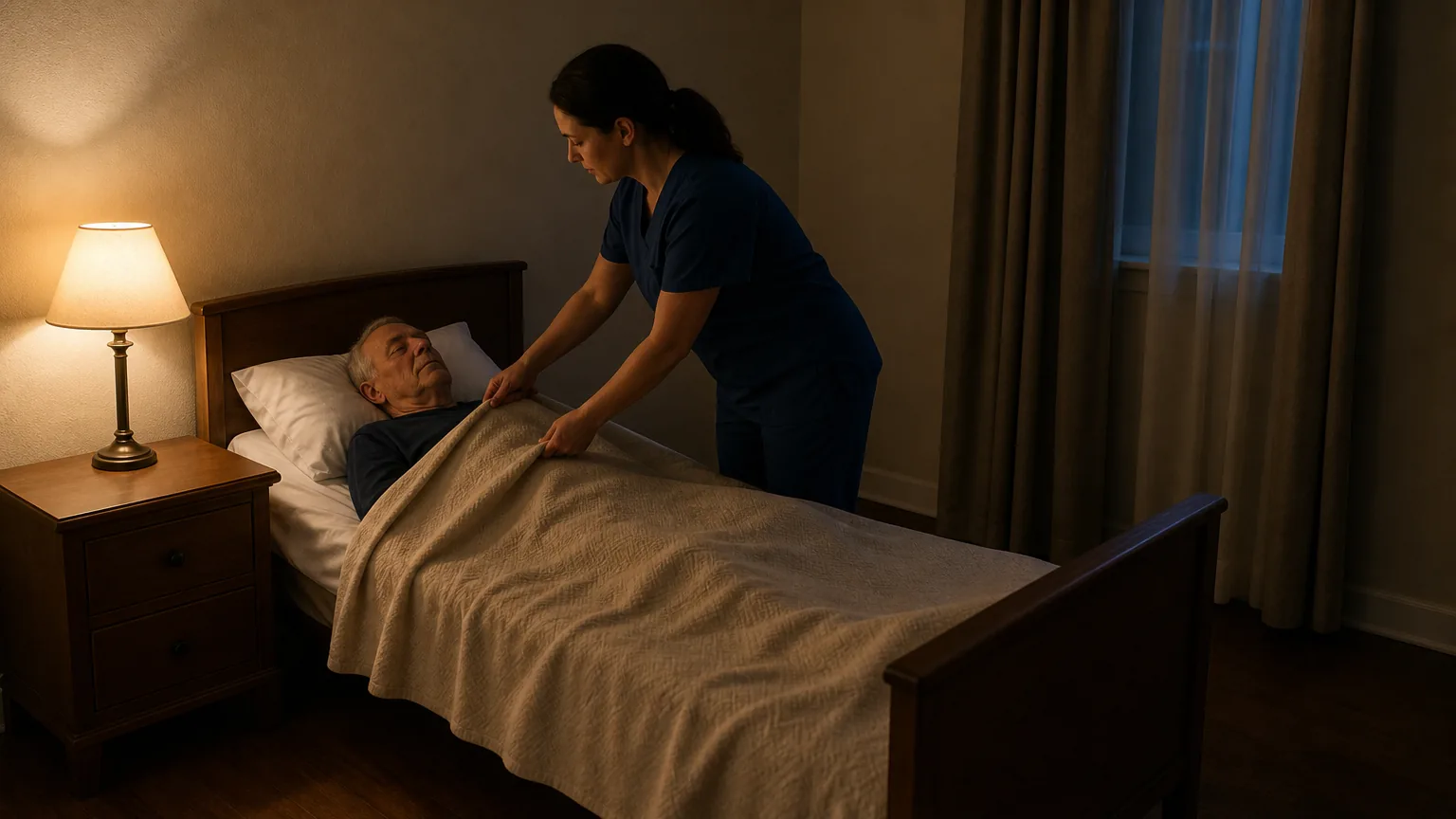
Overnight rules vary sharply. In Texas, communities with 17 or more residents, and any community licensed for residents who may need help evacuating or attention at night, must have awake night staff. A smaller Texas home of 16 or fewer, whose residents can evacuate on their own and do not need routine attention at night, needs night staff who are only “immediately available,” not necessarily awake. Florida requires at least one staff member awake at all hours once a community has 17 or more residents. Neither rule says how many people must be awake, only that someone is. That is why even a small residential care home with a strong daytime ratio deserves a direct question about who is up at night.
Nursing homes show the same pattern. When daily payroll records first became available, Geng and colleagues found large day-to-day swings in staffing, low weekend staffing, and many days below CMS expectations, which is why Care Compare now reports weekend staffing separately. A wide gap between a home’s weekend figure and its overall figure means Saturdays and Sundays run noticeably thinner.
Memory care raises the stakes, because many people with dementia are restless at night and exit-seeking does not keep business hours. Yet when Carder reviewed every state’s rules in 2017, only 17 states addressed staffing types and levels for dementia care. Most leave memory care staffing to their general assisted living rules. Our guide to what to ask when assisted living is really memory care covers the dementia questions in depth.
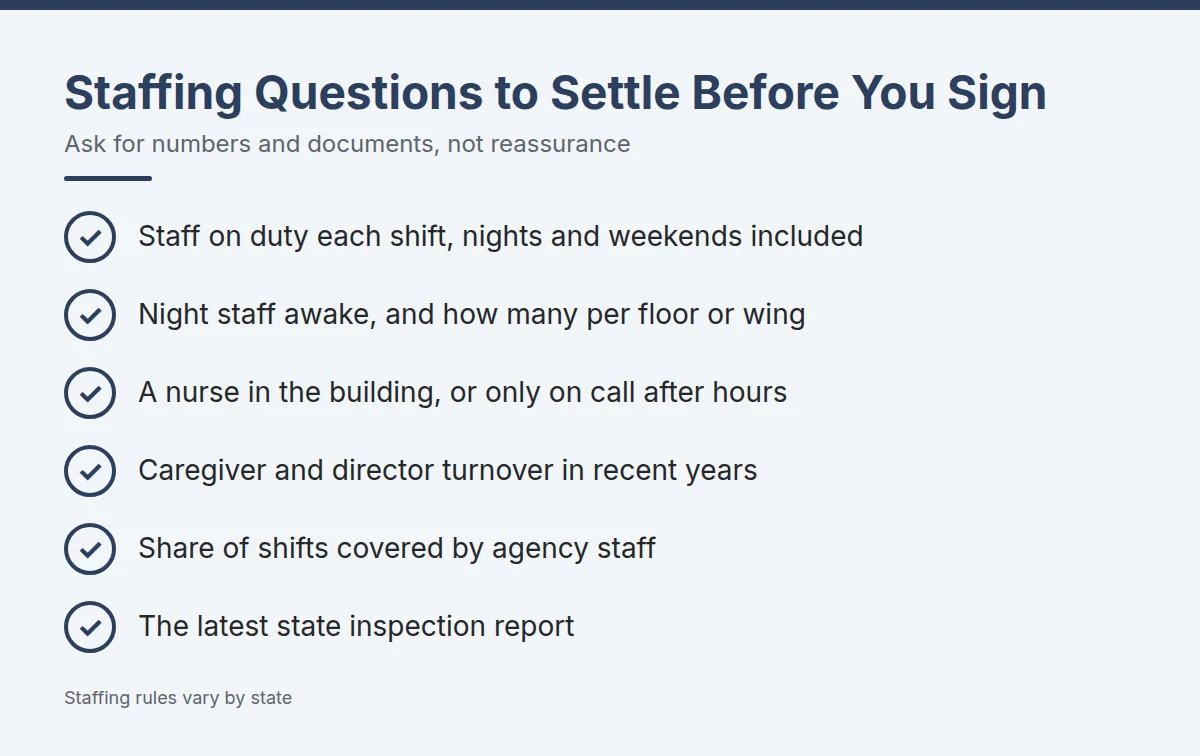
Assisted living has nothing like Care Compare, so ask about each shift by name:
- How many caregivers are on duty overnight, for how many residents, across how many floors or wings?
- Are night staff awake for the whole shift?
- Is a nurse in the building at night and on weekends, or on call by phone? If on call, how fast can that nurse arrive, and who decides whether to call 911?
- Who passes medications overnight and on weekends, and does that person also give hands-on care?
- If your parent needs two people for a transfer, how many staff are in the building at 3 a.m.? The care assessment will show whether that applies.
Turnover and Agency Fill-Ins
Two numbers tell you whether the staffing on paper is the staffing your parent will get: how fast people leave, and how often strangers fill in.
Turnover. Churn runs high across long-term care, so you want a number, not a reassurance. Working from payroll records for 15,645 nursing homes, Gandhi and colleagues put the typical home’s annual nursing staff turnover at about 94 percent, with an average of 128 percent. Assisted living publishes no comparable figures, but in an Ohio survey analyzed by Kennedy and colleagues, average retention rates for direct care workers were 66 percent in assisted living and 61 percent in nursing homes, and nonprofit status went with better retention in both. Turnover tracks quality: Brunt and Bowblis found strong associations between nursing home quality and Care Compare’s staffing and turnover measures. And low churn is possible. One nonprofit operator in Virginia told Senior Housing News this spring that its turnover among certified nursing assistants was below 15 percent.
A caregiver who has worked with your mother for a year knows she takes her coffee before her pills and goes quiet when she hurts. A new one has to learn that, and so does the one after. Ask about the top as well: how many executive directors and nursing or wellness directors the community has had in three years. Leadership churn is one of the signals in our guide to the warning signs of a community in financial trouble.
Agency staff. Agency, contract or pool staff are temporary workers booked through a staffing company to cover open shifts. Some agency use is responsible: an agency aide on a night when two employees call in sick beats a shift run short. The concern is reliance. Pradhan and colleagues found that nursing homes using more agency nurses and aides had lower odds of a higher quality star rating, and that homes in the top quarter for agency use had higher turnover among their own permanent RNs and aides. Heavy agency use and churn tend to travel together.
Agency use can also hide inside a good staffing number, because the payroll hours behind Care Compare count agency workers the same as employees. CMS does publish each nursing home’s raw daily payroll file, which splits every day’s hours into employee and contract hours, for anyone in the family who is handy with spreadsheets.
In assisted living, ask what share of last month’s shifts agency staff covered, and which ones. Do the same agency workers come back, and do they read residents’ care plans before they start? Florida, for one, makes the community responsible for confirming that contracted workers are qualified for the work they do. And if you hire a private aide for your parent, count that person as extra help, not as part of the community’s staffing. Georgia bars communities from counting private sitters or hospice workers toward their ratios.
What to Check Before You Sign
Ask for paper as well as answers, and visit at the hours that matter.
- The state inspection report. States license and inspect assisted living, and many post reports online. Read the last two or three years for citations involving staffing, supervision, falls and medication errors.
- The posted staffing sheet, in a nursing home. Read today’s, then ask for a weekend day and a night shift from last month. The home must make those records available on request.
- Care Compare, for any nursing home, including the skilled nursing wing of a continuing care campus. Compare weekend staffing with the overall figure, and read the turnover and administrator numbers.
- The staffing plan, in assisted living. Ask for a typical week’s schedule by shift, nights and weekends included. A community that will not discuss it is telling you something.
- The dementia care disclosure. Carder’s review found that most states require some form of consumer disclosure from communities that offer dementia care. Compare what it says about staffing and training with what you see.
Then go back unannounced, around 7 p.m. on a weekday and late morning on a Sunday. Count the caregivers you can see on each floor, and notice how long call lights and pendant alarms sound. If you can, watch a shift change: an outgoing aide briefing the incoming one is a good sign, and an empty hallway while both shifts talk in the break room is not. Many electronic call systems log how long each call takes to answer, so ask for average night shift response times. And ask the question no brochure answers: will your parent see the same caregivers most days, or a rotating cast?
Staffing Is What You Are Paying For
The apartment, the dining room and the activity calendar are what you see on a tour. The staffing is what you pay for every month. No single number settles it: a community with a modest ratio, a stable team and a nurse in the building at night may serve your parent better than one with a richer ratio that churns through aides. Look for specific, honest answers that hold up on a Sunday evening.
Staffing rules, inspection practices and public reporting vary significantly by state, and assisted living, memory care and nursing homes are each regulated differently. Your state’s long-term care ombudsman, a free advocate for residents, can explain the rules where your parent lives and help if problems arise after move-in. For a decision this large, a certified senior care advisor can help you compare communities, and an elder law attorney can review the contract before you sign. Nothing in this article is legal or financial advice.
Further reading (sources)
- Bisnow on Massachusetts senior care operators facing the loss of workers with temporary protected status
- Dys and Tunalilar for how staffing levels varied across Oregon assisted living communities
- Hsu and colleagues with caregiver training requirements in assisted living, state by state
- Rome, Harris-Kojetin and Carder on licensed nurses in residential care, by state requirement
- Thomas and colleagues on state staffing rules and hospitalization of assisted living residents
- Georgia Compiled Rules and Regulations for assisted living ratios and on-site nurse hours, and staffing in certified memory care centers
- Florida Administrative Code with minimum staff hours, awake overnight staff and contracted workers in assisted living
- Texas Administrative Code on Type A and Type B assisted living facilities and night shift staffing rules
- Code of Federal Regulations for nursing home staffing rules and the daily staffing posting, and the 75-hour minimum for nurse aide training
- Federal Register on the repeal of the 2024 nursing home minimum staffing standards
- Centers for Medicare & Medicaid Services with the staffing and turnover measures behind Care Compare ratings, and its daily payroll staffing file, split into employee and contract hours
- Geng, Stevenson and Grabowski on day-to-day and weekend swings in nursing home staffing
- Carder for how states regulate dementia care in assisted living
- Gandhi, Yu and Grabowski on nursing staff turnover across U.S. nursing homes
- Kennedy and colleagues with direct care worker retention in assisted living and nursing homes
- Brunt and Bowblis on how Care Compare’s staffing and turnover measures relate to quality
- Pradhan and colleagues for agency nursing staff and quality star ratings, and for agency use and turnover among permanent nurses
- Senior Housing News with how operators are handling the shortage of nurses and aides