Medical Nutrition Therapy in Senior Living: The Free Medicare Dietitian Benefit for Diabetes and Kidney Disease
Published on October 22, 2026

Your father has lived in assisted living for a year. He has type 2 diabetes, and at his last checkup the doctor mentioned that his kidney numbers have slipped. When you ask the community about his meals, the answers sound reassuring: there is a diabetic-friendly option on the menu, and “we have a dietitian.” What nobody mentions is that Medicare will pay a registered dietitian to review his labs, his medications and what he actually eats, and to write a plan for him alone, at no cost to him.
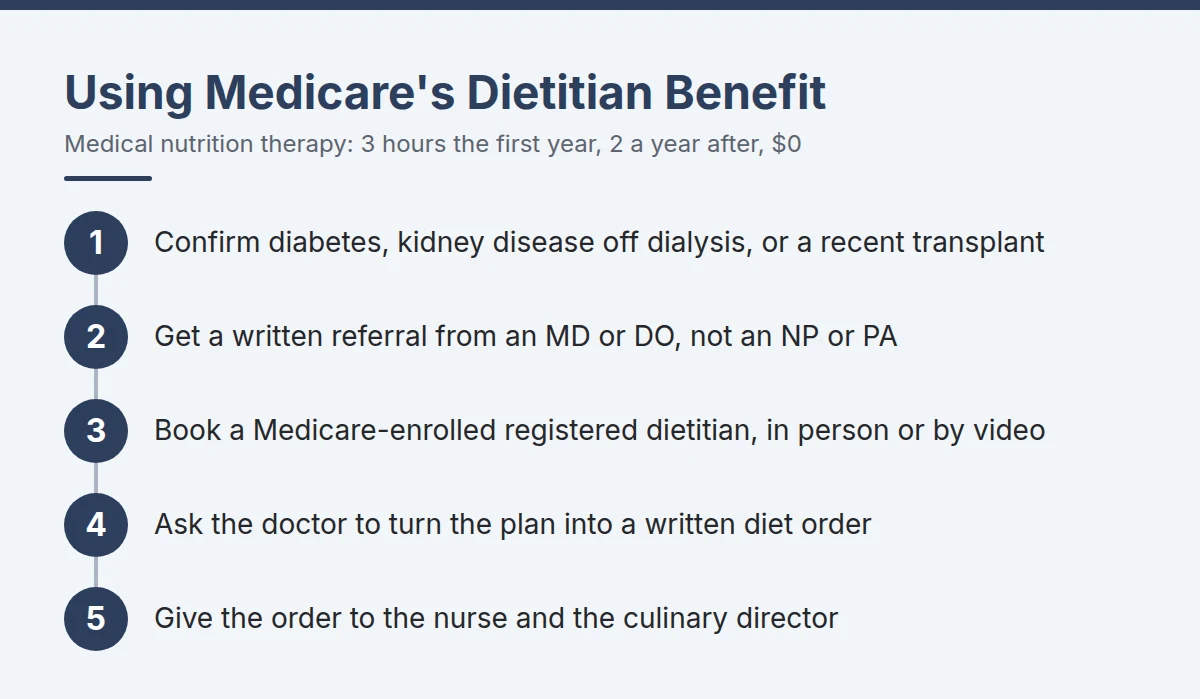
The benefit is called medical nutrition therapy, or MNT. Medicare Part B covers it for people with diabetes, for people with chronic kidney disease who are not on dialysis, and for three years after a kidney transplant: three hours with a registered dietitian in the first calendar year and two hours in each year after that, with no deductible and no coinsurance. In senior living, though, the sessions are the easy part. The harder part is getting the dietitian’s plan out of a folder and onto your parent’s plate.
This guide is for families of residents in assisted living, independent living and memory care. Nursing homes differ: federal rules already require them to employ a qualified dietitian, full-time, part-time or as a consultant. For how Medicare coverage changes from one setting to the next, see our overview of what Medicare actually pays for in senior housing.
What Medicare Covers, and What It Costs
Medicare describes medical nutrition therapy as nutrition education used to manage, treat or prevent chronic disease. It starts with an assessment of your parent’s nutrition and lifestyle, followed by individual or group sessions and follow-up visits. Only a registered dietitian, or a nutrition professional who meets Medicare’s education, training and state licensing rules, can provide it.
The hours come from Medicare’s national coverage determination for MNT:
- Three hours in the first year. Medicare.gov ties these initial hours to the calendar year and says they cannot carry over into the next one, so a referral that arrives in November leaves only weeks to use them.
- Two hours in every year after that.
- More when something changes. If the doctor determines that a change in diagnosis, medical condition or treatment regimen calls for a change in your parent’s nutrition plan, the doctor can order additional hours. A drop in kidney function is a change in condition; a switch to insulin is a change in treatment.
Your parent pays nothing. Federal rules exempt MNT from the Part B deductible and list it among the preventive services Medicare pays at 100 percent of the approved amount. Registered dietitians are also among the practitioners who must accept Medicare’s approved amount as full payment, so a dietitian who bills Medicare for a covered session cannot bill your parent for anything on top. Compare that with the physical and occupational therapy in our guide to therapy in assisted living, which costs 20 percent after the deductible.
Medicare Advantage plans cover the same benefit and cannot charge deductibles, copays or coinsurance for Medicare-covered preventive services received in network. The words that matter are “in network,” so call the plan before booking and ask which dietitians it uses.
Who Qualifies, and the Kidney Rule Families Misread
A doctor has to document one of three diagnoses in your parent’s medical record:
- Diabetes. Medicare’s definition is simply diabetes mellitus, so type 1 and type 2 both qualify.
- Chronic kidney disease that does not yet need dialysis. Medicare’s definition uses a glomerular filtration rate (GFR) of 15 to 59, which is stages 3 and 4 in the standard kidney disease staging, and it also covers kidney failure in a person who is not receiving dialysis.
- A kidney transplant within the last 36 months.
Two details trip families up. The first is the kidney window’s upper edge. A lab report showing an estimated GFR of 62 does not qualify on kidney grounds, even if the doctor has mentioned early kidney disease. If your parent also has diabetes, that diagnosis qualifies on its own.
The second is dialysis. MNT based on kidney disease is not covered for people on maintenance dialysis, because Medicare covers their nutrition therapy as part of dialysis care. A parent who decides, with their doctors, to manage kidney failure without dialysis keeps the benefit: Medicare’s definition includes end-stage kidney disease “when dialysis is not received.”
Getting the Referral
The referral rule is stricter than for most Part B services: only a physician, meaning a doctor of medicine or osteopathy, can refer for MNT, with the qualifying diagnosis documented in the record. That surprises many senior living families, because plenty of residents see a nurse practitioner or physician assistant for routine care. Those clinicians can order the diabetes training described below, but not MNT. If your parent’s regular clinician is an NP or PA, ask whether a physician in the practice, or your parent’s kidney or diabetes specialist, will sign the referral.
When you ask, be specific: a referral for medical nutrition therapy for the named condition (type 2 diabetes, say, or stage 3b chronic kidney disease), with recent lab results sent along so the dietitian is not starting blind.

Then find the dietitian:
- Ask the community first. Some consulting dietitians are enrolled in Medicare and see residents individually under a referral. Others are hired only to work on the menus.
- Ask the doctor’s office, or search online. NIDDK points people with kidney disease to the Academy of Nutrition and Dietetics’ online search for dietitians who specialize in kidney disease. Hospital nutrition clinics and diabetes education programs are other places to look.
- Ask two questions before booking: are you enrolled in Medicare, and will you bill this visit as medical nutrition therapy?
Expect to search a little. A review by Lee and colleagues found MNT for kidney disease underused, and too few dietitians (especially ones board-certified in kidney nutrition) for the number of Medicare-eligible adults with the disease, with gaps that vary by state.
Video visits count. Registered dietitians can provide Medicare telehealth, and CMS says that through December 31, 2027, beneficiaries can use it anywhere in the United States, including their own apartment. For a parent who no longer drives, a video visit with you or an aide sitting in may be easiest. From 2028, most Medicare telehealth is scheduled to require a rural medical facility again unless the rules change.
If you live far away, coordinating a doctor, a dietitian and a kitchen is the kind of work a geriatric care manager does. Our guide to building your senior care team covers what they charge and when one is worth it.
Diabetes Self-Management Training: The Companion Benefit
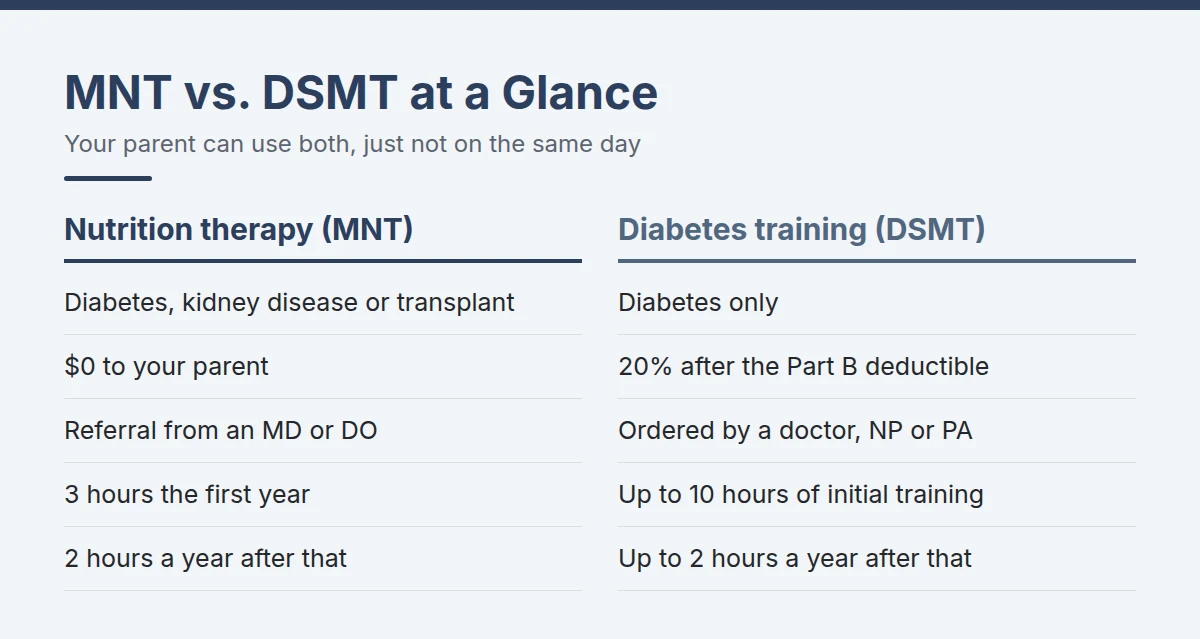
A parent with diabetes can also use diabetes self-management training (DSMT), a separate Part B benefit run by accredited programs. Where MNT focuses on food, DSMT covers the wider skills of living with diabetes: healthy eating and activity, checking blood sugar, taking medications and reducing risks. Its terms differ in four ways that matter:
- It is not free. After the Part B deductible, $283 in 2026, your parent pays 20 percent of the Medicare-approved amount. A Medigap policy or Medicaid may cover that share.
- It runs mostly in groups. Medicare covers up to 10 hours of initial training, generally 1 hour one-on-one and 9 hours in a class of 2 to 20 people, then up to 2 hours of follow-up a year. Individual sessions replace the class when none is available within 2 months of the order, or when the doctor documents special needs such as severe vision, hearing or language limitations.
- More clinicians can order it. A physician, or a qualified nonphysician practitioner such as a nurse practitioner or physician assistant, who is treating your parent’s diabetes can order DSMT.
- It stacks with MNT. Medicare’s coverage determination says that when the doctor finds both medically necessary, your parent can have both in full, as long as MNT and DSMT are not provided on the same day.
Few people use it. A CMS study of Medicare beneficiaries newly diagnosed with diabetes in 2010 found that only about 5 percent used DSMT, and that older beneficiaries, people eligible for both Medicare and Medicaid, and people with other health conditions were less likely to. Many senior living residents fit at least one of those descriptions.
Whether DSMT is worth it depends on how much of the managing your parent still does. The classes can pay off for an independent living resident who checks their own blood sugar and cooks some meals. For a memory care resident whose medications and meals are handled by staff, the dietitian’s individual plan will usually matter more.
Why “We Have a Dietitian” Is Not the Same Thing
When a community says it has a dietitian, ask what that person does. Assisted living has no federal dietitian rule like the one for nursing homes, and state rules vary. Florida’s are a clear example: every regular and therapeutic menu must be reviewed once a year by a licensed or registered dietitian or another qualified nutrition professional. That is a review of the menu, not an assessment of your parent.
A dietitian hired by the community works for the community. A dietitian seeing your parent under an MNT referral works from your parent’s own diagnoses, labs, medications, weight history and food preferences, and can send recommendations to the referring doctor and to the community. The menu item marked diabetic-friendly or renal was written for a typical resident with that condition, and your parent may need something else. (Our guide to dining in senior living covers how good programs handle therapeutic and texture-modified diets in general.)
The two can be the same person: a community dietitian who is enrolled in Medicare and willing to see your parent under a referral already knows the kitchen.
Turning the Dietitian’s Plan Into Dinner
A good plan that never reaches the kitchen changes nothing. The bridge is usually a written diet order. Florida’s rules show how it works: a community that provides meals must serve therapeutic diets as ordered by the resident’s health care provider, mark the menu items that fit each therapeutic diet, and document when a resident refuses the diet and tell the provider. Wording differs from state to state, so ask what your parent’s community needs before it will change a meal. Then:
- Ask the dietitian for recommendations the kitchen can use: how to spread carbohydrates across meals and snacks, a sodium limit, which high-potassium or high-phosphorus foods to limit, any fluid limit, and what to do about desserts.
- Ask the doctor to turn them into a written diet order the community can file.
- Give the order to two people: the nurse or wellness director, who updates your parent’s service plan, and the culinary director, who runs the dining room. Ask how the order reaches the server, and whether it follows your parent to the café, the snack cart and activity parties.
- Decide what should be tracked. Under Florida’s rule, a community that offers a select menu, a buffet or family-style dining does not have to record what a resident eats unless the provider’s order says monitoring is necessary. If you want intake or weight watched, put it in the order.

Timing matters as much as the menu for a parent on insulin or other diabetes medicines that can push blood sugar too low. The American Diabetes Association’s 2026 standards for older adults note that irregular meals raise the risk of low blood sugar and that consistent eating patterns are essential to reducing it. Whoever gives your parent’s insulin needs to know when, and whether, your parent ate. Our guide to medication management in assisted living covers who actually hands out the doses.
For a parent with both diabetes and kidney disease, even the fix for a low can cause trouble. NIDDK advises people with kidney disease who have diabetes to treat a low with apple, grape or cranberry juice rather than orange juice, which is higher in potassium. Ask which juice the staff keep on hand.
When the Right Diet Is a Less Restrictive One
A dietitian’s job is not always to add rules. For a frail parent, the most useful recommendation may be to remove some.

The American Diabetes Association’s standards warn that in nursing homes and post-acute care, therapeutic nutrition plans and modified food textures can lead residents to eat less, contributing to weight loss and undernutrition, while meals tailored to a person’s culture, preferences and goals may improve quality of life and nutrition. The Academy of Nutrition and Dietetics’ position favors individualized nutrition, including the least restrictive diet, for older adults in long-term care and other settings, and says clinicians must weigh a therapeutic diet’s risks against its benefits, especially for frail older adults. An unappealing diet, it notes, can lead to poor eating and drinking, and then to malnutrition.
Kidney disease has the same tension. The 2024 kidney disease guideline from KDIGO, an international guideline group, suggests 0.8 grams of protein per kilogram of body weight a day for adults with stage 3 to 5 kidney disease. For older adults with frailty or muscle loss, though, it advises considering higher protein and calorie targets, set after a careful individual assessment, because slowing kidney decline and preventing malnutrition can pull in opposite directions. NIDDK makes the same point more plainly: some people with kidney disease need moderate amounts of protein, but too little protein can lead to malnutrition.
So a textbook renal diet or diabetic diet can be the wrong diet for an 88-year-old who is losing weight. Watch for unplanned weight loss, plates coming back half eaten, skipped meals, or a parent who says the food has no taste. Those are reasons to call the doctor about the diet. A change in condition can justify additional MNT hours, which is a better answer than enforcing the same diet harder.
Questions to Ask the Culinary Director
- Which therapeutic diets do you serve, and do you need a written order from the doctor for each one?
- Which menu items fit my parent’s plan, and can you give me carbohydrate counts for them?
- Will you follow a plan written by an outside dietitian, and will your dietitian talk with ours?
- Does a therapeutic diet change the monthly fee or the care level?
- How long is the gap between dinner and breakfast, and what can my parent eat at night? (Florida’s rule allows no more than 14 hours; check your state’s.)
- Who tracks weight and intake, and who calls the doctor if my parent stops following the diet?
- What does staff do for a low blood sugar, and which juice do you keep on hand?
- In memory care, who chooses the plate for a resident who can no longer choose?
Medical nutrition therapy is one of the few Medicare benefits that costs your parent nothing, and in senior living its value depends on a chain of handoffs: from the doctor to the dietitian, from the dietitian to a diet order, and from the order to the plate. Families who follow that chain get a plan built for their parent instead of a menu built for everyone.
Coverage rules change, assisted living rules vary from state to state, and every Medicare Advantage plan has its own network, so confirm the details with your parent’s doctor, the plan or your State Health Insurance Assistance Program (SHIP), which offers free Medicare counseling. For a dispute with a community over a contract or a care plan, involve an elder law attorney. Nothing in this guide is medical, legal or financial advice.
Further reading (sources)
- Medicare.gov on medical nutrition therapy eligibility, hours and costs
- Medicare.gov for diabetes self-management training hours and the 20 percent coinsurance
- CMS National Coverage Determination 180.1 with the yearly MNT hours, extra hours and the same-day rule for MNT and DSMT
- CMS on Medicare telehealth from anywhere through December 31, 2027
- 42 CFR 410.130 covering Medicare’s MNT definitions of diabetes, kidney disease and physician
- 42 CFR 410.132 for who can refer for MNT and the dialysis exclusion
- 42 CFR 410.134 on the qualifications a dietitian needs to provide MNT
- 42 CFR 410.141 with the DSMT ordering, group class and follow-up rules
- 42 CFR 410.152 on MNT among the preventive services Medicare pays at 100 percent
- 42 CFR 410.160 for the services exempt from the Part B deductible
- 42 U.S.C. 1395u covering the assignment rule for dietitians and other practitioners
- 42 CFR 422.100 with the ban on cost sharing for in-network preventive services in Medicare Advantage
- 42 CFR 410.78 on registered dietitians as Medicare telehealth practitioners
- 42 CFR 483.60 for the nursing home dietitian requirement
- Florida Administrative Code 59A-36.012 covering assisted living menu review, therapeutic diet orders and meal spacing
- Federal Register with the 2026 Part B premium and deductible notice
- National Institute of Diabetes and Digestive and Kidney Diseases on healthy eating for adults with chronic kidney disease
- American Diabetes Association Professional Practice Committee for the 2026 standards of care for older adults with diabetes
- Dorner and Friedrich with the Academy of Nutrition and Dietetics position on individualized diets for older adults
- KDIGO CKD Work Group on the 2024 guideline for evaluating and managing chronic kidney disease
- Lee and colleagues for low use of medical nutrition therapy for chronic kidney disease
- Strawbridge and colleagues on how few newly diagnosed beneficiaries use diabetes self-management training