Therapy Without Leaving the Building: How Speech, Physical, and Occupational Therapy Work in Assisted Living
Published on October 10, 2026
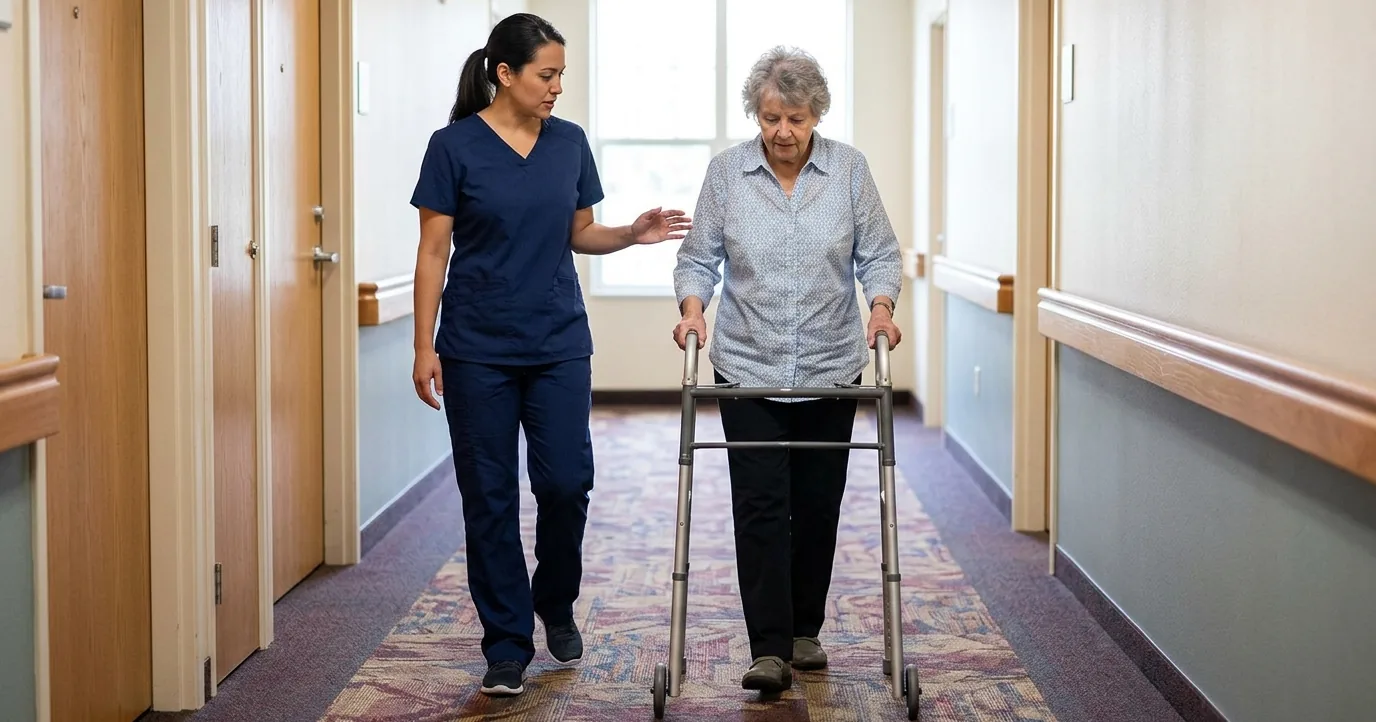
Your mother has been back in her assisted living apartment for a week since the hospital, and she is not quite herself. She shuffles where she used to walk, and she has started coughing at meals. Then someone from the therapy room off the lobby stops by with an offer: physical therapy three mornings a week, an evaluation with the speech therapist, and all of it without leaving the building. It sounds convenient, and it is. It also raises questions nobody at the front desk can answer. Is this part of the rent? Who is billing whom? And what happens when someone decides she has stopped improving?
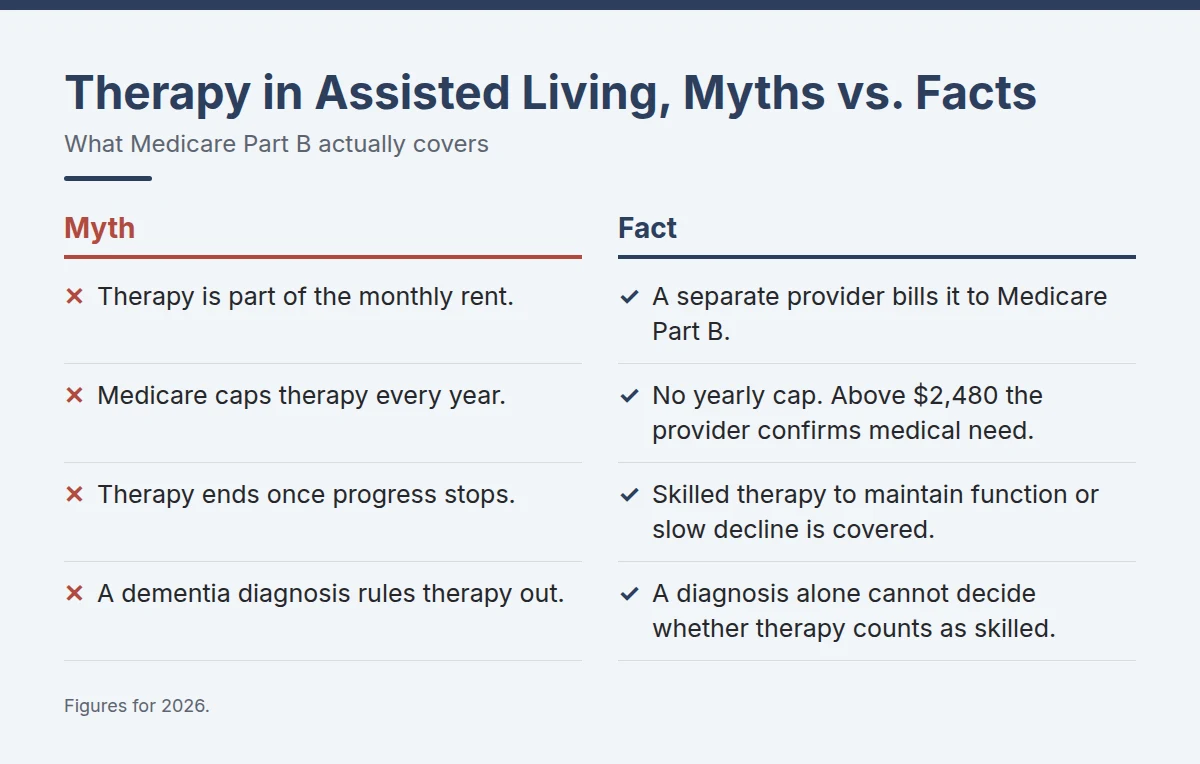
The short version: therapy is not part of the rent. It usually comes from a separate therapy business that bills Medicare Part B the way an outpatient clinic would, because Part B lets therapists treat people where they live, and an assisted living apartment is home. After the annual deductible your parent owes 20 percent, and there is no yearly dollar cap. Medicare can also keep paying for therapy that holds your parent steady or slows a decline, not only therapy that makes them better, and that is the rule families are most often told wrong.
This guide is for residents who are not in a Medicare-covered skilled nursing stay: people in assisted living, in memory care licensed as assisted living, or in an independent living apartment. For how the skilled nursing benefit works, see our overview of what Medicare actually pays for in senior housing.
Who Actually Provides the Therapy
States license assisted living communities, and Medicare does not certify them, so the community itself has no way to bill Medicare for therapy. The therapists in the building’s therapy room usually work for an outside company (sometimes one owned by the same operator), and that company bills Medicare under its own enrollment, entirely separate from your parent’s monthly statement.
Medicare lets outpatient therapy providers treat patients at home and pays them the same fee schedule rates there as in a clinic, so a session in your parent’s apartment costs no more than the same session across town. The rules are the same in any home setting: an independent living apartment, a small residential care home, or a senior co-living building with a shared kitchen.
Your parent also does not have to use the company down the hall. In Original Medicare, federal law lets a beneficiary get services from any qualified provider willing to treat them, so a resident can stay with the outpatient clinic they used before the move, or ask for a different provider that will come to the apartment. Convenience is a fine reason to choose the in-house team, but it should be a choice.
One more distinction helps when you read the activity calendar. Medicare does not count general exercise for overall fitness and flexibility, or activities meant for diversion or motivation, as therapy, even when a therapist leads them. Billable therapy follows an evaluation and runs under a written plan of care built for your parent. The chair yoga class in the community room is an amenity. The physical therapist’s balance training is a Medicare service with a bill attached.
Three Disciplines, Three Different Jobs
Medicare covers physical therapy, occupational therapy and speech-language pathology on the same terms, but each one solves a different problem.
Physical therapy works on strength, balance, walking, and getting up from a bed, chair or toilet. In assisted living, those abilities are often thin. In a study of 1,791 residents in 189 assisted living and residential care settings, 61 percent walked slower than about two feet per second, only 26 percent could stand up from a chair five times, and just 19 percent could hold a heel-to-toe stance for one second. Residents who did better on those simple tests had a lower risk of nursing home placement, fracture and functional decline over the following year, and the researchers described the weaknesses they found as modifiable.
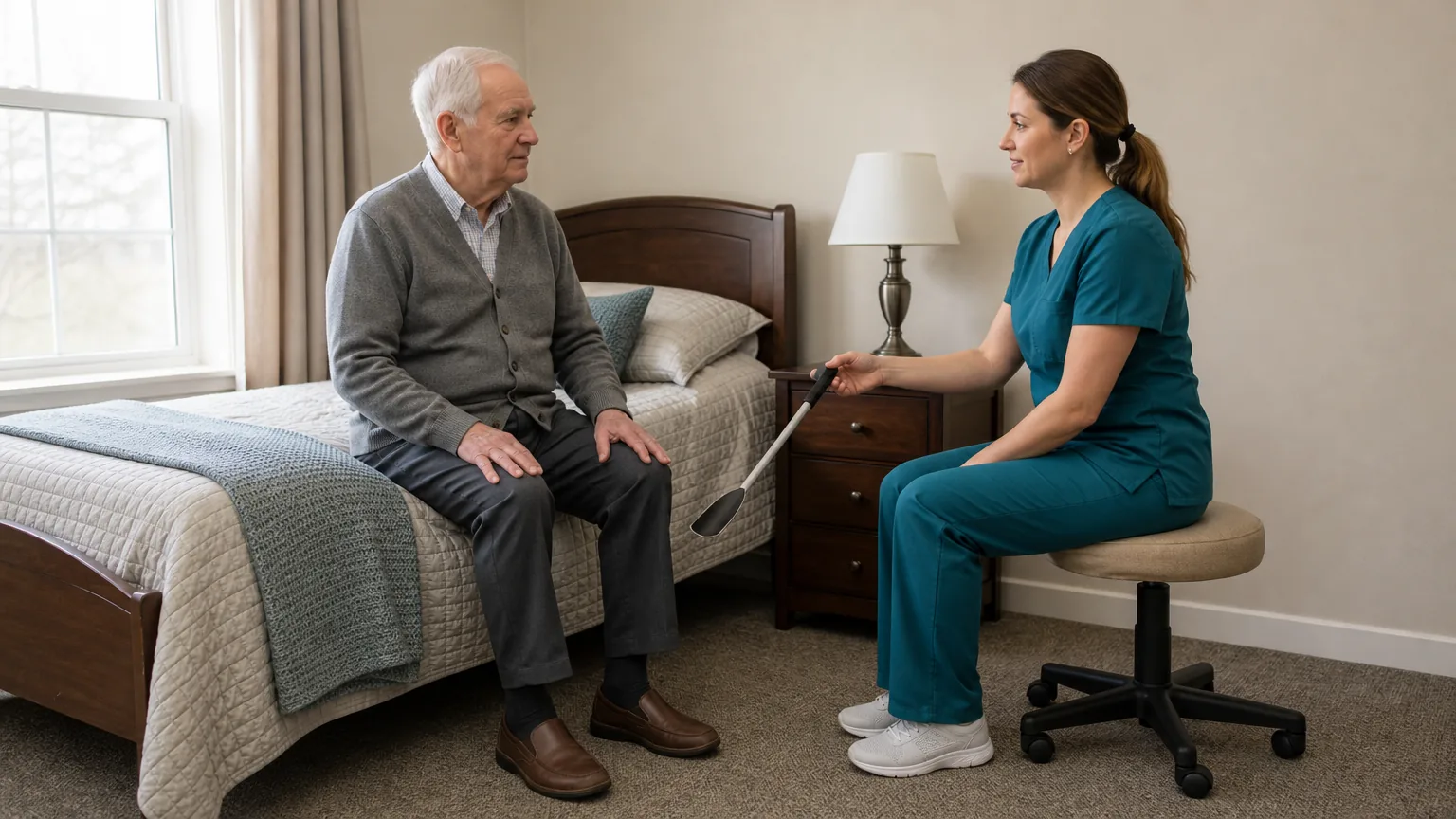
Occupational therapy focuses on the tasks of daily life: dressing, bathing, toileting, grooming and eating. Medicare’s manual describes it as teaching compensatory techniques that make a person more independent in those activities, or that help them adapt to a condition that is getting worse, along with fitting splints and self-help devices. In practice that might mean a new way to get dressed after a shoulder injury, a safer routine for the shower, or a utensil your father can actually grip. These are the same tasks a community scores when it sets your parent’s care level, as our guide to ADLs and the care assessment explains. One caution: Medicare refuses to buy much of the bathroom equipment a therapist may recommend, which our guide to Medicare equipment rules in assisted living covers.
Speech-language pathology covers much more than speech. Medicare’s own description includes therapy for cognitive and swallowing skills, and swallowing is often the urgent one. A Finnish study of all 1,466 residents of assisted living facilities in the Helsinki area found caregiver-reported swallowing difficulties in 11.8 percent of them. Those residents were nearly three times as likely to be malnourished (30.6 percent versus 11.0 percent), and swallowing difficulty still predicted death over three years after adjusting for age, sex, other illnesses and nutrition. The American Speech-Language-Hearing Association warns that swallowing problems can lead to dehydration and pneumonia. A speech-language pathologist evaluates the swallow and may teach exercises, special movements or strategies, or prescribe new textures for food and drinks, which the community’s kitchen will then need to follow.

On the cognitive side, speech-language pathologists work with people with dementia using techniques such as spaced retrieval, a method of learning information so it can be recalled later, and external aids like memory books, memory wallets and communication cards. They also train family members and care staff in communication strategies. ASHA notes that dementia treatment is often delivered as maintenance therapy, which matters a great deal for the coverage question below.
What Part B Therapy Costs in 2026
The math is ordinary Part B math. Your parent pays the annual Part B deductible, $283 in 2026, and then 20 percent of the Medicare-approved amount for each session. A Medigap policy pays some or all of that coinsurance depending on the plan, and Medicaid can cover it for residents who qualify for both programs.
There is no annual cap. Congress repealed the old dollar caps on outpatient therapy in the Bipartisan Budget Act of 2018, and Medicare.gov now states that there is no limit on how much Medicare pays for medically necessary outpatient therapy in a calendar year. What remains are two checkpoints that families sometimes mistake for limits:
- The KX threshold, $2,480 in 2026. Once your parent’s approved charges for the year pass $2,480 for physical therapy and speech-language pathology combined, or $2,480 for occupational therapy, the provider adds a code called the KX modifier to each claim, confirming that the therapy is medically necessary and that the record supports it.
- The review threshold, $3,000. Above $3,000 in a year, in each of the same two groupings, claims can be selected for targeted medical review, which weighs factors such as a provider’s denial rate or unusual billing patterns. That figure stays at $3,000 through 2027.
Neither number stops therapy. If your parent hears “you’ve hit your cap,” ask the provider which of these it means.
Families end up paying when the provider believes Medicare will not cover the therapy, usually because it no longer counts as medically necessary. To bill your parent instead of Medicare, the provider must first hand over a written Advance Beneficiary Notice of Noncoverage, known as an ABN. Medicare’s manual is explicit about one version of this: when therapy above the threshold is denied because the provider left off the KX modifier, the provider is financially liable unless it issued a valid ABN. The form lets your parent decline the therapy, or keep it and ask the provider to bill Medicare anyway, which preserves the right to appeal a denial.
Medicare Advantage plans must cover the same therapy, and federal rules require them to apply Original Medicare’s coverage rules, allowing a plan its own criteria only where Medicare’s are not fully spelled out. But a plan can require prior authorization, may limit your parent to its network, and sets its own copays. Call the plan before therapy starts and ask whether the in-house company is in network.
When Home Health Is the Cheaper Route
Some residents can get the same therapy without the 20 percent. Medicare’s home health benefit covers physical therapy and speech-language pathology at home (occupational therapy can continue under it, though it cannot open eligibility on its own), and your parent pays nothing for covered home health services. Medicare’s home health rules let an assisted living facility count as home, as long as it is not primarily engaged in providing skilled nursing or rehabilitation the way a nursing home is.
The catch is the homebound test, which has two parts. First, your parent must need help to leave (a cane or walker, a wheelchair, special transportation, or another person), or have a condition that makes leaving inadvisable. Second, they must normally be unable to leave, and leaving must take a considerable and taxing effort. Trips for medical care, religious services or adult day care do not disqualify them, and neither do occasional short outings such as a haircut or a family event.
Two practical rules follow. The routes do not overlap: while your parent is under a home health plan of care, the home health agency must provide all of their therapy, so the in-house company cannot bill Part B for sessions during that period. And the exits differ. When a home health agency ends all of your parent’s Medicare-covered services, it must give written notice at least two days ahead, and that notice opens a fast appeal. An ordinary outpatient therapy practice owes no such notice, so if it thinks Medicare will stop paying, the paperwork you will see is the ABN.
Before therapy starts, ask which route the provider is using, and ask your parent’s doctor whether your parent qualifies as homebound.
”She Has Plateaued” Is Not the Test
More therapy ends on this sentence than on any billing rule: your parent has stopped making progress, so Medicare will not pay anymore. Medicare does not require improvement, and the 2013 settlement in Jimmo v. Sebelius led CMS to rewrite its manuals to make that plain, as our guide to appealing a Medicare rehab cutoff explains. The outpatient therapy manual now says coverage “does not turn on the presence or absence of a beneficiary’s potential for improvement from the therapy, but rather on the beneficiary’s need for skilled care.” Skilled therapy may be needed to improve a condition, to maintain it, or to prevent or slow further deterioration, and Medicare’s coverage pages for each discipline say the same thing in plain language.
Under that maintenance standard, the manual covers:
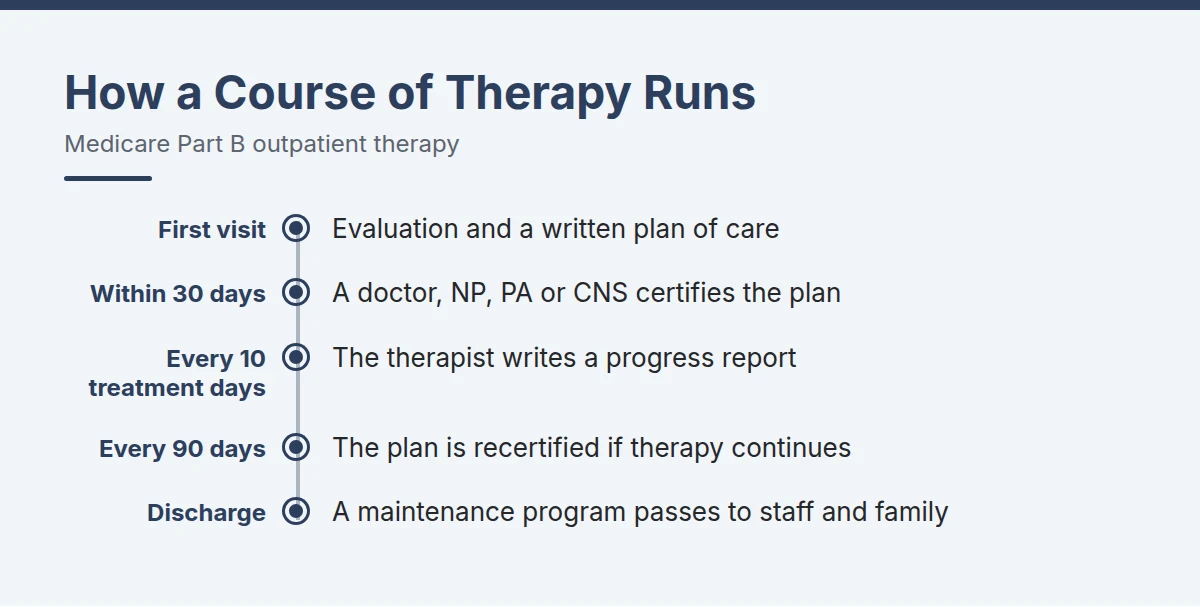
- Designing a maintenance program, when it takes a therapist’s specialized skill to create one.
- Teaching it to your parent and to whoever will carry it out, which in assisted living can include the community’s aides.
- Periodic reevaluations to check the program and revise it.
- Hands-on maintenance therapy, but only when a therapist’s skill is needed to do it safely and effectively, because the procedures are complex or because your parent’s own medical complications demand it.
What it does not cover is an exercise routine that your parent, a family member or an aide could safely carry out without a therapist. That is the real question to press. It is not whether your parent is still improving, but whether the care still needs a therapist’s skill.
The manual’s own examples are worth knowing. In one, a patient with multiple sclerosis needs to slow a loss of communication ability, and the speech-language pathologist’s evaluation, the design of a maintenance program and the training of family or support staff are covered, even though the patient does not yet need regular individual sessions. In another, a patient with Parkinson’s disease nearing the end of a rehabilitative course can get covered sessions in which the therapist works out which exercises will best preserve function and teaches the family to carry them on.
A diagnosis is not a reason, either. The manual says a diagnosis or prognosis cannot be the sole factor in deciding whether a service is skilled, and that rehabilitation can be needed, and improvement can happen, even with a chronic, progressive, degenerative or terminal condition. A parent with dementia or Parkinson’s is not disqualified by the label.
If you hear “plateaued,” ask the therapist to explain in writing what has changed, and ask whether a maintenance program would help. If your parent’s doctor agrees that skilled care is still needed, ask the doctor to say so in the record. Your State Health Insurance Assistance Program, or SHIP, offers free counseling if a denial needs to be appealed.
Questions to Ask Before Therapy Starts
- Who is the provider, and which benefit is it billing? Part B outpatient therapy and home health carry different costs and different notice rules.
- Who signed off on the plan of care? Medicare itself does not require a doctor’s referral to start therapy, but a physician, nurse practitioner, physician assistant or clinical nurse specialist must certify the therapist’s plan, normally within 30 days of the first session, and it must be recertified at least every 90 days if therapy continues.
- What are the goals? Ask whether they aim at improvement or maintenance, and what success will look like.
- Can we see the progress notes? The therapist must write a progress report at least once every 10 treatment days.
- Will you train the staff? If aides learn your parent’s transfer technique, exercises or meal textures, the work carries into the other 23 hours of the day.
- Is any of this not covered? If the answer is yes, expect an ABN, and ask why.
Therapy down the hall can be one of the best things assisted living offers: skilled help with walking, dressing, swallowing and thinking, delivered where your parent already lives. It works best when the family knows who is billing, what your parent owes, and that “not improving” is not the end of the road.
Coverage rules change, assisted living licensing is a matter of state law, and every Medicare Advantage plan sets its own procedures, so confirm the specifics with Medicare, the plan or a SHIP counselor, and involve an elder law attorney when an appeal or a large bill is at stake. Nothing in this guide is legal or financial advice.
Further reading (sources)
- Medicare.gov on outpatient speech-language pathology coverage, including swallowing and cognitive therapy
- Medicare.gov with home health coverage, costs and the homebound test
- CMS Medicare Benefit Policy Manual, Chapter 15 for outpatient therapy in the home, maintenance programs and liability above the threshold
- CMS Medicare Benefit Policy Manual, Chapter 7 on home health for assisted living residents and consolidated billing
- Federal Register with the 2026 physician fee schedule rule setting the therapy thresholds
- Federal Register for the 2026 Part B premium and deductible notice
- 42 CFR 424.24 on who certifies a therapy plan of care and how often
- 42 U.S.C. 1395a covering a beneficiary’s free choice of qualified provider
- 42 CFR 405.1200 for which providers must give notice before covered services end
- 42 CFR 422.101 on Medicare Advantage plans following Original Medicare coverage rules
- 42 CFR 422.138 with the rules for prior authorization in Medicare Advantage
- Giuliani and colleagues on physical performance and later outcomes among assisted living residents
- Lindroos and colleagues for swallowing difficulties, malnutrition and mortality in assisted living
- American Speech-Language-Hearing Association on speech-language pathology for people with dementia
- ASHA with tips for care partners of adults with swallowing disorders