Building Your Senior Care Team: Geriatric Care Managers, Elder Law Attorneys, Placement Agents, and Who to Hire When
Published on October 16, 2026

By the third week of a senior living search, most families have taken advice from five or six people. A hospital discharge planner handed over a list. A referral agent called within an hour of an online form. A financial advisor has views on the house, a friend’s lawyer has views on Medicaid, and the sales director at the community you liked best has views on everything. Most of them are genuinely trying to help. Almost none of them says out loud who pays them, or which part of the decision is actually theirs.
That matters because advice tends to follow the money. Being paid is not a sin, but every payment model pulls in a direction, and a family that can see the pull can use each of these people well. This guide maps who does what, how each one charges, how to check the credential on the business card, and the order to bring them in. It ends with the question families ask most about the paid role many have never heard of: when a care manager is worth the hourly rate.
Start With Who Pays Each Person
Every professional in a senior care decision falls into one of a few funding models, and the model tells you more about the advice than the job title does.

You pay them, and they work for your parent. A geriatric care manager bills by the hour. An elder law attorney bills hourly or quotes a flat fee. A fee-only financial planner charges an hourly rate, a flat fee or a percentage of the assets managed. They are paid the same whether your parent moves, stays home, or picks the least expensive option.
The community pays them. Placement and referral agents are free to families because the community your parent moves into pays them a commission. The community’s own sales director is paid by one building to fill that building.
The hospital pays them. The discharge planner works for the hospital, under Medicare rules covered below.
The public pays them. The Area Agency on Aging, the State Health Insurance Assistance Program (SHIP), the long-term care ombudsman and accredited veterans service organization representatives charge families nothing.
A product pays them. Some financial professionals earn a commission when your parent buys an annuity, a life insurance policy or a long-term care policy. That is legal and common, and it is why “How are you paid on what you recommend?” is the first question to ask anyone with a product to discuss.
The Geriatric Care Manager: The Professional Who Works for Your Parent
The role most families have never heard of is the one built for this situation. Geriatric care managers rebranded about a decade ago as Aging Life Care Professionals, and their trade group, the Aging Life Care Association (ALCA), has more than 2,000 members. Most come from nursing or social work; others are therapists or gerontologists.
A care manager coordinates care rather than providing it. Typical work includes:
- An in-home assessment of daily tasks, memory, medications, home safety, and how much help the family can realistically give
- A written care plan that answers the housing question honestly, including “not yet”
- Vetting specific communities, home care agencies, therapists, move managers and hospice providers
- Going to doctor appointments and stepping in when something goes wrong
- Check-in visits after a move, with a report to the family, and mediation when siblings disagree
What it costs. Rates depend heavily on where your parent lives. ALCA’s chief executive told KFF Health News in October 2026 that members charge $150 to $350 an hour. Practices in the same report charged $185 an hour in Texas, billed in 15-minute increments, and $210 in the Washington, D.C. area. Medicare does not pay. Some families split the bill among siblings, some cities have social service agencies that offer care management on a sliding scale, and a long-term care insurance policy is worth reading for a care coordination benefit. Before the first visit, ask for a written estimate of the initial assessment and how calls and travel time are billed.
How to check the credential. “Care manager” on a business card is a job description, not a credential. ALCA’s top tier, Advanced Professional, requires a relevant degree, at least two years of supervised experience after it (three with an unrelated degree), and one of four certifications: Care Manager Certified (CMC) from the National Academy of Certified Care Managers, Certified Case Manager (CCM) from the Commission for Case Manager Certification, or one of two social work case management certifications from the National Association of Social Workers. Ask which one the person holds, and check any nursing or social work license with the state board.
ALCA’s code of ethics bars members from giving or accepting referral fees, which is the clearest line between a care manager and a placement service. If the care manager works for a home care agency rather than independently, ask whether the plan is likely to recommend that agency’s own aides.
The Elder Law Attorney: Before Money Moves or Anything Gets Signed
An elder law attorney is not simply an estate planner with older clients. The work centers on the legal problems that arrive with long-term care: Medicaid eligibility and the look-back, protecting a spouse who stays at home, veterans benefits, guardianship and its alternatives, trusts for a disabled family member, and the admission agreement. Our guide to the paperwork before a senior move covers the documents a family can handle itself and the four situations where a lawyer earns the fee.
What it costs. Many elder law attorneys quote a flat fee for a defined job, such as a set of planning documents or a Medicaid application, and bill hourly for open-ended work. Fees vary widely enough that Yale Medicine’s geriatrics guide tells families to ask about them directly. Get an engagement letter naming the client, the scope and the fee before work starts.
Who the client is. Your parent, even when you write the check. Professional conduct rules let a lawyer accept a family member’s payment only with the client’s informed consent, and only if the payer does not steer the lawyer’s judgment or see confidential information. Expect the lawyer to meet your parent alone for part of the first meeting. That is not a snub. It is how an attorney confirms that the plan is your parent’s own and that your parent has the capacity to sign it.

How to check the credential. Membership in the National Academy of Elder Law Attorneys (NAELA) shows a focus on the field, but it is a membership, not a certification. The credential to look for is Certified Elder Law Attorney (CELA), granted by the National Elder Law Foundation, which the American Bar Association accredits to certify lawyers in elder and special needs law. A CELA has at least five consecutive years in practice, an average of 16 hours a week on elder law over the prior three years, 60 or more elder law matters in that window, 45 hours of elder law continuing education, five peer references and a passed certification exam. Many skilled elder law attorneys are not certified, so treat the letters as a strong signal rather than a requirement, and check any lawyer’s disciplinary record with the state bar.
The Placement Agent: Fast, Free to You, and Paid by the Other Side
A placement or referral agent does one job well: turning a care level, a budget and a ZIP code into a shortlist and a set of tours, quickly. It is free to families because the community your parent moves into pays the agency, and only if the move happens. Our guide to how placement services are paid covers fee sizes and the disclosure laws a handful of states have passed. The short version is that the list can only include communities that have agreed to pay.
The difference between a care manager and a placement agent is scope and incentive. A care manager’s assessment can conclude that your parent should stay home with more help, and the care manager keeps working after a move. A placement agent’s work ends at the signed agreement, and “stay home for now” pays the agency nothing. That does not make the shortlist wrong. It makes it one input, best used once you know the care level your parent needs and what the family can afford.
Titles such as “senior advisor” or “senior living advisor” do not tell you how someone is paid. The only reliable test is the direct question: do the communities you recommend pay you?
The Hospital Discharge Planner: Works for the Hospital, Plans the Next Few Weeks
If the search starts with a fall or a hospital stay, the first professional you meet is usually a discharge planner, typically a nurse or social worker on the hospital’s staff, whose duties are set by Medicare’s rules for hospitals. The hospital must assess what your parent will need after leaving and give you a list of the home health agencies, skilled nursing facilities, inpatient rehabilitation facilities and long-term care hospitals available to your parent. It must tell you that you are free to choose among them, share quality data to help you choose, and flag any home health agency or skilled nursing facility on the list in which it has a disclosable financial interest.

Notice what is missing: assisted living and memory care. The discharge planner’s legal job is a safe next step, usually rehab or home health, not long-term housing. Lean on them for the post-acute piece, equipment orders and Medicare notices, and do not let a two-day discharge window make a five-year housing decision. If someone at the hospital hands you a referral company’s number for assisted living, ask the same question you would ask any agent.
The Money Side: Planners, Tax Preparers, and the Letters After a Name
The financial professional on the team should answer two questions in writing: how long your parent’s money lasts at the care level they need, and what each funding option costs in taxes and benefits eligibility. First, find out how they are paid. A fee-only planner bills you directly; a commissioned advisor is paid by the company whose annuity, policy or investment your parent buys. Both can give sound advice, but only one has a reason to recommend a product.
Be skeptical of credentials with “senior” in the name. A Consumer Financial Protection Bureau review counted more than 50 senior designations in use, from some requiring college-level study to others earned at a weekend seminar. FINRA’s professional designations database shows whether each one requires training and continuing education, takes complaints, and lets you confirm who holds it. FINRA’s BrokerCheck and the SEC’s investment adviser search show licenses and disciplinary history.
A tax preparer belongs on the team too. The IRS lets families count qualified long-term care services as a medical expense when a licensed health care practitioner has certified the resident as chronically ill and the care follows a plan of care that practitioner prescribed. Someone who knows those rules can change the after-tax cost of a move.
The Free Help Most Families Skip
Some of the most useful members of the team cost nothing. Your parent’s Area Agency on Aging offers options counseling and local provider lists with no commission attached, and the long-term care ombudsman advocates for residents after a move. Our guide to free government tools for researching senior care shows how to reach both. For insurance questions, a SHIP counselor is a better first stop than anyone selling coverage, and our explainer on which coverage pays first after a senior living move shows why the order matters.
For a veteran or surviving spouse, help with a VA pension claim, including the Aid and Attendance benefit that can offset assisted living costs, is free from an accredited veterans service organization representative. Federal law generally bars accredited attorneys and claims agents from charging for work done before VA decides the initial claim, so anyone who wants a fee to file the first application is a red flag.
For a parent with dementia, ask the doctor whether a local practice takes part in Medicare’s GUIDE model, which has nearly 300 participants. For people in Original Medicare (not Medicare Advantage) who do not live long-term in a nursing home and are not in hospice or PACE, a GUIDE program provides a trained care navigator, a 24-hour support line, caregiver training and, for some families, up to $2,500 a year toward respite care. It is the closest thing to a Medicare-funded care manager, and few families know to ask.
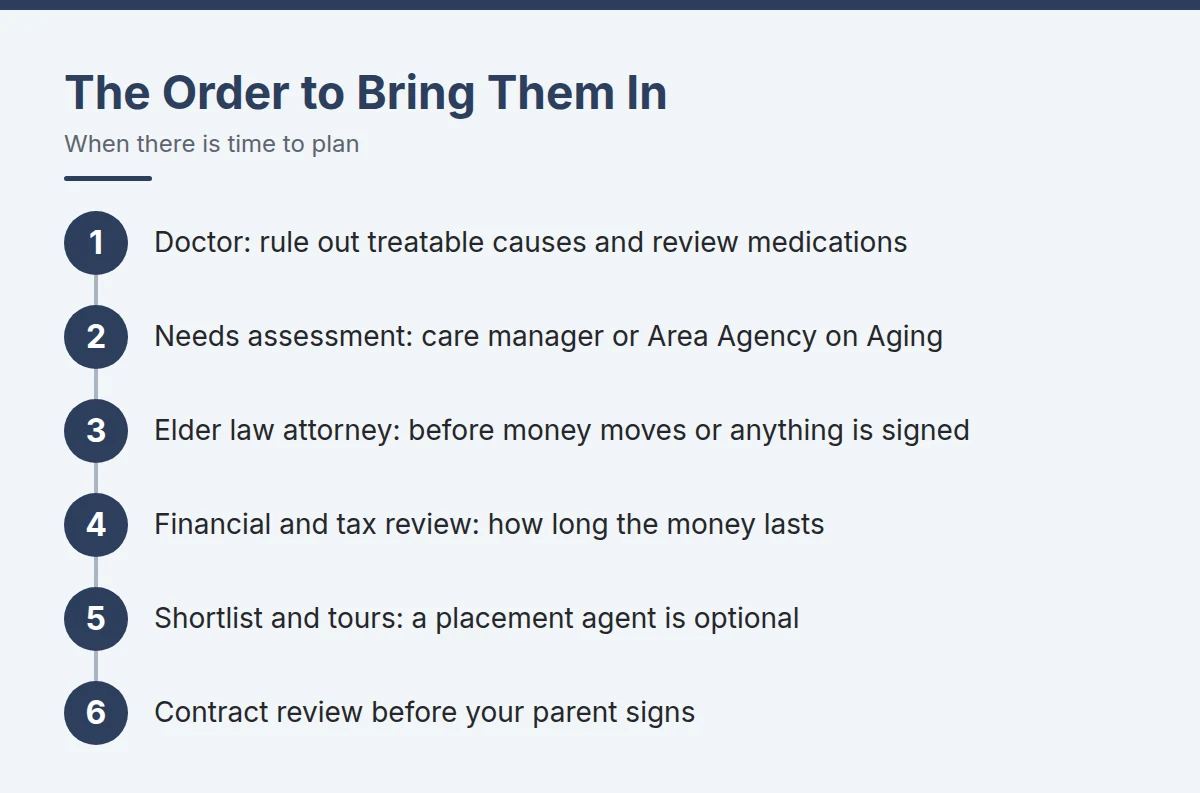
The Order to Bring Them In
When there is time to plan, this sequence lets each professional build on the work of the one before:
- Your parent’s doctor. Rule out treatable causes of decline and review medications before anyone prices care.
- A needs assessment. A care manager if the budget allows, or the Area Agency on Aging if it does not. Everything downstream depends on an accurate picture of the care your parent needs.
- The elder law attorney. Before any asset moves, the house is listed or a contract is signed. Powers of attorney and medical privacy releases come first.
- The financial and tax review. Now the planner can model real costs instead of brochure prices.
- The shortlist and tours. Bring in a placement agent here if you want one, alongside your own research.
- Contract review before signing. The attorney reads the residency agreement, and the care manager checks that the community’s assessment matches theirs.
In a crisis the order compresses but does not disappear. The discharge planner handles the next few weeks. If you live far away, call a care manager the same day. The lawyer still comes before money moves, and if your parent qualifies for a skilled nursing rehab stay, those weeks are time to make the housing decision properly rather than in a hospital hallway.
When a Care Manager Pays for Itself
For some families a care manager is a luxury. For others it is the least expensive decision available. It tends to earn its fee in a few situations:
- You live far away. Monthly visits and a written report replace some of the trips, and the person on the ground notices changes a phone call hides. One family profiled by KFF Health News oversees parents and an aunt in Maryland from Massachusetts this way.
- A crisis needs hands today. In the same report, an Austin care manager arranged a same-day move for an 85-year-old with advanced dementia.
- Siblings disagree. A neutral professional’s written assessment gives everyone one set of facts to argue from.
- The care level is contested. Communities price care from their own assessment, and an independent one gives you grounds to question a score that seems high. Our guide to ADLs, IADLs and the care assessment explains what the nurse is scoring.
- A wrong move would be costly. A second move within a year often means a second community fee, a second set of movers and a second adjustment for your parent.

It is harder to justify when a capable family member lives nearby, needs are simple and stable, or money is tight. In those cases, ask whether the care manager will do a one-time assessment and written plan, then step back while you do the legwork, and lean on the free help above for the rest.
You Own the Decision
Costs, licensing rules and benefit eligibility vary significantly by state, and nothing here is legal or financial advice. The point of a team is that no single member has to be right about everything. The care manager owns the care picture, the elder law attorney owns the legal and Medicaid questions, a fee-only planner and a tax preparer own the numbers, and your family owns the decision. None of that makes the choice easy, but it means you are not making it alone. Bring each person in before you need them, and ask every one of them the same first question.
Further reading (sources)
- KFF Health News on what aging life care managers do, what they charge, and their ban on referral fees
- Aging Life Care Association for the four certifications its advanced members must hold
- Harvard Health Publishing with the case for hiring a care professional, and why Medicare will not pay
- National Elder Law Foundation covering the experience and education behind the CELA credential
- Yale Medicine on what eldercare attorneys handle and what to ask about fees
- Legal Information Institute for the Medicare discharge planning rule hospitals must follow
- Legal Information Institute with the federal limit on fees for help with a VA claim
- U.S. Department of Veterans Affairs on who can help with a claim and which help is always free
- Consumer Financial Protection Bureau about the confusing spread of senior financial designations
- FINRA for decoding the letters after an advisor’s name
- Internal Revenue Service covering which long-term care costs count as medical expenses
- Centers for Medicare & Medicaid Services on the GUIDE dementia care navigation model