Adult Family Homes, Board and Care, or Nothing at All: Why the Small-Home Option Depends on Your State's License Categories
Published on November 2, 2026
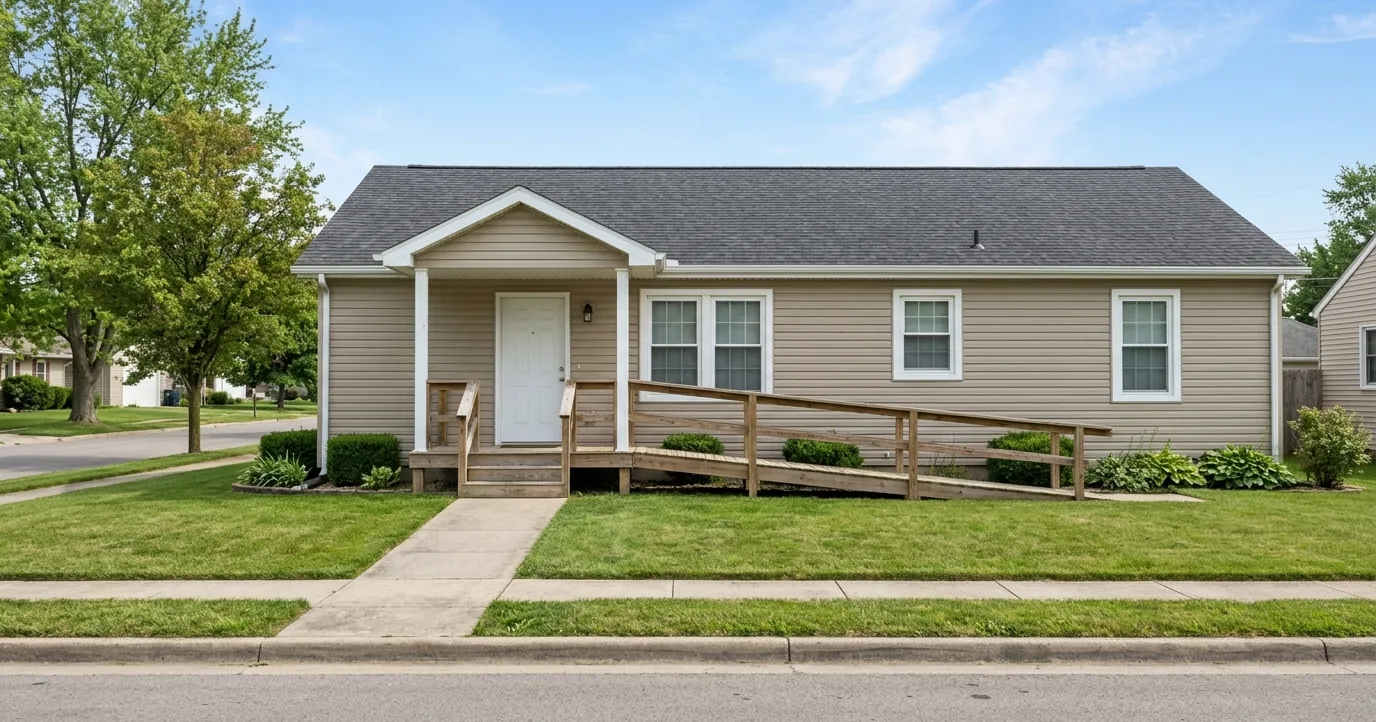
Search for a small care home near Seattle and you will be scrolling for a while. Run the same search near Boston and the list is short enough to read over coffee. It is tempting to blame demand, as if Massachusetts families simply prefer big buildings. The real reason is a line in each state’s law. Washington wrote a license for a care home the size of a house in 1989, and as of January 2026 its social services department counted 5,402 adult family homes holding Medicaid contracts, 1,590 of them in King County alone. That count leaves out homes that take only private payers. Massachusetts, with a population within about a million of Washington’s, never wrote that license. Its 273 certified assisted living residences, counted in January 2025, are organized around individual units; among those reporting standard units, the smallest had 8 and the median had 60.
So before you look for a small home, find out whether your state licenses one, what it calls it, and what fills the gap where it does not. Our guide to small residential care homes covers what daily life, staffing, and cost look like inside one. This piece is about the step before that: whether the option legally exists where your parent lives.
Why Washington Has Thousands of Small Homes and Massachusetts Does Not
Washington’s law defines an adult family home as a residential home where a provider gives personal care, room, and board to between two and six adults who are not related to them, or up to eight with the state’s approval. The same chapter does two things that matter more than any staffing rule. It makes an adult family home a residential use of property, permitted in every area zoned for homes or businesses, including single-family neighborhoods. And it declares that restrictive covenants blocking these homes are contrary to the public interest. In practice, a licensed provider can open a home in an ordinary house on an ordinary street, and the city cannot zone it out.
California reached a similar place by a different road. It has one license, the residential care facility for the elderly (RCFE), for buildings of every size, and the state’s social services department notes that RCFEs are often called assisted living facilities or board and care homes. State law, however, treats an RCFE serving six or fewer people as a family dwelling for zoning, and bars cities from requiring any zoning permit for it that an ordinary family home would not need. The result shows up in the state’s own licensing list. In the version published in May 2025, 6,265 of the 7,939 licensed RCFEs were licensed for six or fewer residents, nearly four in five.
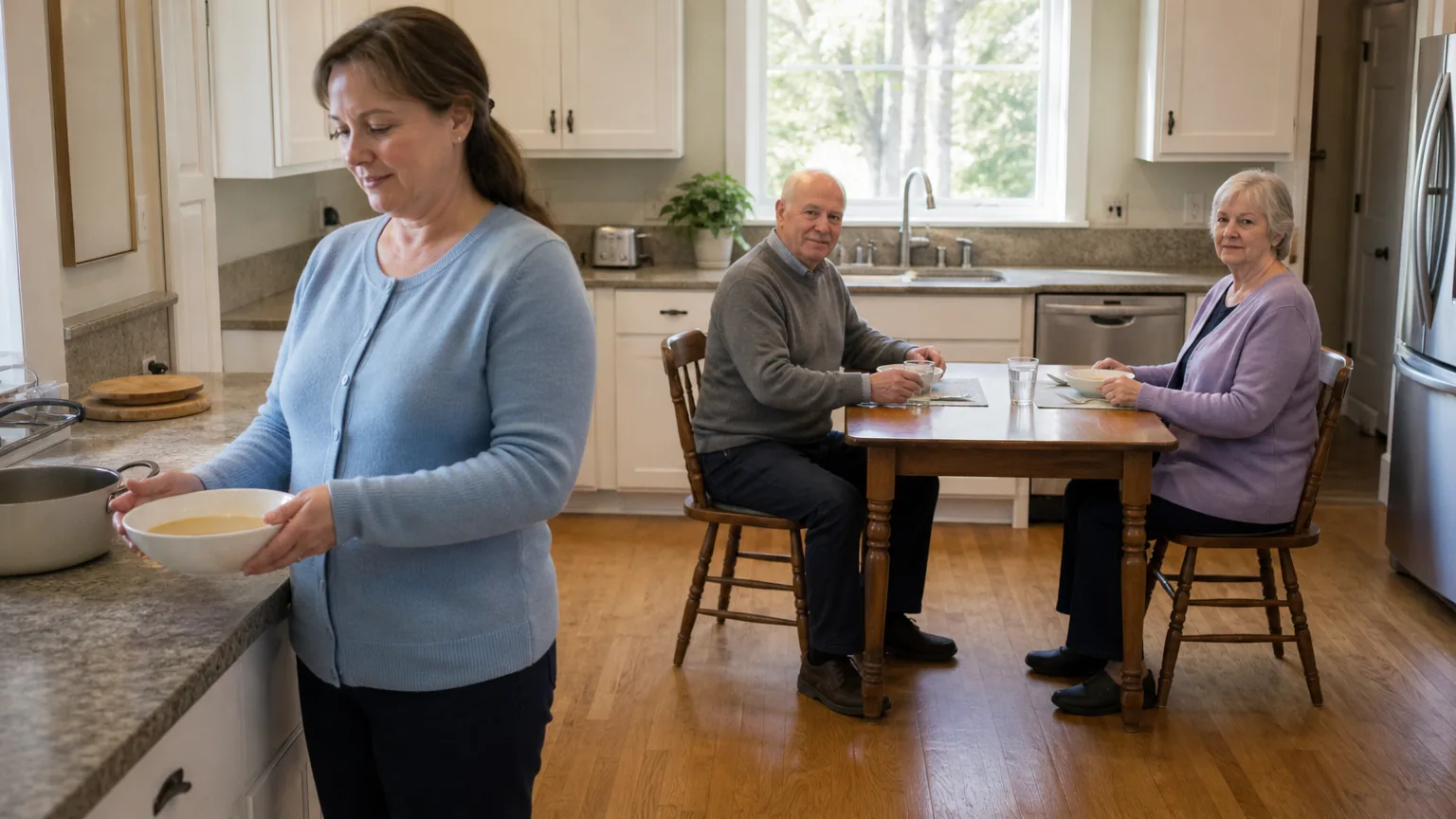
Massachusetts drew its line somewhere else. Under its assisted living statute, any operation that provides room and board plus help with daily activities to three or more unrelated adults, and collects payment for that help, is an assisted living residence. Those residences are certified by the state’s Executive Office of Aging & Independence under a single set of rules regardless of size, and every unit needs at least a half bathroom and a kitchenette, with full bathrooms required in new construction. That is a standard written with apartments in mind, and a converted family house struggles to meet it. The closest house-scale option is MassHealth’s Adult Foster Care, a Medicaid service in which a trained caregiver provides supervision and personal care in a family setting for up to three people. It is a payment program, not a facility license.
The lesson for families is not that one approach is right. It is that the law, more than demand, decides whether the house-sized option shows up in your search results at all.
Find Your State’s Name for the Small Home
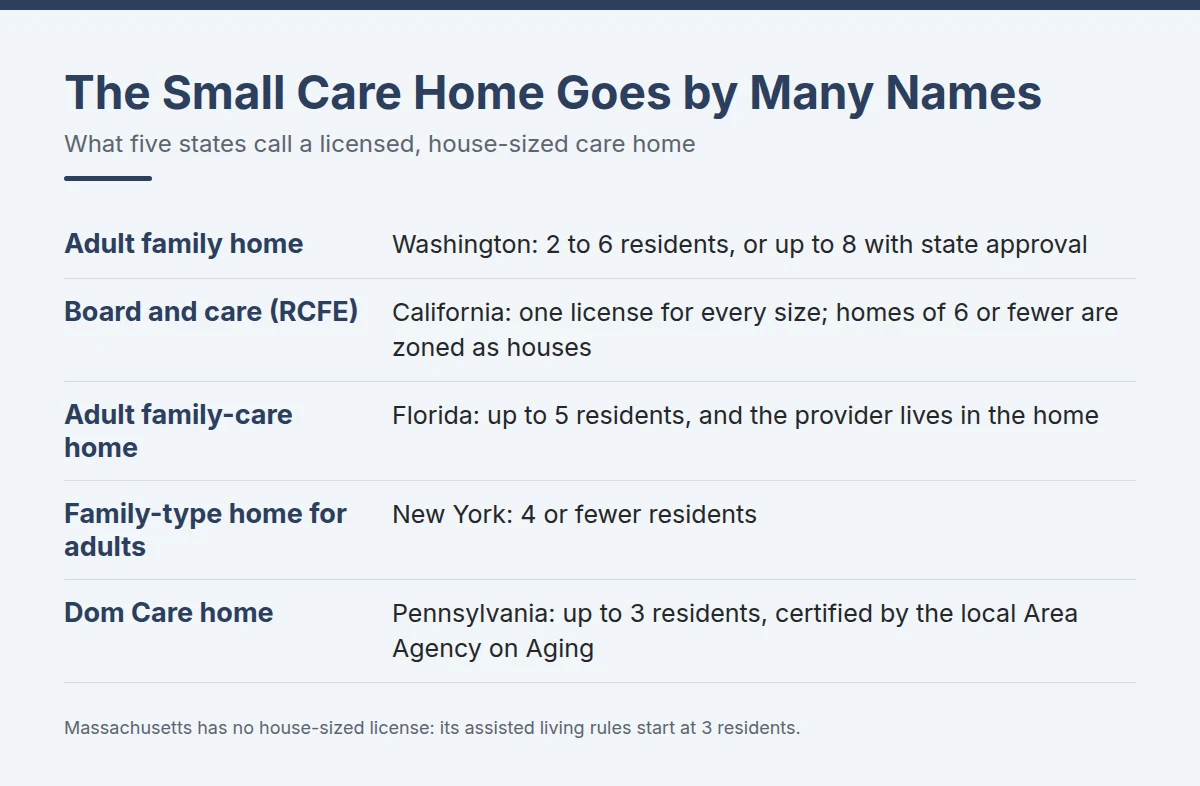
Every state licenses some form of residential care, but the small-home version wears a different name almost everywhere, and the name tells you nothing about the size limit. A few examples, taken from the statutes and regulations themselves:
- Washington: adult family home, two to six residents, or up to eight with approval.
- California: residential care facility for the elderly, often called board and care. Homes of six or fewer are zoned as houses.
- Florida: adult family-care home, no more than five residents, and the person providing care must own or rent the home and live in it.
- New York: family-type home for adults, four or fewer residents. Adult homes and enriched housing programs start at five.
- Pennsylvania: the personal care home license starts at four residents. Below that, the state’s Domiciliary Care program certifies private homes for up to three people through the local Area Agency on Aging.
- Massachusetts: no house-sized license. Assisted living certification begins at three residents.
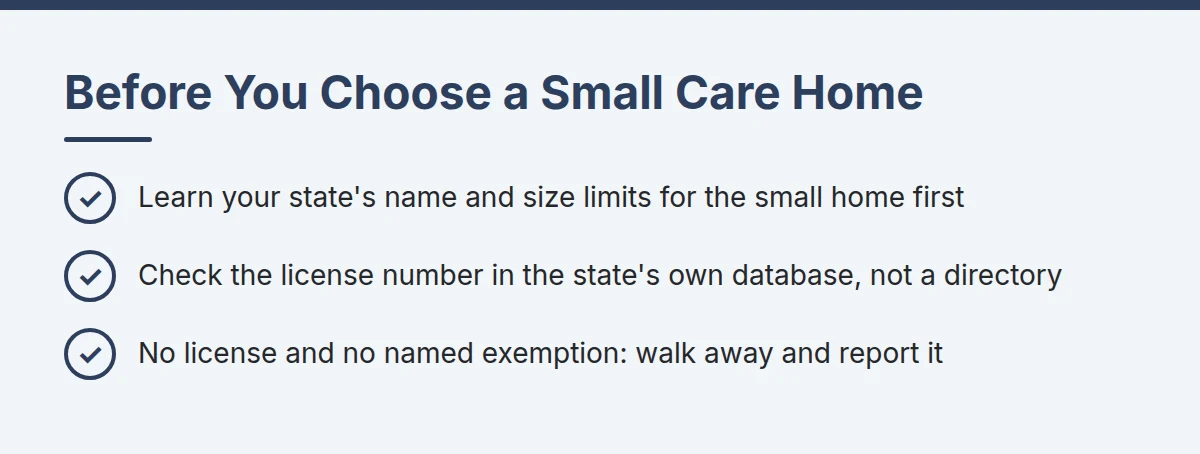
When you find your state’s definition, read it for three numbers. The first is where licensing starts. A 2015 federal review of state rules found that 30 states required a license from the first bed, ten (Washington among them) from the second, six from the third, and Pennsylvania only from the fourth. Below that threshold, a home can operate legally with no license. Florida, for example, exempts a person who owns or rents a home, lives in it, and provides room, board, and personal care to no more than two adults who do not receive the state’s optional supplement. The second number is the cap, the most residents the category allows. The third is whether the operator must live in the home, which tells you whether you are looking at a family taking in residents or a small business with shift staff.
Your Area Agency on Aging can tell you which agency licenses each category in your state. The federal government’s 2015 state-by-state compendium of residential care rules is a useful map of the categories, but rules have changed since it was written, so confirm anything important with the licensing agency itself. And if your parent might move to be near you, remember that license categories do not cross state lines: a parent who fits one state’s small-home rules may not fit another’s.
Check What the Category Allows Before You Fall for the House
The license category also sets the ceiling on care. States decide, category by category, whether a small home may admit someone with dementia who wanders, whether an aide may give insulin under a nurse’s delegation, and what level of need forces a move. A home can be warm, clean, and well run and still be licensed for less care than your parent will need in a year.
Ask the operator, and then the licensing agency, three questions. What does this category allow a home to do? Does this particular home hold any added designation, such as dementia or mental health care? And does it accept Medicaid, if your parent’s savings may run out? That last answer carries real weight in states with a strong small-home sector. Washington’s Medicaid program had authorized adult family home services for 16,066 people as of November 2025, and a home without a Medicaid contract cannot bill Medicaid when private funds run out, which can mean another move.
How to Verify a Specific Home
A licensed small home should be easy to check, and the checking takes minutes:
- Ask for the license number and the exact category name. A licensed operator has both and will not hesitate.
- Look the number up in the state’s own database, not a directory. Washington runs a dedicated adult family home search, and California’s licensing division runs a care facility search across its categories. Confirm that the name, street address, and licensed capacity match what you saw.
- Count residents against capacity. More residents than the license allows is a violation, whatever explanation comes with it.
- Read the inspection and complaint history. Our guide to free government research tools explains where states publish these reports and what to request when they do not.
- Call the licensing agency if anything does not match. Staff there can tell you whether a home is licensed, pending, on probation, or closed.
The Gray Market: Unlicensed Homes in the Gaps
Where a state’s rules leave a gap, someone usually fills it. A 2015 study for the federal Department of Health and Human Services defined unlicensed care homes as places that provide room, board, and some level of services to two or more unrelated people without a state license or certification. Some operate legally below a licensing threshold. Others are simply illegal. The researchers found them widespread in some parts of some states, most often in ordinary single-family houses, and the officials they interviewed, from adult protective services workers to firefighters, described abuse, neglect, and financial exploitation as common. The authors called the work exploratory and cautioned that agencies mostly learn about these homes through complaints, which tilts the picture toward the worst of them.
The residents tended to be people with few other options: older adults with little money, people living on Supplemental Security Income, people with serious mental illness, and people leaving homelessness. Informants also described hospitals, under pressure to free beds, sometimes discharging patients to unlicensed homes. Pennsylvania shows how the rules themselves shape this market. In 2005 it lowered the size at which a personal care home needed a license to four residents. Some homes got licensed and some closed, but informants told the researchers the change also pushed others to keep operating illegally.
These are the signs that a small home may be operating outside the rules:
- The operator cannot give you a license number, or says the home does not need one without naming the exemption. If an exemption is real, the licensing agency will confirm it.
- The operator asks to become your parent’s representative payee for Social Security or SSI, or wants benefit cards, food assistance, or medications handed over. The federal study heard repeatedly about operators collecting residents’ benefits this way.
- There are more residents than the house can reasonably hold, or residents were moved in from another house the same operator runs. Shifting residents between locations to evade law enforcement was one of the patterns the study described.
- Visits must be booked in advance, or residents are locked in and cannot come and go.
- Medications are kept with no record of who took what, and when.
- Payment is cash only, with no written agreement.
If you suspect a home is operating illegally, report it to the agency that licenses your state’s small-home category. If anyone is in danger or being exploited, call adult protective services, or 911 in an emergency. The long-term care ombudsman may also help, although state rules decide whether ombudsmen can enter unlicensed homes at all.
When Your State Has No Small-Home License
If your parent lives in a state like Massachusetts, the house-sized option does not exist as a licensed choice, and a gray-market house is not a substitute for it.
The legitimate alternatives look different:
- The smallest licensed buildings. Size varies even inside one category, and a residence with a few dozen apartments feels very different from one with 150. Ask your Area Agency on Aging which licensed communities nearby are small.
- A caregiver household paid through a public program. Programs like MassHealth’s Adult Foster Care pay a trained caregiver to look after up to three people in a family setting. Pennsylvania’s Dom Care homes, inspected every year, play a similar role for people who qualify, usually paid from the resident’s SSI and state supplement.
- Care brought to the house your parent already has. In-home care and PACE programs can deliver much of what a small home offers without a move.
- A legally unlicensed private arrangement below your state’s threshold. It carries no inspections, so treat it like hiring a private caregiver: a written agreement, a backup plan for sick days, and your own regular, unannounced visits.
License categories change. Pennsylvania rewrote its threshold in 2005, and Washington has amended its adult family home law many times since 1989, so confirm current rules with your state’s licensing agency before you rely on them. Costs, care limits, and Medicaid coverage vary widely from state to state. A certified senior care advisor or an elder law attorney can review a specific home’s license and admission agreement before you sign, and nothing here is legal or financial advice.
Further reading (sources)
- Washington State Legislature on how the law defines an adult family home and its resident limits, and the full adult family home chapter, with its zoning rule and its finding against restrictive covenants
- Washington DSHS for its January 2026 county map of Medicaid-contracted adult family homes, beds, and clients, and its search tool for licensed adult family homes
- Massachusetts General Court with the statute that defines an assisted living residence
- Massachusetts Executive Office of Aging & Independence on its 2025 census of certified assisted living residences and their unit sizes
- Office of the Assistant Secretary for Planning and Evaluation with the 2015 federal study of unlicensed care homes, and its 2015 profile of Massachusetts residential care rules, including Adult Foster Care
- California Department of Social Services for what an RCFE is and why it is called board and care
- California Health and Safety Code on treating care homes of six or fewer as family dwellings for zoning
- California Health and Human Services Open Data Portal with the state’s licensed care facility list, including each home’s capacity
- Florida Legislature for the adult family-care home definition and its two-resident exemption
- New York Codes, Rules and Regulations on the adult care facility types and their size limits
- Pennsylvania Code with the four-resident start of the personal care home license, and the three-client limit for domiciliary care homes
- Pennsylvania Department of Aging for how Dom Care homes are inspected and paid