Mental Health Treatment for a Parent in Senior Living: Adjustment Disorder, Anxiety, Depression, and What Medicare Covers
Published on November 4, 2026

Three months after the move, your father still eats most of his dinners alone in his apartment. On the phone he says he is fine. The next week he says the activities are pointless, and once, almost in passing, that it would be easier for everyone if you did not have to worry about him anymore. The staff tell you he is still settling in. They may be partly right, because a hard stretch after a move is common and most residents find their footing. But settling in has limits that a clinician can name, and that last remark is not part of settling in at all.
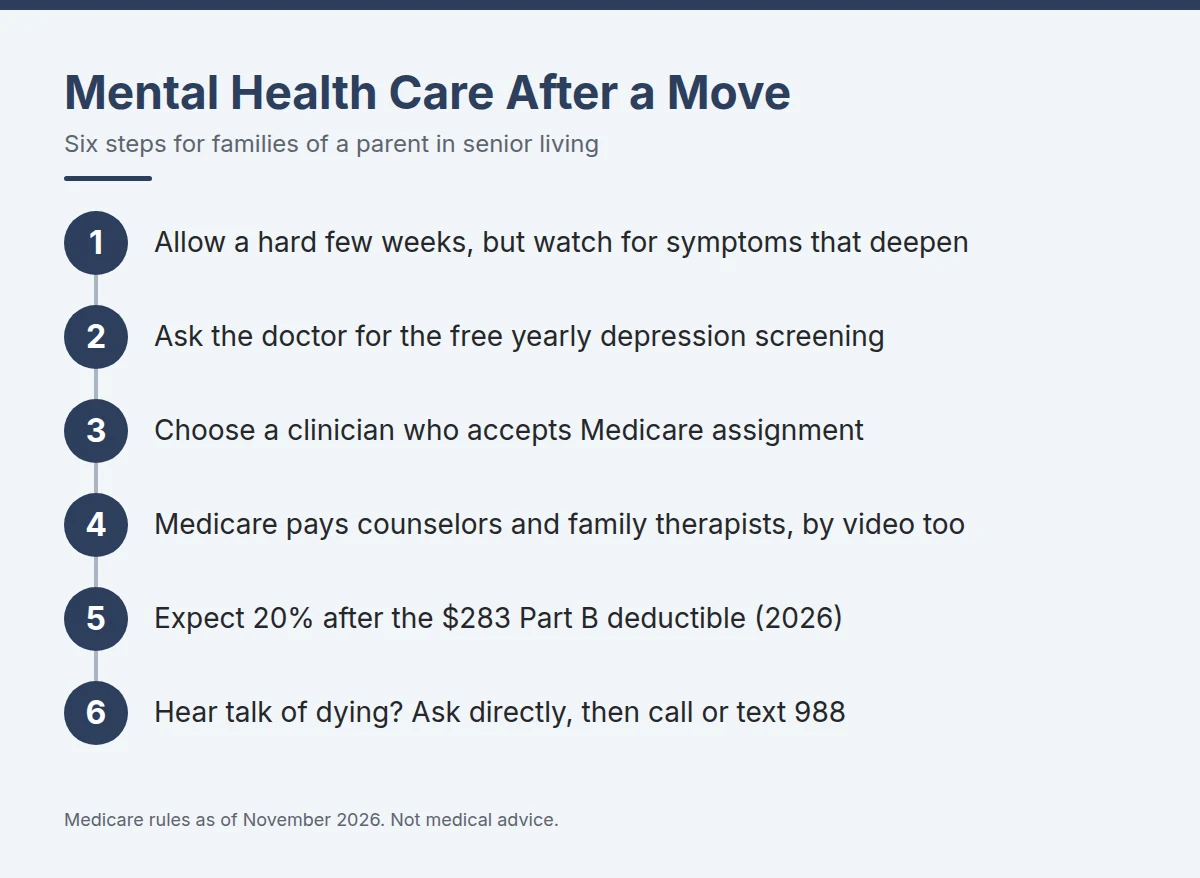
Here is the short version. Moving to a new home is a recognized trigger for adjustment disorder, a stress reaction that usually begins within three months and rarely lasts past six. Depression and anxiety are separate illnesses, and they are common in senior living: in a 2006 Maryland study, about a quarter of assisted living residents were depressed, and most of those had no regular source of psychiatric care. Medicare Part B pays for a yearly depression screening at no cost, for therapy with eight kinds of licensed clinicians (counselors and marriage and family therapists among them), and for video visits your parent can take from home. After the deductible, your parent owes 20 percent. This guide covers how to get a struggling parent into treatment, whether they live in independent living, assisted living or memory care.
Settling In, Adjustment Disorder, or Depression?
Some homesickness, poor sleep and irritability in the first weeks are an expected reaction to a big change. A review of 19 studies on moving into long-term care found that people adjusted best when they had some control over the decision to move, kept their independence in daily life, and held on to the relationships that mattered to them. Staff can help by encouraging new friendships and by giving residents chances to talk about their feelings and the move itself. That is one more reason the way a move is decided matters, which our guide to a parent who refuses to move takes up.
Adjustment disorder is the term for a reaction that runs stronger than the situation would predict. MedlinePlus lists moving to a different home among its triggers. The symptoms follow the stressor, most often within three months, and can include nervousness, crying, hopelessness, pulling away from people, and physical complaints such as skipped heartbeats. It is sometimes called situational depression. With the right help it usually clears within six months, unless the stressor itself continues. Severe cases can bring suicidal thoughts. Treatment centers on talk therapy, often cognitive behavioral therapy, and can include family therapy and support groups. Medication, when it is used, comes alongside talk therapy rather than in place of it. One wrinkle: if the move came soon after a spouse died, normal grief is not adjustment disorder, and a good clinician will sort out which is which.
Depression is a separate illness with its own signs. Medicare’s mental health booklet lists the ones worth raising with a doctor: sad, empty or hopeless feelings; worries about being a burden; pulling away from friends and activities; losing interest in things your parent used to enjoy; low energy; trouble concentrating or sleeping; and loss of appetite or weight. In the Maryland study, a team of geriatric psychiatry clinicians examined 196 assisted living residents with an average age of 86 and found 24 percent of them depressed. Depression tracked most closely with needing help with daily activities. Fewer than half of the depressed residents were taking an antidepressant, and 60 percent had no regular source of psychiatric care.
Anxiety and panic often show up in the body first. A panic attack brings a pounding heart, chest pain, sweating and trouble breathing, and can feel exactly like a heart attack. Panic disorder often starts in the late teens or early adulthood, and a doctor working it up may check for physical causes with heart tests and blood tests for thyroid problems. So a first “panic attack” in a parent’s eighties calls for a medical checkup before anyone calls it nerves, and chest pain calls for 911. Left untreated, panic disorder can lead to depression.
Medical problems can imitate all of this. Thyroid disease, medication side effects and delirium can pass for a mood problem or for dementia, and our guide to conditions that mimic dementia covers the workup that sorts them out.
Where Screening Happens
At the doctor’s office, once a year, for free. Part B covers one depression screening a year, and your parent pays nothing if the clinician accepts assignment. The screening has to happen in a primary care setting, such as a doctor’s office, where follow-up treatment and referrals are available. Primary care is also where trouble tends to surface. In a review of 40 studies, about 45 percent of people who died by suicide had seen a primary care provider in the month before, and older adults had higher rates of that contact than younger ones.
At the wellness visit, if someone asks. The one-time “Welcome to Medicare” visit includes a review of depression risk. Under Medicare’s rules, so does the first annual wellness visit, which must use a standardized screening tool. Later yearly visits are thinner: they update a health questionnaire that touches on mood, stress and loneliness, but a formal depression screen is not a required piece. A parent who has been on Medicare for years is getting the later kind, so ask for the depression screening by name.
The U.S. Preventive Services Task Force recommends screening all adults for depression, older adults included. Common tools include the Patient Health Questionnaire, whose nine-question version asks about suicidal thoughts, and the Geriatric Depression Scale. Anxiety is a different story. The Task Force recommends screening adults up to age 64 but found the evidence insufficient to recommend for or against it at 65 and older, so a doctor may not ask about anxiety unless you raise it.

In memory care, questionnaires that depend on the resident’s own answers can break down. The Cornell Scale for Depression in Dementia was built for that situation: a 19-item scale that draws on interviews with both the resident and a member of the nursing staff. If your parent has dementia and someone reports that they “screened negative,” ask which tool was used.
In the building, every day. Aides and nurses see what a doctor sees twice a year: the skipped meals, the days spent in bed, the activities missed. Ask the community who would notice a change in mood, how quickly you would hear about it, and who passes it on to the doctor. Then ask your parent to sign a release so the doctor and any therapist can talk with you. Our guide to the paperwork before a senior move covers the documents that give a family that access.
Which Clinicians Medicare Pays For
Part B’s outpatient mental health benefit is broader than most families assume. It covers individual and group psychotherapy, psychiatric evaluation, medication management, diagnostic tests, partial hospitalization and intensive outpatient programs, safety planning for someone at risk of suicide, and a follow-up phone call after an emergency room visit for a mental health crisis. It also covers family counseling when the main purpose is to help with your parent’s treatment. A session in which the therapist works with the family on your parent’s care fits that rule. Counseling for your own stress needs your own coverage.
Eight kinds of clinicians can bill for it: psychiatrists and other doctors, clinical psychologists, clinical social workers, clinical nurse specialists, nurse practitioners, physician assistants, and, since 2024, marriage and family therapists and mental health counselors. To bill Medicare, a counselor needs a master’s or doctoral degree, at least two years or 3,000 hours of supervised clinical work after the degree, and a state license, and family therapists face the same bar.

What it costs. After the Part B deductible, $283 in 2026, your parent pays 20 percent of the Medicare-approved amount, plus a facility charge if the visit happens in a hospital outpatient clinic. A Medigap policy picks up some or all of that coinsurance. For a parent with limited income, a Medicare Savings Program can cover it, as our guide to QMB, SLMB and Extra Help explains. A Medicare Advantage plan covers the same services but sets its own network and copays, and some plans add counseling benefits Original Medicare does not.
Ask about assignment before the first appointment. A clinician who accepts assignment takes the Medicare-approved amount as full payment. A clinician who has opted out of Medicare entirely works by private contract, and the patient is responsible for the whole bill. Psychiatrists opt out more than any other physician specialty: 8.1 percent had done so as of November 2024, and they made up 39 percent of all physicians who had left the program.
Medication runs through Part D. Medicare drug plans must cover nearly all antidepressants. In assisted living, staff will often be the ones handing them out, so ask how a new prescription gets started and who watches for side effects. Our guide to medication management in assisted living has the questions.
Collaborative care brings a psychiatrist in through the primary care office. In this model, a behavioral health care manager with training in nursing, social work or psychology follows your parent between visits, and a psychiatric consultant reviews the case with the primary care doctor. Medicare pays for it, the practice needs your parent’s consent, and cost sharing applies even to the care manager’s phone calls. The evidence behind it is strong. In the IMPACT trial, which enrolled 1,801 depressed adults aged 60 and older at 18 primary care clinics, 45 percent of collaborative care patients had seen their symptoms fall by at least half at the one-year mark, against 19 percent of those in usual care. Ask whether your parent’s practice offers it.
If your parent needs a hospital stay, Part A covers inpatient psychiatric care in a general hospital or a psychiatric hospital, though care in a psychiatric hospital is capped at 190 days over a lifetime.
Getting Treatment Into the Apartment
For a resident who no longer drives, the hardest part of therapy is often getting there. Telehealth solves much of that. Through December 31, 2027, Medicare pays for telehealth wherever your parent is, home included, and phone-only visits are allowed at home as well. In 2028 most telehealth returns to its old rural and medical-facility limits, but behavioral health is exempt, so therapy by video from home stays covered. Phone-only sessions also remain available for behavioral health at home when your parent cannot use video or does not want to.

One rule arrives with 2028. A patient who starts mental health telehealth at home after that date will need an in-person visit within six months before the first remote session, and then at least once a year, with limited exceptions. A parent who starts before 2028 counts as an established patient and needs only the yearly in-person visit.
Video therapy works best with a little setup: a room with the door closed, hearing aids in, and the screen at eye level. Ask the community whether a staff member will help start the call, and whether there is a private space for a resident who shares an apartment. Some communities also host clinicians who see residents on site. They bill Medicare themselves, so the same coverage and assignment rules apply, and your parent is free to choose someone else instead, including a clinician from before the move.
Warning Signs That Are Never “Just Adjusting”
Men 75 and older have the highest suicide rate of any age group, male or female: 40.7 per 100,000 in 2023, well above the 26.5 for men aged 65 to 74. A move into care is a particular point of danger. University of Michigan researchers read the death investigation narratives for nearly 48,000 suicides and undetermined deaths among adults 55 and older, in 27 states from 2003 to 2015, and found 1,037 suicides linked to long-term care, a category that included independent living, assisted living and nursing homes. The largest group, 449, involved people in the middle of a move into or out of care, more than the 428 among people already living there. Seven in ten of those deaths during a move involved a gun.
The National Institute of Mental Health lists the warning signs: talking about wanting to die, about great guilt or shame, or about being a burden; feeling empty, hopeless, trapped or without reason to live; withdrawing from people; saying goodbye; giving away important things or making a will; eating or sleeping more or less than usual; and drinking more. The 988 Lifeline adds that these signs matter most when the behavior is new, has increased, or seems related to a painful event, loss or change. A move can be all three.
There is a trap here. Giving away belongings and updating a will are also routine parts of downsizing, and on their own they mean little. Paired with talk of being a burden or of having no reason to live, they mean a great deal.
What the 988 Lifeline advises:
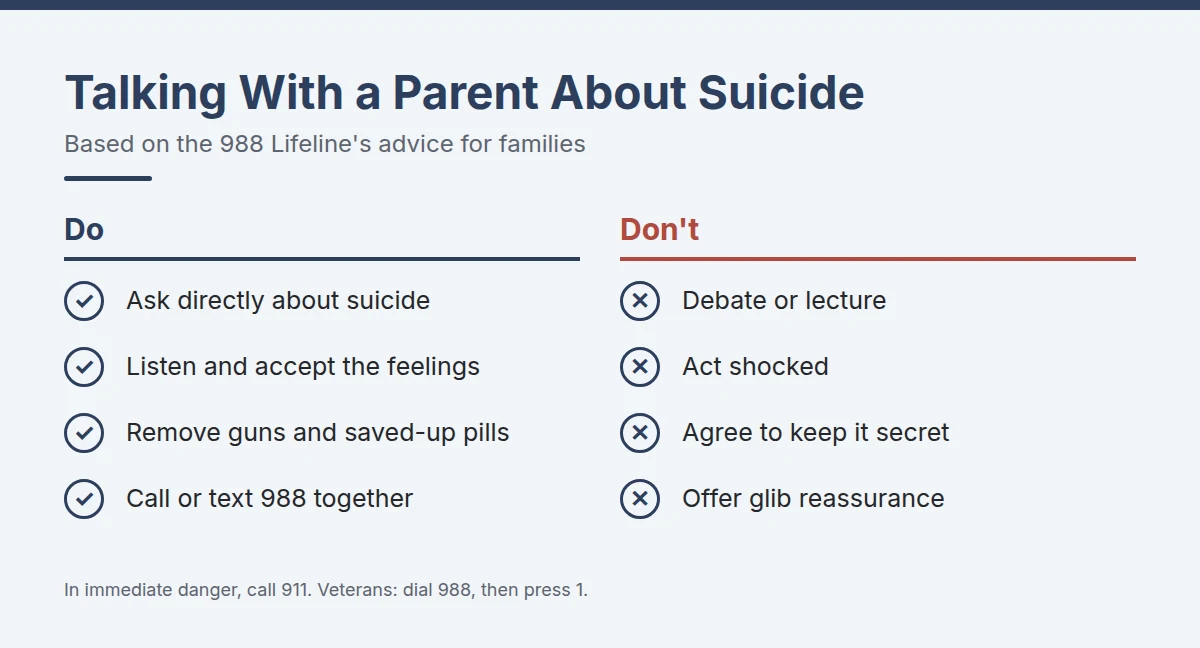
- Ask. Be direct and talk about suicide openly and matter-of-factly: “Are you thinking about killing yourself?”
- Be there. Listen and accept the feelings. Do not debate, lecture or act shocked, and offer hope without glib reassurance.
- Help keep them safe. Remove the means, such as weapons or pills. Ask whether there is a gun in the apartment, the car or a storage unit, and arrange for someone else to hold it. Ask the community to secure any medication your parent may have saved up.
- Help them connect. Call or text 988, or chat at 988lifeline.org. Veterans and the families worried about them can dial 988 and then press 1 for the Veterans Crisis Line. If your parent is in immediate danger, call 911.
- Follow up, and do not agree to keep it a secret.
Tell the community’s nurse or director the same day. Medicare covers safety planning with a clinician for someone at risk of suicide, which makes a sensible next appointment after a crisis call.
Questions to Ask
- Of the community: Who would notice a change in my parent’s mood, and how fast would we hear? Is there a private room for video therapy, and will staff help connect the call? Do any visiting mental health clinicians see residents here?
- Of the doctor: Did the last wellness visit include a depression screening, and which tool was used? Should anxiety be checked too? Does the practice offer collaborative care?
- Of the therapist: Do you accept Medicare assignment? Do you see patients by video? Will family sessions be part of the treatment plan?
- Of yourself: Has my parent said anything about being a burden, or about not wanting to be here? If so, have I asked about suicide directly?
A move into senior living is one of the larger losses of late life, and some sadness afterward is a sign that the old life mattered. It is also a time when depression, anxiety and adjustment disorder can take hold, and all three respond to treatment that Medicare largely pays for. The family’s job is to notice, to ask, and to keep pushing until a clinician is involved.
Mental health coverage changes, Medicare Advantage plans set their own rules, and the licensing of counselors and therapists is a matter of state law, so confirm the details with the plan, the clinician or a State Health Insurance Assistance Program counselor. This guide is not medical, legal or financial advice. If your parent is in crisis, call or text 988, or call 911.
Further reading (sources)
- MedlinePlus on adjustment disorder, its triggers and its usual course
- MedlinePlus for panic disorder symptoms and the medical workup
- Medicare.gov with what Part B covers for outpatient mental health care
- CMS booklet Medicare and Your Mental Health Benefits on warning signs, covered clinicians, inpatient limits and antidepressant coverage
- CMS Telehealth FAQ covering home telehealth, phone-only visits and the in-person rule from 2028
- CMS Medicare Learning Network on behavioral health integration and the collaborative care model
- 42 CFR 410.15 for what the annual wellness visit must include
- 42 CFR 410.54 with the Medicare credential rules for mental health counselors
- Federal Register about the 2026 Part B premium and deductible
- U.S. Preventive Services Task Force on screening adults for depression and suicide risk
- USPSTF for anxiety screening and the evidence gap after 65
- National Institute of Mental Health with the warning signs of suicide
- NIMH on suicide rates by age and sex
- 988 Suicide and Crisis Lifeline for how to help someone who may be thinking about suicide
- Veterans Crisis Line covering how veterans and their families reach crisis support
- KFF on how many physicians have opted out of Medicare, by specialty
- Watson and colleagues with depression among assisted living residents in Maryland
- Brownie and colleagues for what helps residents adjust to a move into long-term care
- Mezuk and colleagues on suicide among older adults living in or moving into long-term care
- Luoma and colleagues covering contact with primary care and mental health providers before suicide
- Unützer and colleagues on the IMPACT trial of collaborative care for late-life depression
- Alexopoulos and colleagues with the Cornell Scale for Depression in Dementia