Who Pays First? Medicare, Retiree Plans, Medicaid, TRICARE, and the VA After a Senior Living Move
Published on October 12, 2026

The first month after a move into assisted living generates more medical paperwork than most families expect. The visiting doctor stops by your mother’s apartment, the therapy team down the hall starts a course of physical therapy, and a fall sends her to the emergency room for an afternoon. Then the envelopes arrive: a Medicare Summary Notice, an explanation of benefits from the retiree plan she kept from her old job, a letter from the state Medicaid office, and a bill marked “pending other insurance” that nobody at the front desk can explain.
All of it follows one set of rules. When someone has Medicare and any other coverage, federal coordination of benefits rules decide which insurer pays first, which pays second, and which pays last. Neither the family nor the provider gets to pick the order. Knowing it explains most of the paperwork, and it heads off the expensive mistakes: a skipped Part B enrollment, a plan switch that quietly cancels a retiree benefit, or months of premiums on coverage that Medicaid has made redundant.
One boundary first. These rules govern medical claims: doctor visits, therapy, hospital and rehab stays, equipment, and drugs. None of the coverage in this article pays assisted living rent or the monthly care fee, a gap our guide to what Medicare actually pays for in senior housing maps in detail.
How the Line Works
Medicare calls each source of coverage a “payer.” The primary payer pays up to the limits of its coverage and passes the rest of the bill to the secondary payer. If the secondary payer does not cover what is left, your parent may owe the balance.
Most of the time the handoff happens on its own. Medicare forwards paid claims to insurers that hold a crossover agreement with its Benefits Coordination & Recovery Center, a group that includes Medigap insurers, employer supplemental plans, the Department of Defense, and state Medicaid agencies. Where no agreement exists, CMS says the person with Medicare has to arrange the secondary payment with the other insurer, which in practice means mailing that insurer the Medicare Summary Notice along with a claim.
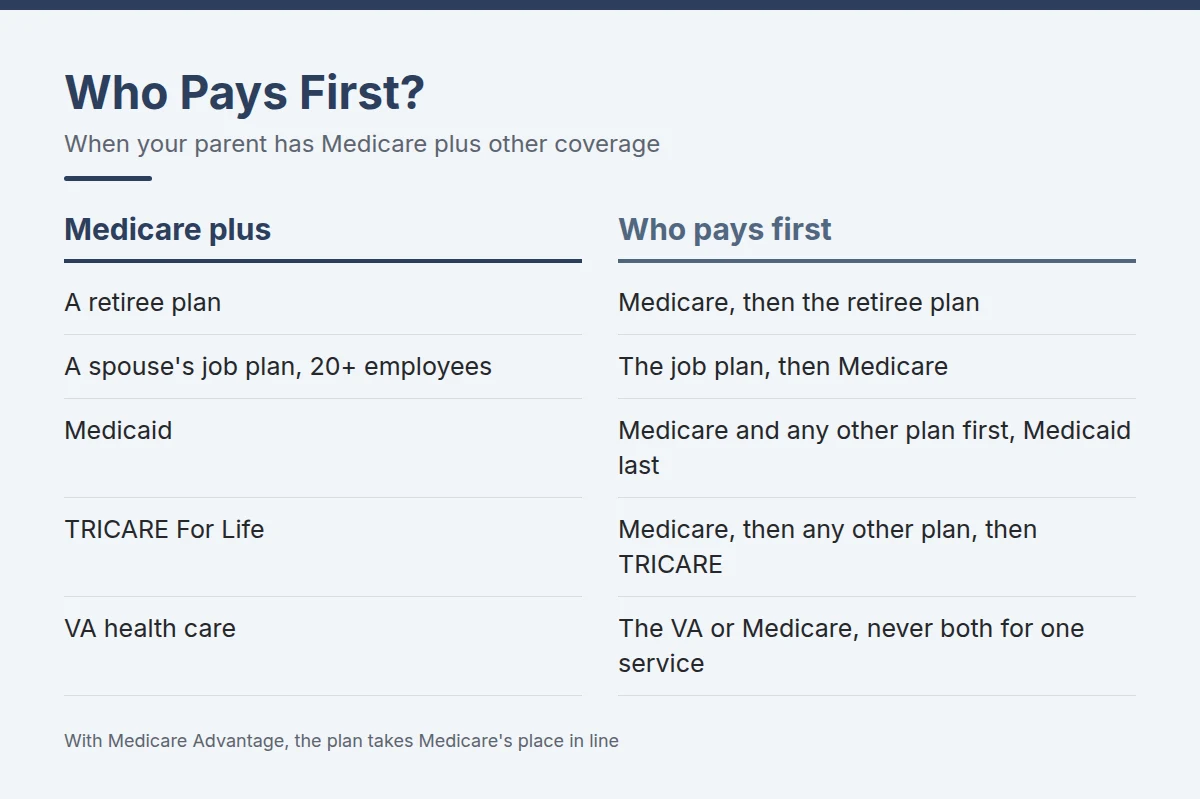
The line is the same when your parent gets Medicare through a Medicare Advantage plan. Federal rules require the plan to identify any insurer that pays ahead of Medicare and to coordinate with it, so the plan simply stands in Medicare’s place.
Take a concrete case. Your father starts sessions with the building’s therapy team, which, as our guide to therapy in assisted living explains, bills Medicare Part B. Medicare pays 80 percent of the approved amount after the annual deductible. The other 20 percent goes to whatever is second in line: a retiree plan, a Medigap policy, Medicaid, or TRICARE. Which one, and in what order, is the rest of this article.
Accidents jump the queue. If your parent is hurt in a car crash, or in a fall that becomes a liability claim against someone, the no-fault or liability insurer pays first for the related care. If it does not pay promptly (usually within 120 days), the provider may bill Medicare, which can make a conditional payment and later recover it.
Retiree Coverage: Medicare First, the Plan Second
If your parent has health coverage from a former employer or union, their own or a spouse’s, Medicare pays first and the retiree plan pays second. Retiree benefits are designed to supplement Medicare, picking up cost sharing and services Medicare leaves out, not to replace it.
That design hides a trap. Medicare warns that retiree coverage might not pay medical costs during any period when someone was eligible for Medicare but did not sign up, and that a retiree may need both Part A and Part B to get the full benefit. A parent who skipped Part B because the retiree card seemed to cover everything can end up with doctor and therapy bills that neither plan will pay.
The order flips only when the job is current. If your parent is covered through a spouse who still works for an employer with 20 or more employees, the employer plan pays first and Medicare second. With fewer than 20 employees, Medicare goes first. COBRA does not count as current employment: Medicare pays first, and COBRA may cover only a small share of the bill.
Why a Retiree Plan Can Shift or Disappear
Families tend to treat a retiree plan as permanent. It is a benefit an employer chooses to provide, and fewer provide it than most people assume. In KFF’s 2025 survey of employers, only 27 percent of large firms that offer health benefits offered any retiree health benefits, and among private for-profit companies the figure was 13 percent. Three things can change the plan your parent holds today.

Signing up for Medicare drug coverage. Medicare tells retirees to check, before joining a Medicare drug plan, whether doing so would end their retiree benefits, including the health coverage that has nothing to do with drugs, for themselves and a spouse. Its warning is blunt: employer or union coverage lost this way may not come back, even for someone who qualifies for Extra Help. A Medicare Advantage plan with drug coverage is Medicare drug coverage too, so it raises the same question. Federal retirees are the main exception, because Medicare says an FEHB plan can be kept alongside Medicare drug coverage. With Open Enrollment running October 15 through December 7, this is the season when a well-meant plan switch does the most damage. Our guide to Part D after a senior living move covers the drug side.
The employer redesigning the plan. Nearly half (47 percent) of large firms that cover Medicare-age retirees now do it at least partly through a contract with a Medicare Advantage plan, up from 26 percent in 2017, and 61 percent of those offer only the Medicare Advantage option. When that happens, the retiree plan stops being a second payer behind Medicare. It becomes your parent’s Medicare coverage, with its own network, service area, and prior authorization rules.
A move. Medicare Advantage plans, including the group versions employers buy, are tied to service areas and local networks, so a move to senior living in another region can leave your parent outside the plan’s reach. Our guide to moving a parent to another state covers the enrollment period that follows. Whether a group plan follows retirees who relocate depends on how the employer set it up, so ask the benefits administrator in writing before the move, not after the first denied claim.
Medicaid: Always Last in Line
Medicaid never pays first for services Medicare covers, and when your parent has other insurance as well, Medicaid waits for that too. For someone with both programs, called dual eligible, a doctor visit runs in a fixed order: Medicare, then any retiree plan or other insurance, then Medicaid for what is left, up to its own limits. Medicaid also pays for care Medicare never covers, above all long-term nursing home care, as our guide to Medicaid eligibility and spend-down explains. Because each state runs its own Medicaid program, a move across state lines means applying again in the new state.

Three details save dual eligible families real money.
The QMB billing ban. The Qualified Medicare Beneficiary group, one of the Medicaid programs that help with Medicare costs, covers Part A and Part B premiums and cost sharing. More than 8 million people were in it in 2023, more than one in eight Medicare beneficiaries. Federal law prohibits Medicare providers and suppliers, pharmacies included, from billing anyone in the QMB group for Medicare deductibles, coinsurance, or copayments. CMS’s own research found QMB enrollees still being billed wrongly. If your parent is in QMB, show both cards at every visit, and question any bill for a Medicare deductible or coinsurance before paying it.
The Medigap pause. Federal law itself says people with Medicaid usually do not need a Medigap policy, and it lets your parent pause one instead of cancelling it. A Medigap insurer must suspend benefits and premiums for up to 24 months while the policyholder has Medicaid, but only if the insurer is told within 90 days of Medicaid starting. If Medicaid ends during the suspension, the policy comes back automatically, provided the insurer hears within 90 days of the loss. That first deadline is easy to miss in the rush of a Medicaid approval.
The retiree plan worth keeping. A retiree plan is a different case from Medigap. It pays ahead of Medicaid, it may also cover a spouse, and in a nursing home its premium does not have to come out of your parent’s personal needs allowance: federal Medicaid rules deduct Medicare and other health insurance premiums from a resident’s income before the rest goes toward the cost of care. Talk to the state Medicaid office before dropping anything.
TRICARE For Life: Behind Everything but Medicaid
Military retirees, and eligible spouses and survivors, who have Medicare Part A and Part B get TRICARE For Life automatically. It is wraparound coverage with no enrollment card: the Medicare card and the uniformed services ID card are the proof.
In the simple case, Medicare pays first and forwards the claim to the TFL claims processor, and for services both programs cover, your parent generally owes nothing. On a doctor visit, Medicare pays 80 percent and TRICARE the other 20. TRICARE also pays the Medicare deductibles, which in 2026 are $1,736 per hospital benefit period and $283 a year for Part B.
Add a retiree plan and TRICARE drops to third: Medicare first, the retiree plan second, TRICARE last. Coverage from a current job reverses the first two. With a third payer in the mix, TRICARE says the TFL claim must be filed on paper, with the provider’s itemized bill, the Medicare Summary Notice, and the other insurer’s explanation of benefits, within one year of the date of care. Medicaid, if your parent has it, still comes after all of them.
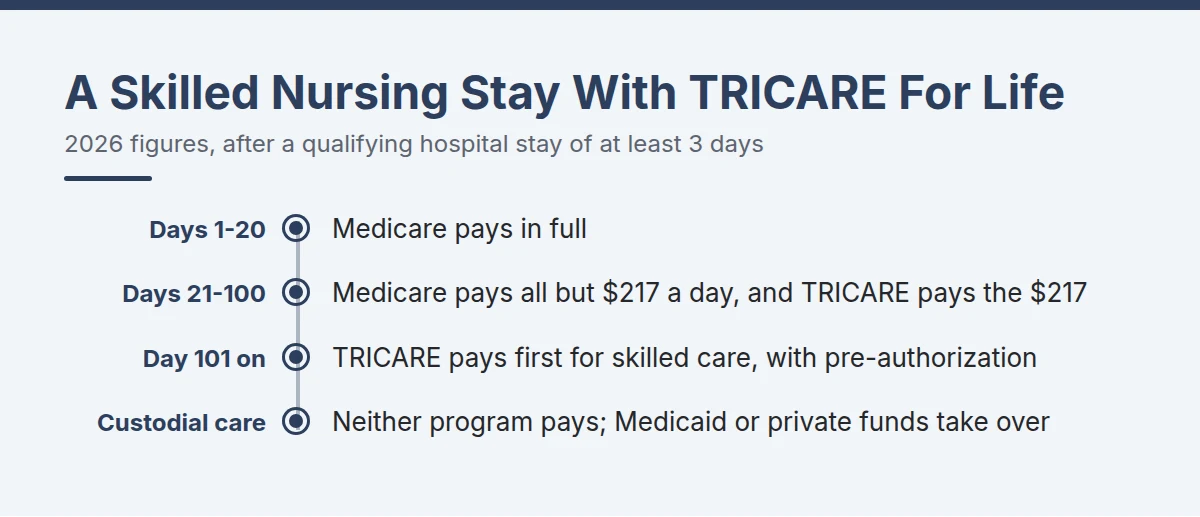
TFL earns its keep in a nursing facility. After a qualifying hospital stay of at least three days, Medicare pays skilled nursing days 1 through 20 in full, and TRICARE pays the $217 daily coinsurance for days 21 through 100. From day 101, TRICARE becomes the primary payer for continued skilled care, with pre-authorization required. Neither program pays for custodial care on its own, which is where Medicaid or private funds take over.
VA Health Care: A Separate System, Not a Second Payer
VA coverage does not line up behind Medicare the way a retiree plan does. Medicare and the VA generally cannot pay for the same item or service, so each time your parent gets care, the choice of provider is also a choice of program. The VA pays for care it provides or authorizes in advance, in a VA facility or a non-VA one. Medicare pays for Medicare-covered care everywhere else, and usually nothing for care from a federal provider. If the VA authorizes only part of a stay at a non-VA hospital, Medicare may pay for the covered services the VA did not authorize.
That matters after a move. A veteran who settles into assisted living near an adult child may now live far from the nearest VA medical center. The doctor who makes rounds in the building and the therapy team down the hall generally bill Medicare, so their visits are Medicare claims unless the VA has authorized the care in advance. Both routes work, as long as Part B is in place.

The VA does bill other insurance. For conditions not connected to military service, it is required to bill a veteran’s private health insurance, and it may bill a Medigap policy, but it does not bill Medicare or Medicaid. Your parent does not owe any balance the insurer leaves unpaid, though a VA copay may apply depending on their priority group. The VA itself urges enrolled veterans to keep Part B: it covers non-VA doctors and hospitals, VA funding can change, and a late Part B enrollment carries a penalty that lasts for life.
One last distinction: VA Aid and Attendance is a pension payment, not health coverage. It never enters the line at all. It is income, and it can go toward the monthly bill.
After the Move: Keep the Line Straight
A short routine prevents most of the trouble.
- Write one coverage sheet. List every card (Medicare or the Medicare Advantage plan, Medigap, the retiree plan, Medicaid, TRICARE, the VA), the member numbers, and the order. Give copies to the community’s nurse or wellness office, the visiting doctor, the therapy provider, the pharmacy, and any hospital. Medicare says telling providers about other coverage helps them bill the right payer and avoid delays.
- Report every change. When a retiree plan ends, Medicaid starts, or your parent moves, call the Benefits Coordination & Recovery Center at 1-855-798-2627 (TTY 1-855-797-2627) so Medicare’s records match, and tell each provider.
- Read the first round of statements. Check that the second payer actually paid. If a claim did not cross over, send the Medicare Summary Notice to that insurer yourself, and keep TRICARE’s one-year filing deadline in mind.
- Change nothing until the benefits administrator answers. Before joining a Medicare Advantage or drug plan, or dropping a retiree plan, ask in writing what happens to your parent’s coverage and a spouse’s.
- Mark the 90-day Medigap deadline on the day a Medicaid approval letter arrives.
Coverage rules, plan documents, and state Medicaid programs all differ, so confirm the specifics with each plan, with the benefits administrator, or with your State Health Insurance Assistance Program, which offers free, unbiased Medicare counseling. Bring in an elder law attorney when Medicaid planning or a liability settlement is involved. Nothing here is legal or financial advice. What it should do is turn a stack of envelopes into a sequence: who paid, who pays next, and who still needs a phone call.
Further reading (sources)
- Medicare.gov on how primary and secondary payers split a bill, and the 120-day rule
- Medicare.gov with who pays first alongside retiree, COBRA, Medicaid, TRICARE, VA and accident coverage
- CMS for how Medicare claims cross over to secondary insurers
- CMS on the ban on billing Qualified Medicare Beneficiaries for cost sharing
- KFF with the share of large employers offering retiree coverage, and the shift to Medicare Advantage
- TRICARE for how TRICARE For Life pays alongside Medicare and other insurance
- TRICARE For Life Cost Matrix 2026 on deductibles and skilled nursing days by payer
- U.S. Department of Veterans Affairs on how VA health care bills other insurance, and why it urges veterans to keep Part B
- 42 CFR 422.108 covering Medicare Advantage plans coordinating with insurers that pay first
- 42 U.S.C. 1395ss for the 24-month Medigap suspension during Medicaid entitlement
- 42 CFR 435.725 with the health insurance premium deduction for nursing home residents on Medicaid
- State Health Insurance Assistance Programs for a state-by-state directory of free Medicare counseling