Dialysis Three Times a Week: Finding Senior Housing for a Parent With Kidney Failure
Published on October 24, 2026

Your mother came home from the hospital with a new schedule: hemodialysis every Monday, Wednesday and Friday, in a recliner at a clinic eleven miles away, starting at 6:30 in the morning. The discharge planner does not think she should live alone anymore. The assisted living community you toured last spring says it cares for residents with all kinds of health conditions, but when you ask who would drive her to the clinic three mornings a week, and who would check on her when she comes back drained, the answers get vague.
Dialysis brings a fixed treatment schedule that the setting has to work around. A community can be lovely and still be wrong for your parent if it cannot get them to treatment and back and look after them afterward. This guide covers which settings can handle dialysis, what to ask on a tour, how Medicare’s kidney failure rules work at any age, and what to do when a frail parent no longer wants treatment.
What Dialysis Asks of a Place to Live
The two main kinds of dialysis put very different demands on a home. Most people go to a center for hemodialysis, according to the National Institute of Diabetes and Digestive and Kidney Diseases (NIDDK), but some dialyze where they live.
- In-center hemodialysis. A machine cleans the blood through two needles placed in an access, usually in the arm, typically three times a week (Monday, Wednesday and Friday, or Tuesday, Thursday and Saturday) for about four hours a session. Clinic staff run it; the setting handles the ride, the meals that fall during treatment, and the hours afterward.
- Peritoneal dialysis (PD). Cleansing fluid goes into the belly through a catheter and is drained later, taking wastes with it, either by hand three to five times a day (about 30 to 40 minutes each, the National Kidney Foundation says) or overnight with a machine called a cycler. Whoever does it must be trained in every step, so a parent who cannot needs a trained helper.
- Home hemodialysis. The clinic treatment done at home, on a more flexible schedule. NIDDK notes that most dialysis centers require a trained partner to be present during home treatments, and that training can take three to eight weeks.
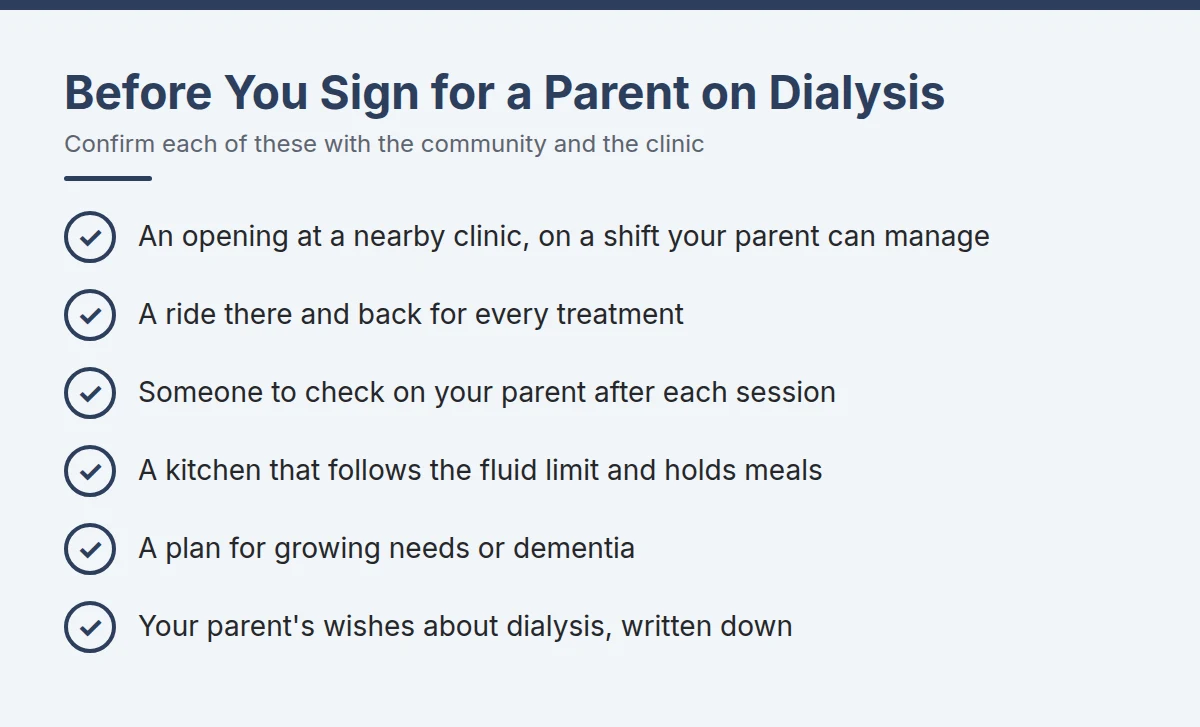
Whichever type your parent uses, a team comes with it. NIDDK says it may include nurses, technicians, a dietitian and a social worker, and every Medicare-certified dialysis facility must have a qualified social worker, generally one with a master’s degree in social work. Make that social worker your first call, and ask which communities nearby already have residents dialyzing at the clinic, and on which shifts.
Which Settings Can Make It Work
Independent living or a senior apartment, with dialysis at home. For a parent who still manages most of their own care, PD or home hemodialysis in their own apartment ends the clinic trips. Medicare Part B covers home dialysis training for your parent and their helper, the equipment and supplies (Medicare’s list includes the machine and a water treatment system), and certain support services, such as visits from dialysis staff. It does not pay for an aide to help with home dialysis unless that help is part of the clinic’s bundled payment. Ask the building whether it permits home dialysis and where a month of supplies would go, and ask the clinic’s home training nurse what the apartment needs.
Assisted living, with trips to a clinic. Each state licenses assisted living and sets how much health care a community may provide. A parent who can manage the trips, follow a fluid limit with reminders, and tell staff when something feels wrong fits the model. A parent who needs a nurse to check on them after every treatment may need more care than the license allows. PD in assisted living is possible, but someone has to do the exchanges; if your parent cannot, ask whether staff are allowed and trained to help, which varies by state, because Medicare will not pay an aide to do it.
Nursing homes, with clinic trips or dialysis in the building. Federal rules require a nursing home to make sure residents who need dialysis receive it, consistent with professional standards, the care plan, and the resident’s goals and preferences. CMS guidance describes the routes: trips to an outside clinic, a certified clinic inside or next to the building, or home dialysis in the nursing home, either at the bedside or in a common area where several residents dialyze at once, which CMS says is commonly called a den. A certified dialysis facility stays responsible for that care under a written agreement with the nursing home, and anyone running a treatment must be trained and competent first.
Dialysis in the building avoids transport time and the disruption of a resident’s day, CMS notes, but nursing homes are not required to offer it, and some states do not allow it there or add rules about who may provide it. Getting in has also become harder: a 2026 study built on 309 interviews across 66 nursing homes, dialysis organizations, Medicare Advantage plans and kidney care companies found many nursing homes admitting fewer residents who need dialysis, and transport problems still unresolved.
Three Round Trips a Week
With in-center dialysis, every treatment means two trips, and the ride home matters as much as the pickup. Settle both before choosing a community.

Medicare’s ambulance rule is narrow. Original Medicare covers an ambulance to the nearest dialysis facility only when other transport could endanger your parent’s health, and scheduled, repeating rides need a doctor’s certification dated within 60 days. Bed-confined, under the federal rule, means unable to get up from bed without help, unable to walk, and unable to sit in a chair or wheelchair; a parent who does not meet that test needs some other medical reason an ambulance is required.
Other ways to get there:
- Medicaid. States must ensure necessary transportation to and from medical providers for people on Medicaid. Ask how far ahead rides must be booked and what happens when a driver runs late.
- Medicare Advantage. A plan may cover some transportation to dialysis that is not by ambulance. Check the plan’s materials.
- The community’s van. If there is one, ask whether it covers your parent’s shift, including a 6 a.m. start or a Saturday, and what each trip costs.
- The clinic. Medicare’s dialysis booklet sends families with transport problems to the clinic’s social worker.
Then look at the clinic end. Medicare gives your parent the right to choose a dialysis center, so the one closest to the community may fit best if it has an opening on a workable shift, and Medicare’s Care Compare tool rates certified facilities with stars. Call before you sign a contract, and ask the current clinic’s social worker to help arrange the transfer. If you cannot find a facility willing to take your parent, Medicare says you have the right to file a grievance.
The Hours After the Chair
NIDDK says standard hemodialysis can leave people feeling tired or washed out for several hours after each treatment. When the Dialysis Outcomes and Practice Patterns Study asked 6,040 hemodialysis patients how long they took to recover from a session, 41 percent said two to six hours and 27 percent said seven hours or more, with older patients reporting longer recovery.
Falls are the other worry. NIDDK lists low blood pressure, which can make a person faint or more likely to fall, among the problems common with a standard hemodialysis schedule. In a study of 162 hemodialysis patients aged 65 and older, 47 percent fell during at least a year of follow-up, a rate (1.6 falls per person per year) at least double the published rates for older adults living in the community.
So ask what happens when your parent gets back:
- Who checks on them? Ask who looks in after treatment, how soon, and what staff do if your parent feels faint or a needle site will not stop bleeding.
- What about meals? A midday shift can wipe out lunch three days a week, so ask whether the kitchen holds a tray. Hemodialysis also brings strict limits on liquids, phosphorus, sodium and potassium, and liquid in foods counts toward the fluid limit. The clinic’s dietitian helps set the plan; the kitchen has to follow it.
- Who knows the access? NIDDK calls the hemodialysis access “your lifeline.” It should be washed daily and checked for warmth or redness, and a working access has a vibration that can be felt over it. If the vibration stops, the clinic needs to know.

Why Memory Care and Dialysis Are a Hard Combination
Cognitive problems are common on hemodialysis and often go unrecognized: in a study of patients aged 55 and older, about three in four of those tested had moderate or severe cognitive impairment, yet only 2.9 percent had a documented history of it. In-center treatment asks a lot of a person with dementia, who must sit still for about four hours, three times a week, in an unfamiliar room, with two needles in the arm. A resident who cannot be left alone in memory care cannot be left alone at the clinic either, so plan on an escort for every trip.
CMS’s guidance on dialysis inside nursing homes spells out the risk: some complications, such as a drop in blood pressure or a needle that slips out, need immediate action, and a resident with cognitive limits may not recognize them or call for help. When a resident cannot ask for help, CMS says qualified dialysis staff should stay in the room, in direct sight of the resident and the access, for the whole treatment.
Clinics also have conduct rules. Federal rules let a dialysis facility discharge a patient whose behavior is disruptive and abusive enough to seriously impair care or the facility’s operation, but only after documenting the problem and efforts to resolve it, giving the patient and the local ESRD Network 30 days’ written notice, and trying to place the patient elsewhere. Ask the clinic how it handles a patient who becomes agitated during treatment.
What can work: memory care with nurses on staff, a clinic willing to take residents with dementia and a family member or paid companion at every treatment, or a nursing home with dialysis in the building. Our guide to choosing memory care covers how to judge staffing and training. For some families, the harder question is whether dialysis still serves their parent at all.
How Medicare Covers Kidney Failure, at Any Age
Medicare treats permanent kidney failure that needs regular dialysis or a transplant, which it calls end-stage renal disease (ESRD), as its own route to coverage. A parent who is 65 or older and already has Parts A and B is covered for dialysis from the start, so this section matters most for a parent under 65 or one who never took Part B.
- Age does not matter. Your parent qualifies at any age if they or their spouse worked long enough under Social Security, the Railroad Retirement Board or as a government employee, or if they already get or qualify for those benefits.
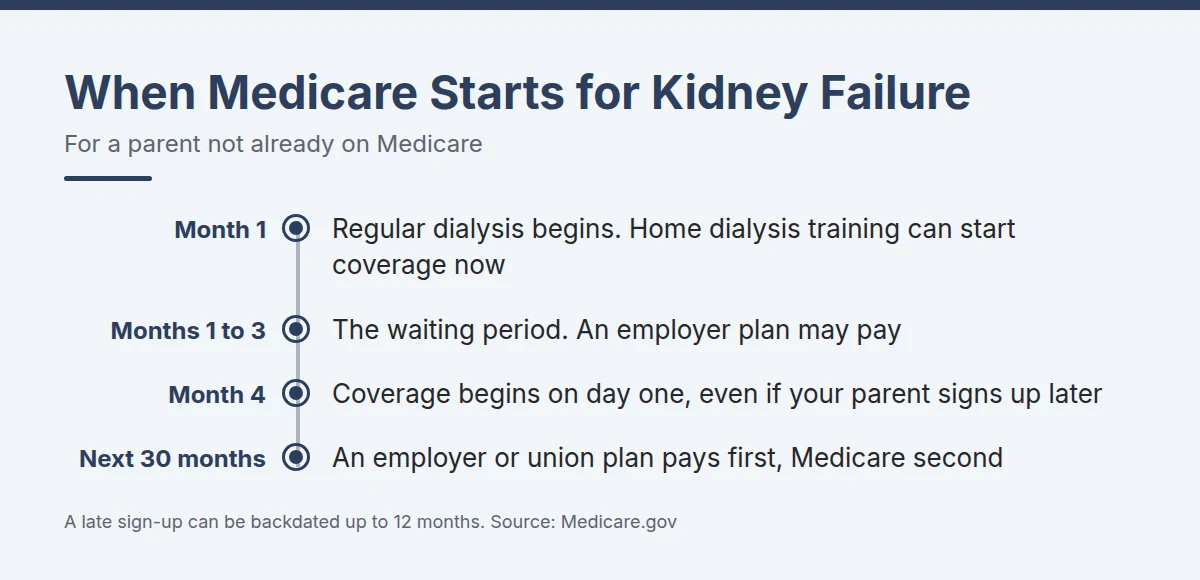
- There is a waiting period. Coverage usually starts on the first day of the fourth month of dialysis, and that clock runs even before your parent signs up: start dialysis on July 1, and coverage begins October 1, even if the application goes in on December 1. An employer group health plan may pay for the first three months.
- Home training starts it sooner. If your parent enters a home dialysis training program at a Medicare-certified facility in the first three months, the doctor expects them to finish it and dialyze at home, and they keep up regular dialysis, coverage can begin in the first month.
- Coverage can reach back. A late application can be backdated up to 12 months, but no earlier than when your parent first became eligible.
- You can apply for your parent. Social Security takes the application, and if your parent cannot file because of a physical or mental condition, a relative or other person responsible for their affairs can file instead.
- Employer coverage pays first for 30 months. An employer or union group health plan pays first during a 30-month coordination period, with Medicare second. Our guide to who pays first after a senior living move covers that order with other coverage.
- A Part B penalty can end. Signing up again on the basis of ESRD stops a Part B late enrollment penalty.
Your parent then pays 20 percent of the Medicare-approved amount for dialysis after the Part B deductible ($283 in 2026). The coinsurance covers the whole bundle, including the clinic’s nurses, social workers and dietitians, most dialysis drugs and lab tests, which the clinic cannot bill separately. Medigap, Medicaid or a Medicare Advantage plan may pick up some or all of the 20 percent, though not every insurer sells Medigap to people under 65. In a Medicare Advantage plan, confirm that the clinic and kidney doctor are in network.
When a Frail Parent Wants to Stop, or Never Start
Dialysis is a treatment, not an obligation. Federal rules give every dialysis patient the right to refuse or discontinue treatment, and to hear about every option, including transplant and home dialysis. NIDDK describes another path, conservative management: kidney care without dialysis or a transplant, focused on symptom control and quality of life. Dialysis, it notes, may not lengthen life or improve its quality for people who are elderly and frail, or who have other serious illnesses such as dementia, heart failure or cancer.
The research behind that caution is sobering. In a national study of 3,702 nursing home residents who started dialysis between 1998 and 2000, 58 percent had died within a year, and only 13 percent had kept their level of daily function from before dialysis.
How conservative care compares is less settled. A 2025 Cochrane review of 24 studies covering 26,127 people aged 65 and older found no randomized trials and rated the evidence on survival and quality of life very low certainty, partly because the people choosing each path differed in ways the studies could not fully adjust for. The American Society of Nephrology’s 2026 guidance calls conservative management whole-person care that is often a good choice for people who put independence and quality of life ahead of the burdens of treatments such as dialysis.
Stopping dialysis once it has started is a different decision, on a shorter timeline. NIDDK says a person who needs dialysis to survive and does not receive it may live a few days or weeks; in a study of 1,947 hospice patients who had stopped dialysis, average survival after enrollment was 7.4 days.
For housing, each path changes the question:
- Conservative management ends the clinic trips, and a parent not on dialysis can use Medicare’s dietitian benefit for kidney disease, which maintenance dialysis rules out (how that benefit works).
- Hospice comes to wherever your parent lives, including assisted living and nursing homes (our hospice guide). Electing it waives regular Medicare payment for care related to the terminal condition, except what the hospice provides. If the terminal illness is something else, such as cancer, CMS says your parent can have both the kidney benefit and hospice, and hospices can serve patients who keep dialyzing. If kidney failure itself is the hospice diagnosis, ask the hospice before enrolling how it handles dialysis.
Whatever the choice, it is your parent’s, made with the kidney doctor and written down. An advance directive and a health care power of attorney let the person your parent chose speak for them later (what to sign, and when).
Questions to Ask on a Tour
- How many residents are on dialysis now, and which clinics do they use?
- Who drives them, at what hours, and on which days? Does that cover a 6 a.m. start or a Saturday shift, who waits if treatment runs late, and what does each trip cost?
- Who checks on residents after treatment, and do staff know how to check an access?
- Can the kitchen follow the clinic dietitian’s plan, including a fluid limit, and hold a meal on treatment days?
- Do residents do PD or home hemodialysis in their apartments here, and can staff help?
- In a nursing home: is dialysis offered on site, at the bedside or in a den? Which dialysis facility runs it, and who stays in the room during treatment?
- If my parent’s needs grow, at what point would you ask them to move?
Dialysis turns a housing search into a scheduling problem, and the community that solves it is not always the most attractive one on the tour. Start with the clinic’s social worker, and confirm a chair and a ride before you sign anything. For a complaint about dialysis care, or a clinic that will not take your parent, ESRD Networks and state survey agencies handle grievances; 1-800-MEDICARE has your state’s Network number.
Coverage rules change, assisted living rules vary from state to state, and every Medicare Advantage plan has its own network, so confirm the details with your parent’s kidney doctor, the plan, or your State Health Insurance Assistance Program (SHIP), which offers free Medicare counseling. For contracts, discharges or decisions about treatment, involve your parent’s doctors and, where needed, a certified senior care advisor or an elder law attorney. Nothing in this guide is medical, legal or financial advice.
Further reading (sources)
- Medicare.gov on ESRD eligibility, the four-month wait, home training and retroactive coverage
- Medicare.gov with the kidney dialysis coverage booklet, from home dialysis aides to ambulance rides
- CMS for the revised guidance on home dialysis in nursing homes, including den settings
- CMS Medicare Benefit Policy Manual, chapter 11 on dialysis for hospice patients and nursing home residents
- National Institute of Diabetes and Digestive and Kidney Diseases covering in-center and home hemodialysis
- NIDDK on conservative management of kidney failure
- National Kidney Foundation for how manual and cycler peritoneal dialysis work
- 42 CFR 406.13 with when ESRD Medicare begins and who may apply for a patient
- 42 CFR 410.40 on Medicare’s ambulance rules, including bed confinement
- 42 CFR 431.53 for Medicaid’s duty to ensure transportation to providers
- 42 CFR 483.25 covering the nursing home dialysis requirement
- 42 CFR 494.70 on dialysis patients’ rights to refuse treatment and file grievances
- 42 CFR 494.140 with the dialysis facility social worker requirement
- 42 CFR 494.180 for the limits on involuntary discharge from a dialysis facility
- 42 CFR 418.24 on the Medicare benefits waived when hospice is elected
- Brazier and colleagues with interviews on dialysis access and transport for nursing home residents
- Rayner and colleagues for recovery time after hemodialysis sessions
- Cook and colleagues on falls among older hemodialysis patients
- Murray and colleagues covering undiagnosed cognitive impairment in hemodialysis patients
- Kurella Tamura and colleagues on function and survival after nursing home residents start dialysis
- Yang and colleagues with the Cochrane review of conservative kidney management versus dialysis in older people
- Wong and colleagues for the American Society of Nephrology guidance on conservative management
- O’Connor and colleagues on survival after stopping dialysis and enrolling in hospice