IV Antibiotics in Assisted Living: When a Parent Can Get Home Infusion Without Moving, and Who Pays
Published on October 27, 2026

The plan from the infectious disease team sounds manageable: six weeks of an IV antibiotic for your father’s bone infection, given through a thin catheter in his upper arm. Then the hospital case manager explains where those six weeks will happen. Not in his assisted living apartment, because the community “doesn’t do IVs.” A skilled nursing facility has a bed on Thursday.
Sometimes that is the right call. Often it is simply the easiest one to arrange. Whether a parent can finish IV treatment at home (and an assisted living apartment counts as home for most of what follows) turns on three questions: what the drug is and how often it runs, who may handle the line under your state’s rules and the community’s own policy, and which part of Medicare pays for which piece. This guide takes them in order, and it is candid about the cases where a short nursing facility stay really is the better plan.
Four Places the Doses Can Happen
Doctors call IV antibiotic treatment after discharge outpatient parenteral antimicrobial therapy, or OPAT. Writing in 2020, infectious disease physicians at Johns Hopkins described home infusion as the most common way it is delivered nationally, usually by the patient and family with support from a single nurse who may visit about once a week. The realistic options look like this:
- The family home or an independent living apartment. A home infusion pharmacy delivers the drug and supplies, a nurse teaches the routine and checks the line, and your parent or a relative gives the doses in between.
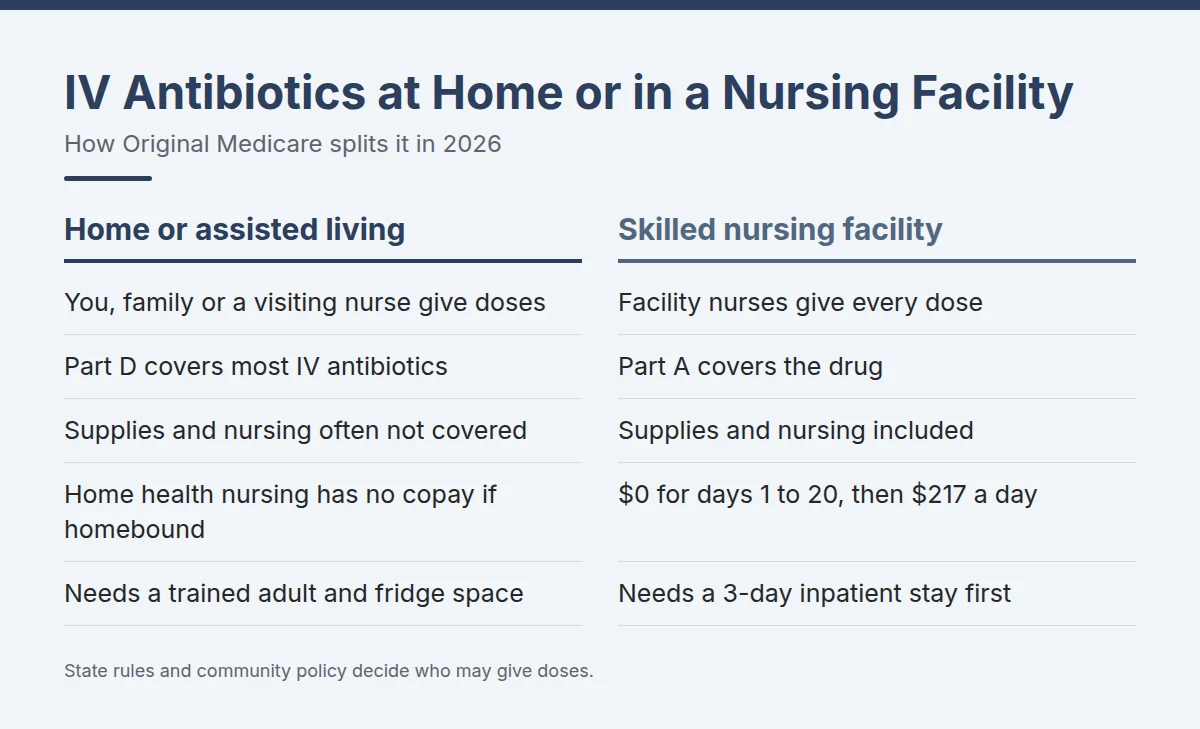
- Assisted living. The same model works in an apartment, but someone still has to give every dose: your parent, a relative, a visiting nurse, or community staff where state law and the community’s policy allow it.
- An infusion clinic or doctor’s office. Your parent travels for each dose, which suits a drug given once a day and a parent who can manage the trip. The Hopkins team noted that dialysis centers are also common sites for IV antibiotics, so a parent already in the chair three times a week may be able to fold the doses into those visits (our guide to housing for a parent on dialysis covers that schedule).
- A skilled nursing facility. Nurses give every dose, and Medicare Part A can cover the stay after a qualifying hospital admission.
The Infectious Diseases Society of America’s practice guideline for OPAT says patients or their caregivers should be allowed to give their own doses. It also sets out what safe home infusion needs at a minimum: adequate refrigeration and storage, and at least one adult who can reliably learn sterile infusion technique and stay in touch with the treatment team.
Age alone is not the obstacle. In a Spanish hospital study of 420 courses of IV antibiotics given by patients or their caregivers through elastomeric pumps (small disposable balloon reservoirs that push the drug in at a set rate), side effects and catheter problems were about as common in patients aged 80 and older as in those under 65. Patients also seem to prefer home: when a Johns Hopkins team surveyed 98 patients on IV antibiotics, 71.7 percent of those treated at home said they would recommend their setting to others, against 32.7 percent of those treated in skilled nursing facilities.
What Home Infusion Looks Like Day to Day
The line. Most courses run through a PICC (a peripherally inserted central catheter, threaded from a vein in the upper arm to a large vein near the heart) or a midline, a shorter catheter that stays within the arm. The IDSA guideline says a midline may be used instead of a central line for adults who need IV therapy for less than 14 days. In a 2025 study of 2,824 patients across 69 Michigan hospitals, with a median age of about 67, serious complications (bloodstream infections or clots) occurred with 0.8 percent of midlines and 3.4 percent of PICCs; the study left out vancomycin. Which line fits is a medical decision, but it is fair to ask which one your parent is getting and why.
The delivery. Medicare drug plans must give members access to home infusion pharmacies that can deliver within 24 hours of a hospital discharge, and those pharmacies must make sure the nursing and supplies are in place before they dispense the drug.
The schedule. Some regimens run once a day. Others, like the four-times-a-day antibiotic course in one of the examples in Medicare’s home health manual, mean a dose about every six hours, around the clock, and some run for hours at a stretch through a small portable pump. In assisted living, the schedule matters more than almost anything else: a once-a-day dose can be timed for when a relative or visiting nurse is there, while a dose every six hours needs someone available at 2 a.m.
The checks. Nurse visits are often weekly. The IDSA guideline calls for blood tests to be tracked throughout treatment, and for vancomycin it notes the usual practice of checking drug levels once a week when kidney function is stable.
The storage. The drug often needs refrigerator space, and the boxes of flushes, dressings and tubing need somewhere to go. That is why refrigeration and storage head the IDSA’s list of basics.

Who Is Allowed to Touch the Line in Assisted Living
Assisted living is licensed by the states, and two layers of state law decide who may handle an IV: the assisted living rules, which set what care a community may provide, and the nurse practice act, which sets what a nurse may hand off to an aide.
Washington shows how firm the nursing side can be. Its nursing law lets a registered nurse working in a community setting, a category that includes licensed assisted living facilities, delegate some tasks to certified nursing assistants and home care aides. But apart from insulin injections, it says the administration of medications by injection, sterile procedures and central line maintenance may never be delegated. The aide who helps your parent dress in the morning cannot be handed the care of a PICC line.
Pennsylvania draws its line in the assisted living rules instead. A residence there may not admit, keep or serve someone who needs continuous intravenous fluids unless the state approves an exception for that resident, case by case, after the residence shows it has the staff, the skills and a backup plan; the department answers in writing within five business days. Intermittent IV therapy, which describes a typical antibiotic schedule of separate doses, needs no such approval as long as a licensed health care professional manages it.
Federal home health rules add a wrinkle. Medicare covers home health visits for assisted living residents, but its manual says claims are denied when the visits duplicate care the community is required to provide under its state license.

Then comes the community’s own policy, which can be stricter than the state’s. A community may decline residents with central lines, insist that an outside nurse or a family member give every dose, or want a written plan before your parent comes back. Ask the executive director or the wellness nurse, and get the answers in writing before the discharge date. If your parent lives with dementia, also ask how staff would keep a confused resident from pulling at the line, and who would notice redness, swelling or a fever between nurse visits. Our guide to medication management in assisted living covers who hands out ordinary pills; an IV dose sits a level above that.
Who Pays: Original Medicare Splits Home Infusion Three Ways
Original Medicare has no single home infusion benefit. It has three partial ones, and which one applies depends mostly on the drug.
Part B, for a short list of pump drugs. When a drug has to run through an external infusion pump that Medicare covers as durable medical equipment, Part B pays for the pump and for the drug and supplies used with it, and a separate Part B home infusion therapy benefit pays for professional services such as nursing visits, caregiver training and monitoring. Your parent pays 20 percent of the Medicare-approved amount, and the Part B deductible applies to the equipment and supplies. An assisted living apartment counts as home for this benefit; a hospital or skilled nursing facility does not. Our guide to Medicare equipment rules in assisted living explains how that home test works.
The list is short. Medicare’s coverage policy for external infusion pumps names certain antiviral and antifungal drugs (acyclovir, foscarnet, amphotericin B and ganciclovir), heart drugs for advanced heart failure, some chemotherapy, opioids for cancer pain, drugs for pulmonary hypertension and immune globulin given under the skin, among others. It names no antibiotics for bacterial infections. And the services benefit pays only for days when a nurse or other skilled professional is actually in the home.
Part D, for most IV antibiotics, but only the drug. Most IV antibiotics fall to your parent’s Part D plan, which covers the medication itself through a network home infusion pharmacy. Part D does not pay for the supplies or the nursing, and while the plan must see that they are in place before the drug is dispensed, that rule does not make Medicare pay for them. The Hopkins physicians summed up the result in 2020: Part B covers fewer than 10 percent of IV antimicrobials, Part D covers the drugs but not the supplies or nursing, and patients outside Medicare Advantage can face very high out-of-pocket costs for daily medications and supplies. That gap was the most common barrier to sending their own patients home, they wrote, and 56 percent of their IV antibiotic patients were discharged to skilled nursing facilities to finish treatment.
Home health, for the nursing, if your parent is homebound. If your parent qualifies for Medicare home health, a certified agency’s nurse can teach the IV routine and look after the line, and covered home health services and supplies carry no copay or deductible. Medicare’s manual counts teaching the care of peripheral and central lines, and the giving of IV medications through them, as skilled nursing. One of its examples is close to the scenario above: a patient going home after pneumonia on IV antibiotics four times a day, a spouse who learned to give them in the hospital, and a home health nurse ordered to teach the drug’s administration and the warning signs to watch for. The drug itself is excluded from the home health benefit, but the manual lists I.V. supplies among the supplies bundled into the agency’s payment while your parent is under its plan of care.
To qualify, your parent must be homebound: needing help, a device or special transport to leave home (or being advised not to leave), with leaving home a considerable and taxing effort. Trips for medical care do not by themselves disqualify them, and an assisted living apartment can count as home. The manual even describes a patient leaving the hospital with osteomyelitis, a bone infection, who needs IV antibiotics and qualifies for skilled nursing facility care, and it says home health can still be paid if the patient meets its rules.
Infusion clinics, under Part B. If your parent can get to an infusion clinic or doctor’s office for each dose, Part B covers most injectable and infused drugs when a licensed medical provider gives them. In most cases your parent pays up to 20 percent of the Medicare-approved amount after the deductible, and in a hospital outpatient setting there is also a copayment for the visit.
Skilled nursing, under Part A. A skilled nursing facility stay is covered after at least three consecutive days as an admitted hospital inpatient, not counting the day of discharge, when your parent needs daily skilled care that, as a practical matter, can only be given there. IV injections are on Medicare’s list of skilled nursing services, and the stay includes nursing, room and board, drugs and supplies. Coinsurance starts on day 21: $217 a day through day 100 in 2026. A six-week course runs into 22 coinsurance days, or $4,774, unless a Medigap policy or other coverage picks that up.
Other coverage. If your parent is in a Medicare Advantage plan, the plan’s own rules decide how home infusion, home health and skilled nursing are covered, and which pharmacy and agency to use, so get them from the plan before the discharge date. If your parent also has Medicaid, ask the state Medicaid office or the infusion pharmacy whether it will cover what Medicare leaves out; that varies by state. Our guide to Part D and the long-term care pharmacy explains how drug coverage shifts when a parent moves.
A change coming in 2027. Section 6222 of the Consolidated Appropriations Act, 2026 widens the Part B pump benefit, for items furnished from April 1, 2027, to drugs whose FDA prescribing information calls for administration by or under the supervision of a health care professional and for infusions at least 12 times a year, when a qualified home infusion supplier gives or supervises them at home. CMS has named one drug, patisiran, that may qualify. Those criteria describe long-term infusions given at least monthly rather than a few weeks of antibiotics, so for most families facing an antibiotic course, the gap described above remains.
When a Skilled Nursing Stay Is the Better Plan
Home is not always right, and the infectious disease team may have good reasons to recommend a facility:
- Nobody can give the doses. If the drug runs every six hours, neither your parent nor a relative can learn the routine, and the community cannot staff it, the IDSA’s basic requirement of one adult who can reliably learn the technique is not met.
- The antibiotic is not the only need. A parent who also needs close daily nursing assessment, or daily rehab after a long hospital stay, may be better served where both happen under one roof.
- Confusion makes the line unsafe. Delirium or dementia can mean a parent pulls at the catheter or cannot report pain, swelling or a fever.
- The math favors it. For a short course, a stretch of fully covered facility days may cost less out of pocket than weeks of uncovered supplies and nursing at home. Ask the infusion pharmacy for its daily charge in writing before deciding.
A nursing facility is not automatically the safer choice, though. University of Wisconsin researchers who followed 101 patients discharged to skilled nursing facilities on IV antibiotics (two-thirds of them 65 or older, with a median of 48 treatment days) found that 29 percent were readmitted to the hospital within 30 days, against under 20 percent in earlier studies of patients treated at home or in infusion clinics. The authors caution that nursing facility patients tend to be older and sicker, so the gap is not proof that the setting caused it.

If your parent does go to a facility for the course, ask the assisted living community whether it will hold the apartment and whether rent continues while they are away. And if Medicare coverage is cut off before the antibiotics end, our guide to appealing a Medicare rehab cutoff explains the fast appeal.
Questions to Settle Before Discharge Day
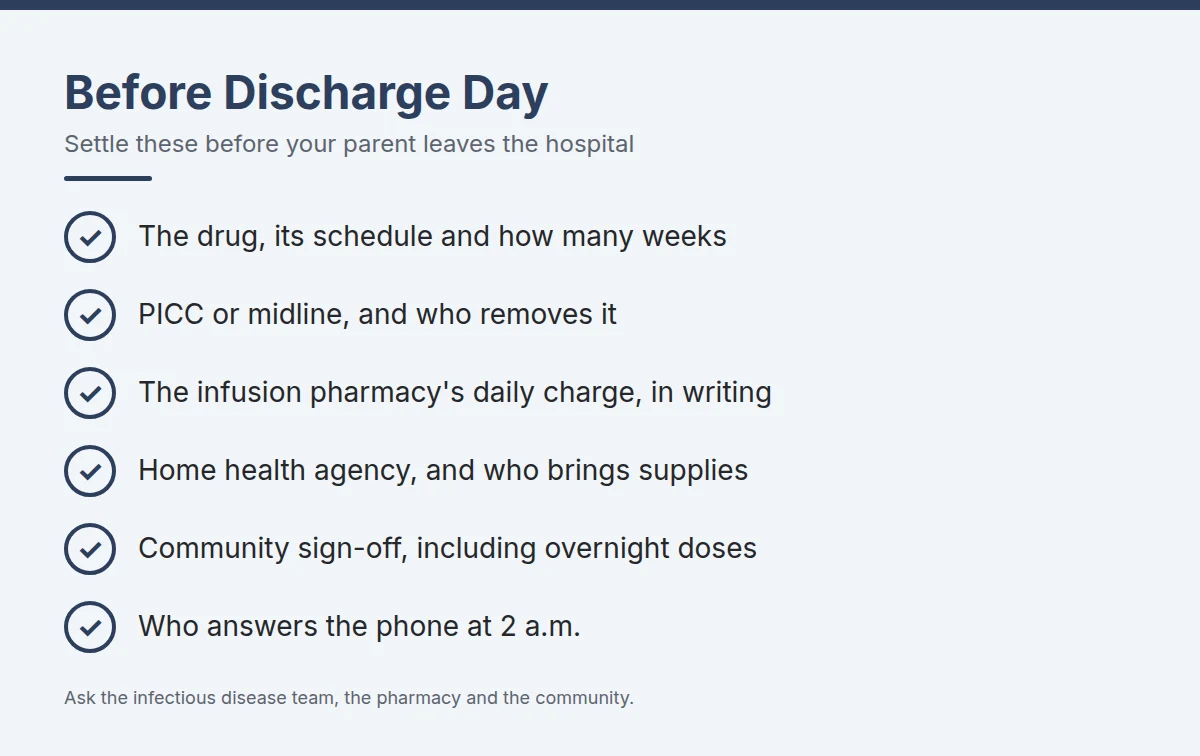
- What is the drug, how often does it run, and for how long? Ask whether a once-a-day option exists, or a plan to switch to pills partway through. In the Wisconsin study, about half of all changes to treatment were step-downs to pills or to longer-term suppressive or preventive therapy.
- Which line is going in, a PICC or a midline, and who removes it at the end?
- Which home infusion pharmacy? Is it in your parent’s Part D or Medicare Advantage network, and what will your parent owe each day for supplies and nursing? Get the figure in writing.
- Does your parent qualify for home health? Which agency will send the nurse, and who supplies the tubing, flushes and dressings?
- For the community: Will you accept a resident with this line? Who gives each dose, including overnight, and does your license allow it? Is there refrigerator space, and a sharps container?
- Who answers at 2 a.m. if the pump alarms or the line will not flush? A qualified Part B home infusion supplier must ensure safe infusion around the clock, seven days a week; ask any pharmacy or agency how it handles nights.
- Who draws the weekly blood tests, and which doctor reviews them?
- If a facility is still the plan: was your parent formally admitted as an inpatient for three days, and what will days 21 onward cost?
IV antibiotics turn a housing question into a staffing and billing question, and the answer is often more flexible than the first one offered at discharge. Start with the infectious disease doctor and the hospital case manager, then call the infusion pharmacy and the community’s wellness nurse the same day, because the nursing and supplies have to be lined up before the first dose leaves the pharmacy.
Coverage rules change, assisted living and nursing rules differ from state to state, and each Medicare Advantage plan sets its own terms, so confirm the details with your parent’s doctors, the plan, or your State Health Insurance Assistance Program (SHIP), which offers free Medicare counseling. For a dispute over a discharge or a residency contract, a certified senior care advisor or an elder law attorney can help. Nothing in this guide is medical, legal or financial advice.
Further reading (sources)
- Medicare.gov on what Part B covers for home infusion equipment, supplies and nursing services
- Medicare.gov for Part B coverage of infused drugs given by a provider, and what they cost
- Medicare Coverage Database with the external infusion pump policy and its list of covered drugs
- CMS Medicare Benefit Policy Manual, chapter 7 on home health rules for IV medications, line teaching, supplies and assisted living
- Federal Register for the CMS proposal carrying out the 2027 infusion pump change
- Federal Register, with the 2026 skilled nursing facility coinsurance amounts
- 42 CFR 486.505 defining home, home infusion drugs and the days a nurse must be present
- 42 CFR 414.1550 on the drug categories and per-visit-day payment for home infusion services
- 42 CFR 423.120 for Part D’s home infusion pharmacy and 24-hour delivery rules
- 42 CFR 409.20 listing what a covered skilled nursing facility stay includes
- 42 CFR 409.30 on the three-day inpatient stay required before skilled nursing coverage
- 42 CFR 409.31 with the daily skilled care and practical matter tests
- 42 CFR 409.33 naming IV injections among skilled nursing services
- 55 Pa. Code 2800.229 for Pennsylvania’s assisted living rules on IV fluids and IV therapy
- Revised Code of Washington 18.79.260 on the nursing tasks that may never be delegated to aides
- Norris and colleagues, writing for the Infectious Diseases Society of America, with the practice guideline for IV antibiotics outside the hospital
- Mansour and colleagues on Medicare’s home infusion gap and nursing facility discharges
- Mansour, Arbaje and Townsend for patient satisfaction with IV antibiotics at home versus in nursing facilities
- Langenstroer and colleagues covering readmissions among patients finishing IV antibiotics in nursing facilities
- Paje and colleagues on midline catheters versus PICCs for IV antibiotics
- Mujal and colleagues for IV antibiotics given at home by older patients and their caregivers