Medicare Open Enrollment for a Parent in Senior Living: The Family's Annual Plan Review Guide
Published on November 6, 2026

Every September an envelope from your parent’s Medicare plan arrives and, more often than not, goes straight into a drawer. It is the Annual Notice of Change, and it describes the coverage your parent will have on January 1 if nobody does anything. Most people do nothing: KFF notes that most Medicare beneficiaries say they do not compare their options from one year to the next. For a parent in senior living, that habit costs more than it would at home, because the plan now has to work with a pharmacy, a group of visiting clinicians and a rehab partner that the community picked, not your parent.
This fall’s window, October 15 through December 7, sets coverage for 2027, and the ground has shifted. KFF counts 28 Medicare Advantage plans with drug coverage open to the average beneficiary for 2027, down from 32. Among standalone drug plans, it projects that three in four members without Extra Help will pay a higher premium if they stay put, and no standalone plan will have a $0 premium for anyone paying full price.
This guide is the yearly review: what to check, in what order, and the exceptions that let some residents change plans outside the season. If your parent is moving in this year, begin with our guide to Part D after a senior living move, which covers the pharmacy switch and the one-time enrollment rules a move brings.
Which Calendar Your Parent Is On
The rules turn less on your parent’s health than on the kind of building they live in.
Independent living, assisted living and memory care. Medicare treats these residents as living in the community. Its list of institutions covers skilled nursing and nursing facilities, facilities for people with intellectual disabilities, psychiatric and rehabilitation hospitals, long-term care hospitals and swing-bed hospitals. Assisted living is not on it. For these families the fall window is the main chance to change plans each year, with a smaller second chance from January through March for anyone in Medicare Advantage. A memory care unit inside an assisted living community follows this calendar; one inside a nursing home follows the next one.
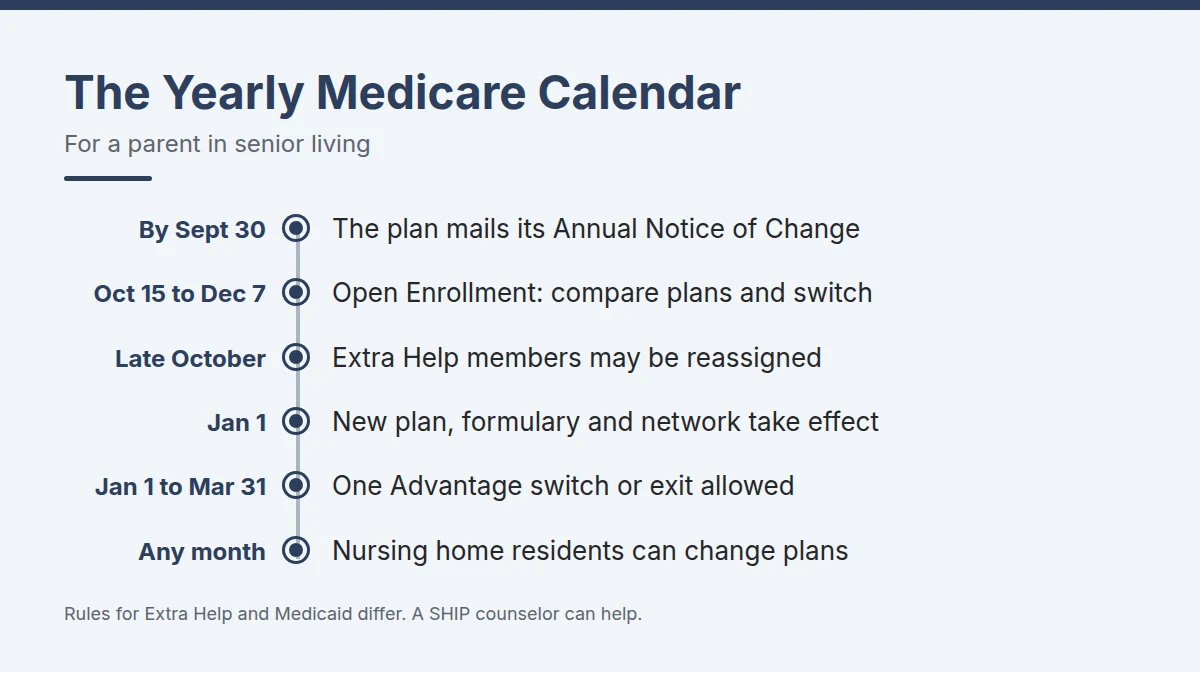
A nursing home. A parent who has lived in a nursing home for 90 days, or is expected to stay that long, counts as “institutionalized,” and that opens a continuous enrollment period. Your parent can join a Medicare Advantage plan, switch to another, or return to Original Medicare in any month, and a matching period covers standalone drug plans. It runs until two months after the month they move out. One limit applies: an Advantage plan may close itself to these midyear enrollments, although it must still let a resident leave.
That difference sets the stakes. For an assisted living family, a poor choice in December can mean a year in the wrong plan. For a nursing home family, fall is still the natural time to look, but a mistake can be fixed the following month.
Start With the Notice of Change
Plans must tell members about changes taking effect January 1 at least 15 days before open enrollment begins, which means by September 30. Read the notice for the premium, the deductible, drugs that change tiers or leave the formulary, and new approval rules. Then check the network yourself, provider by provider, because the notice describes the plan, not the people who see your parent.
Watch for a second kind of letter. If the plan itself is not renewing, your parent gets a special window from December 8 through the end of February. KFF expects many members of departing plans to be moved automatically into a similar plan from the same insurer, while others will need to pick a new plan or will end up in traditional Medicare. Treat an automatic move like any new plan and run every check below.
If plan mail goes to your parent’s apartment and vanishes into a stack, ask the plan to copy you. When an authorized representative completes an enrollment, CMS expects the plan to ask whether notices should go to the member, the representative, or both.
Check the Drug Plan Against the Building’s Pharmacy
Build the medication list from the community’s records, meaning its medication administration record or the pharmacy’s profile, not the bottles you remember from your parent’s old kitchen. Include each strength and how often it is given. Then compare plans with the 2027 numbers in mind: a drug plan may charge a deductible of up to $700, up from $615, and out-of-pocket spending on covered drugs stops at $2,400 for the year, up from $2,100.
The pharmacy is where senior living differs most from life at home. Communities that manage medications usually work with a long-term care pharmacy, and the cheapest plan on Medicare’s Plan Finder is no bargain if that pharmacy is outside its network. If Plan Finder lets you select the community’s pharmacy, do it. Either way, call your two or three finalist plans, name the pharmacy, and ask whether it is in network for 2027. Then ask the pharmacy which plans it has contracts with next year.

Standalone drug plans deserve the hardest look this year. KFF found that 76 percent of standalone plan members without Extra Help, about 10.4 million people, will pay more in 2027 if they keep their plan, and 2.4 million of them face increases of more than $50 a month. The average beneficiary has nine standalone plans to choose from.
Check the Advantage Network Against the People Who Treat Your Parent
If your parent is in Medicare Advantage, list everyone who actually provides care, not just the doctor named on the card:
- The primary care practice or house-call group that visits the building
- The podiatrist and any wound care clinician who comes on a schedule
- A psychiatrist, psychiatric nurse practitioner or therapist, if your parent sees one (our guide to mental health treatment in senior living explains who these clinicians are)
- The company that provides physical, occupational and speech therapy on site
- The home health agency the community works with
- The hospital where your parent’s specialists practice
- The nursing home the community uses for rehab after a hospital stay
Emergency care is covered in or out of network. Nearly everything else on that list depends on the network.
Verify each one by phone, because directories are a weak guide. When Senate Finance Committee staff posed as relatives seeking a mental health appointment for an older family member through Medicare Advantage directories in 2023, only 22 of 120 listings (18 percent) produced an appointment with an in-network provider taking new patients, and a third were wrong numbers, dead lines or unreturned calls. Ask each office’s billing staff whether it will be in network with the plan, by name, for 2027.

Rehab is the item families most often discover too late. Advantage plans generally steer rehab to the nursing homes they contract with, but one federal rule helps some residents. A plan must cover post-hospital skilled nursing care at a “home” facility if your parent chooses it and the facility accepts terms similar to those of the plan’s contracted nursing homes. Home means the nursing home where your parent lived before the hospital stay, the skilled nursing facility of a continuing care retirement community where they lived, or the facility where their spouse lives. The facility can still decline, so ask the community’s own skilled nursing unit whether it takes your parent’s plan.
Networks also change during the year. When CMS judges a plan’s network change significant, members who were seeing a departing provider get a special window to switch plans.
Nursing Home Residents: The Institutional Special Needs Plan
Some nursing homes have a Medicare Advantage plan built around them. An institutional special needs plan, or I-SNP, enrolls only people who need nursing home level care for 90 days or longer. CMS requires an I-SNP serving facility residents to own, operate or contract with the nursing home, and the facility must give the plan’s clinicians (physicians, nurses, nurse practitioners and care coordinators) access to its members. The largest I-SNP places nurse practitioners it employs inside the nursing homes it serves, to coordinate care and treat new illnesses on site.

The evidence on that model is encouraging. A 2025 working paper by Rahman, McGarry, White, Grabowski and Kosar, not yet peer reviewed, drew on 12 million resident-quarters of data from 2016 to 2022. It found that I-SNP enrollment cut quarterly hospitalization rates among nursing home residents with dementia by 3 to 4 percentage points, roughly a third of their hospitalizations, without consistent effects on other health outcomes or quality measures. The plans remain a niche: citing earlier work, the authors put the share of long-stay residents enrolled at 2.2 percent in 2006 and 8.8 percent in 2021.
An I-SNP is still an Advantage plan, with a network and its own approval rules, and it changes who directs day-to-day medical care. Before enrolling, ask:
- Does my parent’s current doctor stay involved, or does the plan’s clinician take over?
- Is the plan run by the nursing home’s own operator or by an outside insurer? CMS allows both.
- What happens if the plan’s contract with the facility ends? CMS requires that contract to include a transition plan for members.
- What happens if my parent moves? The plan must be ready to provide care at the new residence or at another facility it contracts with.
Assisted living residents are not always shut out. Some I-SNPs enroll people living in the community who meet their state’s nursing home level of care standard, as judged by an independent assessor, and CMS lets those plans limit enrollment to residents of specific contracted assisted living communities. Ask the community whether one serves the building. For nursing home residents, the continuous enrollment period means an I-SNP can start in any month the plan is taking new members.
Extra Help and Medicaid Open More Doors
Extra Help, Medicare’s low-income subsidy for drug costs, lets a parent switch into any standalone drug plan once a month, all year, unless a plan’s drug management program has flagged them as at risk of misusing opioids or similar drugs. It does not allow joining or switching between Advantage plans with drug coverage. A parent with full Medicaid as well as Medicare can join, once a month, a special needs plan fully coordinated with the state’s Medicaid managed care plan, enrolling in both together. Gaining, losing or changing Medicaid or Extra Help status, such as newly qualifying for Medicaid nursing home care, opens a separate one-time window that lasts three months.
Extra Help families should also read their fall mail closely. In late October, CMS reassigns members it originally placed in a standalone plan whose 2027 premium will rise above what Extra Help fully covers, moving them to a plan whose premium Extra Help still covers in full. A parent who chose the plan themselves is not moved and pays the difference. A reassignment brings a new formulary, so run the pharmacy check again. Our guide to Medicare Savings Programs and Extra Help explains who qualifies.
The January to March Safety Valve
A parent in Medicare Advantage gets one more change between January 1 and March 31: a switch to another Advantage plan, or a move to Original Medicare with a standalone drug plan. It is a single change, effective the first day of the next month, and it does not run in reverse. A parent in Original Medicare cannot use it to join Advantage or to swap drug plans.
Before using the window to leave Advantage, check one catch. Federal law guarantees a Medigap supplement without health questions only in specific situations, such as leaving a first Advantage plan within 12 months of joining. Outside them, unless your state adds protections, a Medigap insurer can turn your parent down or charge more because of their health. Get the quote before dropping the plan, not after.
Get Authorized Before You Need to Call
None of this works if Medicare will not talk to you. Medicare’s phone line will discuss your parent’s information only if your parent gives permission during the call or has named you on the Authorization to Disclose Personal Health Information form. Filed online through your parent’s Medicare.gov account, it takes effect immediately; mailed on paper, it generally takes a few weeks.
That form lets Medicare speak with you. It does not let you enroll your parent in a plan. Under CMS rules, someone other than the beneficiary may sign an enrollment only if state law gives them that authority, for example a court-appointed guardian, an agent under a durable power of attorney for health care, or a surrogate under a state consent law. The representative must attest to that authority, sign, and give contact information, and being your parent’s Social Security representative payee is not enough on its own.
The plan is a separate company with its own privacy duties. HIPAA covers Medicare Advantage and drug plans, and it requires them to treat a person with legal authority to make your parent’s health care decisions as your parent. Plans keep their own records of who may speak for a member, so ask each one what it needs from you. Our guide to the paperwork before a senior move covers powers of attorney and HIPAA releases.
The Fall Review, Step by Step
- Read the Annual Notice of Change when it arrives in September.
- Pull the current medication list from the community’s records.
- Compare plans, then confirm the long-term care pharmacy by phone.
- Confirm each clinician, hospital and rehab facility for 2027, by name.
- In a nursing home, ask whether an I-SNP serves the facility.
- With Extra Help or Medicaid, note the monthly windows and watch for reassignment letters.
- Make the change by December 7 and hold January to March in reserve.
- Get authorized with Medicare and the plan before you need either one.
If the comparison gets complicated, your parent’s State Health Insurance Assistance Program (SHIP) offers free, unbiased Medicare counseling and can walk you through the plan comparison. Plan networks, formularies and dollar figures change every year, and state law shapes who may act for your parent. Confirm the details with the plan, a SHIP counselor, or an elder law attorney when the decision is a large one. Nothing here is legal or financial advice. The aim is simpler: that the envelope in September gets opened, and the plan your parent has in January fits the place they actually live.
Further reading (sources)
- KFF on the 28 Advantage drug plans the average beneficiary can choose from in 2027
- KFF with the 2027 premium increases facing people who keep their standalone drug plan
- Medicare.gov for the 2027 drug deductible and out-of-pocket cap
- Medicare.gov explaining how a family member gets authorized to speak with 1-800-MEDICARE
- CMS with its 2027 enrollment guidance on the March window, Extra Help switches, reassignment and authorized representatives
- CMS on how institutional special needs plans must work with nursing homes and assisted living
- Rahman, McGarry, White, Grabowski and Kosar for I-SNP enrollment and hospitalization of nursing home residents with dementia
- Senate Finance Committee staff with a secret shopper test of Medicare Advantage provider directories
- 42 CFR 422.62 covering Advantage election periods, including the nursing home window
- 42 CFR 423.38 on drug plan enrollment periods for Extra Help and Medicaid
- 42 CFR 422.2 defining which facilities count as institutions
- 42 CFR 422.111 and 42 CFR 423.128 on when Advantage plans and drug plans must announce next year’s changes
- 42 CFR 422.113 for emergency care outside an Advantage network
- 42 CFR 422.133 with the right to rehab at a home skilled nursing facility
- 42 U.S.C. 1395ss on when a Medigap policy is guaranteed
- 45 CFR 160.103 and 45 CFR 164.502 covering HIPAA’s reach to Medicare plans and its personal representative rule
- State Health Insurance Assistance Programs for a directory of free local Medicare counseling